It was noon on a summer Sunday in front of the bronze doors of Berlin’s seven-century old Marienkirche [St. Mary’s Church]. The service had ended and the huge old church was emptying. Members of the congregation passed by the bent Roma woman waiting for them at the door, paper cup in hand. From inside came the last notes of the organ, once played by Bach in 1747. It was “Israel Sunday,” an annual event when this Protestant congregation invited members of the Jewish community to participate in a service dedicated to acknowledging common roots and aspirations.
Spread out around the church was Berlin with its weekend sounds of families at the nearby Neptune fountain, the clanging of yellow trams on Karl Liebknecht Strasse, and distant street musicians strumming guitars and tootling saxophones. Perhaps a hundred persons, members of the congregation or the curious, now gathered in a loose circle on the worn concrete before the church as two white-robed clergy passed out long-stemmed dark red roses.
Street sounds occasionally made it difficult for all to hear the brief comments of the ministers of the Marienkirche, but none seemed to be unaware of the significance of the ceremony; this was an unusual event, an act of remembrance and contrition. A representative of the city’s Jewish Community read a traditional Jewish prayer in German before asking the slender Cantor at his side to sing it in Hebrew. The emotion of the cantor’s voice was unmistakeable: lament, sorrow, loss, but also healing.
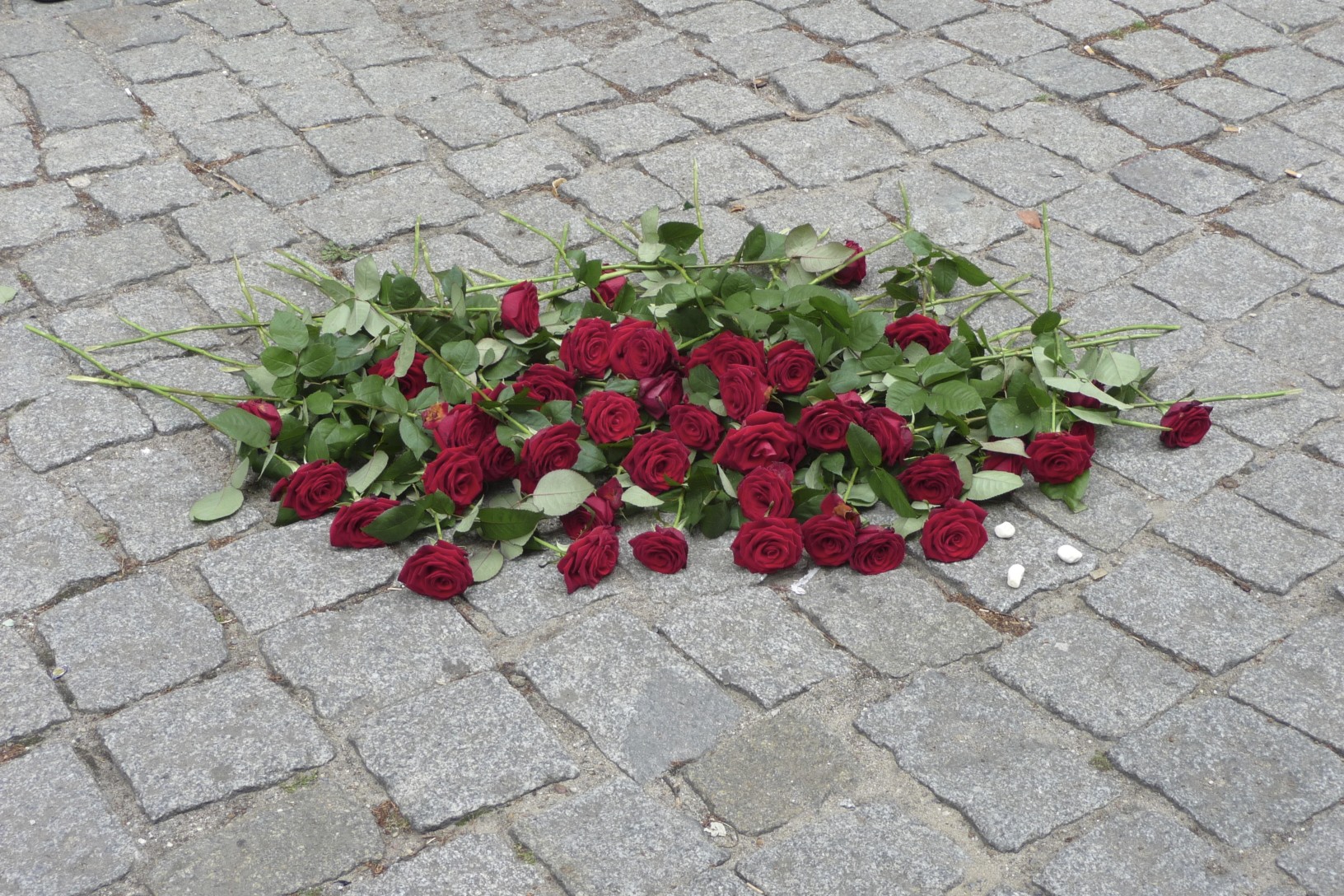
Precisely as the Cantor ended, a single bell of the church began a lento tolling. Members of the congregation, one at a time, stepped forward and placed a red rose in the center of the assembly. Some stood briefly with bowed heads. The great bell high in the steeple tolled 42 times as 42 roses were placed on the concrete. A moment of silence followed and many present were moved by the simple dignity of the proceedings.
Passersby might reasonably have concluded that this gathering was a commemoration for victims of the Holocaust, common enough in a city with memorials both great and small to that hideous scar of the last century: the murder of European Jews. However, this brief ceremony commemorated another event: the trial of 4 Jews and one Christian in this very place before the Marienkirche in the year 1510. In those days this church towered over the low buildings and the market place of a much smaller city, one still far from realizing its future importance in German and world affairs. The verdict of that trial half a millennium past: death to all, either by burning or decapitation. Moreover, the execution was followed by a widespread expulsion of Jews from the city and from the Province of Brandenburg. Reflecting on this event, who would not also think of the horrors of the death camps and other lapses into murderous intolerance over the centuries?
The accused Jews of 1510 heard no Cantor as they faced the flames, so these moments in August, 2010 were for them as well as for us. In Spandau, a western section of the city, a museum had arranged an exhibit explaining the trial in context.
Briefly told, here is the story, based on the only document of the time The Sumarius [Frankfurt/Oder,1511].
During a night in early February, 1510 a certain Paul Fromm, who made his living repairing metal vessels (in German, a kesselflicker, and in English, a tinker) stole a number of sacred objects from the village church at Knobloch, in the Province of Brandenburg, west of Berlin. Among these objects was a brass container with two communion wafers. As it happened, these ritual wafers had been consecrated and thus understood to be, in effect, the body of Christ. This outrage was soon widely known and suspicions fell upon the Jews of Brandenburg. However, some four months after the theft, Fromm, a Christian, was apprehended. He immediately confessed and stated that he had himself eaten the host. Open and shut case? Hardly. The Bishop of Brandenburg, apparently had his own motives for complicating matters and ordered a further investigation of Fromm which included torture. The tinker now changed his story: he had only eaten one of the sacramental breads. The other had been sold to a Jew, Salomon of Spandau.
Salomon was quickly apprehended and under torture stated that he had desecrated the host verbally with curses and then by stabbing it with a knife. Then, broken into pieces, it was given to a number of other Jews who similarly misused the holy object. Within weeks some 100 Jews had been arrested, incarcerated, and accused of having played a role in this grave insult to Christendom.
Host desecration has a long history in Christian-Jewish relations. Jews were traditionally (and often continue to be) seen as responsible for the death of Jesus. Worse, they presumably sought to continue the pleasure by stealing and defiling communion bread. Superficially, this seems to make the Jews adherents of the Roman Catholic doctrine of transubstantiation in which seemingly ordinary bread becomes the flesh of the founder of Christianity. Communion wine (the blood of Christ) is seldom mentioned as an object of theft and a feature of desecration. However, Jews were often accused of abducting Christian children in order to bleed them for those Jewish rituals which required the blood of a Christian child, usually a male. Not surprisingly, this accusation became part of the charge against the arrested Jews in Berlin in June, 1510. It mattered not at all that no child had been reported as missing during this period–authorities preferred to believe that the clever Jews, desperate for Christian blood to make Passover matzos, had likely chosen their victims from among transient or peasant populations less likely to come to the attention of church officials in Berlin.
On the 19th of July, 1510 before the doors of the Marienkirche, a crowd had gathered, to watch the show trial of 41 Jews who had been deemed the guilty parties in the desecration of the host and the wanton use of Christian blood. In short order, all were condemned to death by public burning. Two of the Jews had opted to be baptized as Christians; they escaped the flames and were “mercifully” beheaded instead. Only one Jew escaped the death sentence, a man who had a reputation as an eye doctor–he was allowed to live out his life in a monastery.
The execution took place a mile and a half away at a place called “Rabenstein” associated in those times with public execution. At that time, it was presumably a more open space than the area near the Marienkirche, thus less danger of fire spreading to the houses. The bound prisoners, most likely wearing pointed caps signifying their status as culprits, were marched through the crowds who now looked forward to a spectacle. Paul Fromm, the Christian tinker whose crime had begun this horrific fever of anti-semitism, was carried in a cart and along the way tormented with hot irons by the townspeople. He would be burned to death in a pyre of his own. The 38 Jews were arranged on a three-layered platform of wood, straw and pitch. Customarily, their ashes would be dumped in the river Spree or on nearby fields. Incineration was deemed most appropriate to discourage any notion of an afterlife. Such executions were popular and served to strengthen the Christian unity of Berlin.
Who were the victims? No list of names was provided in The Sumarius of 1511. Using other sources, the possible names of those burned to death that day were identified only by their first names e.g. Mosche, Mendle, Salomon, Nathan, Meyer, etc. and the Spandau exhibit represented them with a series of empty picture frames: persons scarcely known to history. At their end, what thoughts might have come to these terrified victims concerning a world so lacking in compassion and justice?
Shortly after the executions, which affected many families among the estimated 400-500 Jews in the Province, the survivors, whether incarcerated or not, were expelled and many reportedly moved east towards Poland. No Jews were officially welcomed or allowed in Brandenburg for nearly thirty years. Here, as elsewhere, there is potent evidence that economic motives and envy of the Jews help explain this event. These were often deliberately obscured by traditional Christian religious rationales for mistreatment of Jews.
Now, 500 years later almost to the day, the brief ceremony outside the Marienkirche ended. The officiants shook hands and the participants dispersed. The roses remained on the ground before the church. The old Roma woman stayed as well. When the ceremony ended the church was again open to tourists, and she stood beside the door and held out her worn paper cup to them. Several days later, the roses, now faded and dry, still lay where they had been placed.
 P.N.ZOYTLOW
0 Responses to “Field Report #21 A Desecration Remembered (August, 2010)”