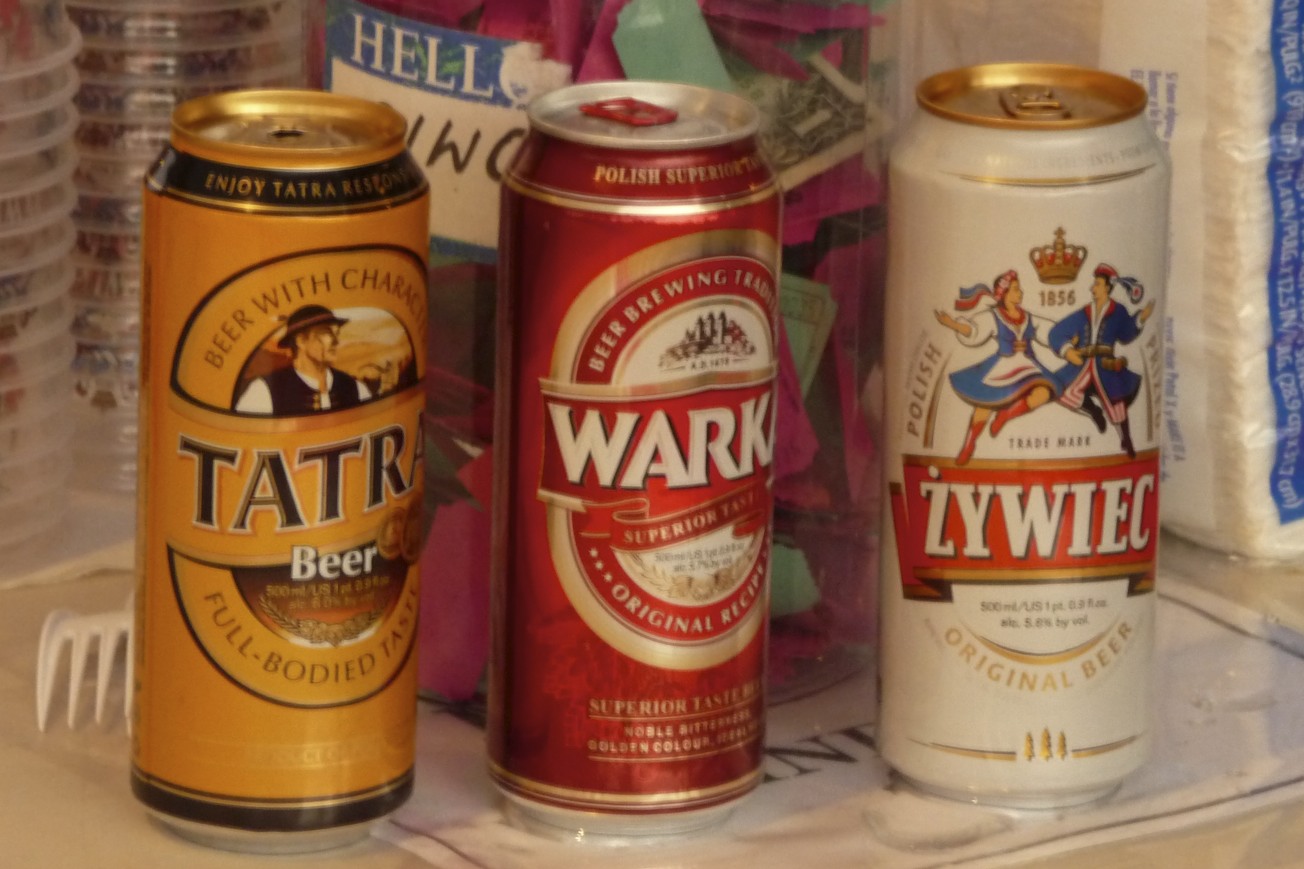
Three Polish Beers
Attending yet another folk festival did not call strongly to Zoytlow, yet this is precisely where he found himself in mid-October. Each year, depending on where he travels, Zoytlow has opportunities to wallow in the Ethnic Soup. Over the years, without losing an appreciation for the efforts of ethnic groups to share their culture with others, he concluded that a certain formulaic approach hangs like musty drapery over most folk festivals. Music, food and drink, dance, and a display of dated cultural artifacts: that’s the stuff of folk festivals. Here and there enterprising merchants attempt to peddle something suggestive of the Old Country to the visitors. Supporting it all are the volunteers who move things around, cook the food, take the tickets and dress up looking ethnic and friendly. Really, there is nothing wrong with the concept, just don’t attend too many.
So it was that P.N. Zoytlow attended the Fifteenth Polish Festival on the grounds of the Polish Roman Catholic Mission Church of St. Maximillian Kolbe. He was persuaded to attend and observe for the best of all possible reasons: curiosity. For years (whilst in town) he had often passed this small and simple church in San Diego and wondered about its unexpected appearance so far from the better-known regions of Polish settlement in the United States e.g. Michigan, Pennsylvania, Wisconsin and Illinois. No, St. Maximillian Kolbe had put down its roots in a part of San Diego better known for its surfer subculture and just a few streets over from a modest Hare Krishna Temple. San Diego is only about 2% Polish, probably half of them immigrating since 1980. Compare this to Posen, Michigan with its 61% Polish population.
The church (specifically a “mission” serving the particular cultural and linguistic needs of Polish Catholics) is named in honor of St. Maximillian Kolbe, canonized in 1982 by Pope John Paul II who called him a “patron saint of our difficult century.” He is considered the patron saint of prisoners, particularly political prisoners. Kolbe was killed at Auschwitz in 1941 after volunteering to die in place of a prisoner who had a wife and children. He had provided spiritual comfort to others and did so until the moment he was given a lethal injection by his Nazi captors. Besides Kolbe, the modest church features a few other of the venerated: the Black Madonna of Czestochowa, Patroness of Poland, and a cramped portrait of Blessed Mother Theresa of Calcutta. The church also gives testimony to the sufferings of the Poles under both fascism and communism and, in particular, the Katin Forest Massacre in 1940.
Leaving the somber little church, Zoytlow passed through a gate onto what is usually the parking lot. There stood a tall, slender man with an enormous cap of tawny-colored bear skin (presumably) a regular forest aristocrat from the land where European bison still wandered dense ur-forests. He wore a wooden pendant with the image of the Dark Virgin, the Madonna of Czestohowa. Another visitor had just inquired about this object and this Noble Pole, with glittering eye, was giving testimony to the miracles ascribed to this image: how the Hussites had put two slash marks onto her cheek and how her visage had become so dark, and how she had protected Poland against the Swedes and so on. These tales were well told, but told at some length against the competing allure of music and cooking smells and so PNZ was reminded of some distant poem, decades ago in high school English class in which some old fellow keeps a polite younger man from going to a party. Something like that.
As folk festivals go, this one attempted too much in too small a space. The church itself was smaller than most upscale California homes in this region. In the parking lot (with a cramped capacity of 17 vehicles-a small congregation) the event attempted to squeeze six food tents, a stage and dance platform, a section of folding chairs for an audience of perhaps 150-200, an inflated play area for children to flop and hurl themselves, several vendors, a few stand-up tables for eating, and a beer tent. Under these conditions one’s sense of personal space might edge into the range of elbow-to-elbow, but not yet cheek-by-jowl
The food was classic Polish fare: pierogi, kielbasa, golabki, bigos, and placki . Zoytlow (whose name may or may not suggest a Slavic connection) found these words intoxicating and began with the pancakes (that’s the placki) and was soon flabbergasted and possibly gobsmacked, realizing that they were, without doubt, the best he had ever eaten!! This was unexpected. The search for perfect or near-perfect potato pancakes had been a quest of many years. Had he found the pancake apotheosis? Wonderful to think of it that way, but Zoytlow also felt a lingering sadness that the search was now over. This kartoffel quest had taken him from his mother’s table to street vendors in Europe through countless American breakfast joints and now this—these plates of burnished amber: the Poles make the best potato pancakes!! Dutifully, he sampled the other fare (mostly permutations of pork, potato and cabbage), but looked in vain for a slice of dewy-moist poppyseed cake to finish the meal. Due to the small space and few tables available, most visitors ate leaning against fences or simply weaving on their feet, disposable plate in one hand, plastic fork in the other.
On stage, a father-daughter duo played accordion and sang tunes advertised in the program as “best-loved Polish songs.” A small audience filled the chairs and two couples had ventured on the stage to dance. The dancing appealed mostly to those who were middle-aged and portly, if not outright obese. The audience was delighted at how nimble these dancers were and one might say even elegant during a tango, one of those “best-loved” tunes along with “Besame mucho” sung in Polish. But there were others which came right from the Polish heartland, songs about beautiful places with chestnuts and fields and rivers. Because Zoytlow continues to be faithful to the 75 minute rapid-research concept which has produced these Field Reports since the beginning, he was not present to hear the more contemporary music of Zbigniew G. who, it was said by a man enjoying his bigos (a cabbage stew) to be the one to see tonight. (“You don’t want to miss him!”). But, Zoytlow would be gone by the time Zbig lit up the night.
Behind the church was the area designated as the “beer garden.” This, Zoytlow quickly concluded, was not a beer garden. He recalled the blunt statement found in the beloved Wikipedia:
The characteristics of a traditional beer garden include trees (no sun umbrellas), wooden benches(no plastic garden chairs), gravel bed (no street pavement), and solid meals (no fast food).
No problem with “fast food” here–everything was slow cooked; in all other respects this “garden” failed. Geography was destiny. This beer venue was forced to absorb a section of a public alley behind the church, obviously some municipal permission had been required. The result was a ten yard square section of concrete surrounded by a temporary six-foot steel cyclone fence. Capacity was set at 130 persons, inadequate for a Festival which had touted Polish beer a the beer garden thereby creating high interest in this corner of the scanty fesitval grounds. To enter in, one had to wait in line until enough patrons left. Once cleared by security officers you passed by a
counter where three brands of Polish beer were offered–in cans! No fresh brewski on tap! . And each can cost $5. But the line of expectant communicants for this Polska piva never lessened despite these hardships. Tatra, Warka, and Zwieck were the three brands available. Saying these words sounded (to Zoytlow) like anincantation to summon (Holy Parking Lot notwithstanding) a demon or to placate the stone-faced security men guarding the entrance and egress of the ever-restive beer zone.
The Poles had always had challenging geographical problems but had always survived and here, on this postage stamp of California real estate, they once again demonstrated that geography need not be destiny. Everywhere, from beer dispensary (not “garden!”) to the stage now awaiting the arrival of Zbigniew G. and his band, were men, women, and especially comely maidens of Polonia-in-America wearing t-shirts, usually red with white eagles, proclaiming “Polska.” And they were happy. The good humor of the Polskas moving through the throng was contagious. Zoytlow was half-giddy and also pleased with himself for remembering that someone has once quipped that Poland was a “geographical expression.” Emboldened by this small but seemingly clever idea, he asked one of the ubiquitous maidens if she perhaps knew of that signature polka “Kiss Me, I’m Polish.” To avoid any confusion regarding his own possibly goatish intent, Zoytlow smiled innocently and waved towards the musicians on stage. She smiled back a tad uncertainly, but no, she had not heard of it, and hurried on to the kitchen somewhere in the church basement. A man and his wife, overhearing him, tried to recall such a tune. It sounded familiar, but it also sounded, said she, “like a lotta things.” Cheerfully, her husband called to a man in a brown Polska shirt serving up pierogi in the food tent. “ Hey, Zarek, you know “Kiss Me?” Zarek looked up, shrugged, sure they just played it, you know, “Besame Mucho.”
Zoytlow looked at his watch. No more time left and if Zbigniew G. and his band were doing “Kiss Me, I’m Polish!” he would never know about it–but such are the pitfalls of a rigorous methodology in field research.

[Editor’s note: PNZ told me that he had found “Kiss Me, I’m Polish!” on U-Tube, mostly in Polish, performed by the Grammy winner Eddie Blazonczyk and the Versatones somewhere in the true Polish-American heartland back East. (http://www.youtube.com/watch?v=QIQBVQ8P8FU&NR=1) California, he added sourly, was not a good place to look for the real thing.]
 P.N.ZOYTLOW
Nice article! The Pole, telling the story of Our Lady of Czestachowa, was me. Thank you for listening. I usually try to pay attention, to see if the guests are getting bored with my tales. (although, how could anyone not be interested in Poland?)
I learn a lot of Polish history at St. MKs.
There was a dessert stand with the poppy seed desserts (although one almost had to know, where that stand was.
Wiwat!