“Rubbery Cuds”of Manhattan
This story begins on a night flight from Omaha to LaGuardia in New York. Does anyone like the middle seat? Zoytlow does not! However, he does operate along the lines of whatever happens effects change. Not “affects” though that may be true, too. However, this is not about probability or outcomes or causalities. That said, what if one had taken an aisle seat—or taken the next flight? Alternatively, not had a reason to go to New York City (and I have lately forgotten that reason). The man in the window seat was one of those who could sleep, and he did, leaning his bulk against the window. There would be none of those little upbeats with him. One might hear “going to New York? (Obviously) “Family there?” and likely “great place to visit, but who can afford it” and so on.
The woman to my left, on the aisle, appeared to be in her early fifties, well-dressed, unscented, and wearing the smallest pair of lemon tinted granny glasses I had ever seen. She was reading a business journal, the page opened to a column by a well-known commentator titled “Crunch Time for Chewing Gum Moguls.” Skipping the usual patter,
this observer dove in with “what a clever title, but to what does it refer?” She gave a confident smile of incandescent whiteness while lightly exhaling a slight hint of the blended mint on her breath. Yes, she was chewing gum, and in a manner so discreet that her jaw hardly moved.
Her name was Malvis…something. She was a lawyer for a consortium of confectioners. Under discussion in the big city was a proposal to tax chewing gum manufacturers for damages. “What damages?” “The spots,” she answered and rolled her eyes.
* * * *
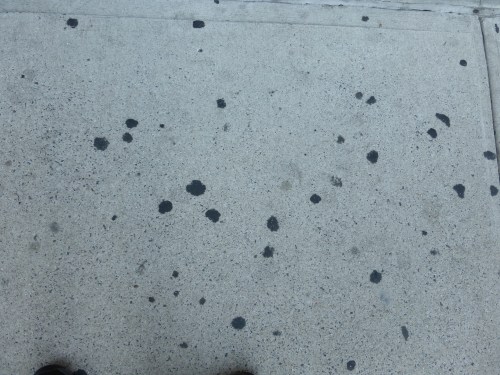
Zoytlow believes that every story has a backstory and that every backstory has a backstory and so on until we reach ultimate causality. In New York City and urban areas in other cities and countries, spat-out chewing gum achieves an afterlife on sidewalks as flat black spots. Imagine tar spots. These dark moles on the city’s epidermis are nearly everywhere, but they mass together near the entrances to subways, bus stops, or at the entrances to bars, stores, and apartments. Once situated, they remain for years. The grime of the city and the unintended pressure applied by pedestrians assures them unexpected longevity.
Zoytlow thinks that the gum issue evolved from its very beginnings on Staten Island in the 19th Century. Staten Island? What about the origins of chewing gum with Native American groups, especially those in southern Mexico and Central America where chicle occurs as a latex-like substance from the sapodilla tree.
In 1865 the ex-President of Mexico, General Antonio Lopez de Santa Anna, lived on Staten Island, where he hoped to raise an army for a return to Mexico, something he had managed to do, from time to time, throughout a long military and political career. Santa Anna chewed chicle, something noted by his American secretary, Thomas Adams. The General imported more than a ton of chicle in hopes of interesting buggy manufacturers into adapting the substance to their wheels. This failed, but Adams founded the chewing gum industry, producing Chiclets. Later he joined with William Wrigley, and chewing gum became widely available. Chewing gum became astonishingly popular, but not technically addictive. Gene Autry, singing radio cowboy for many years, was sponsored by Wrigley. He told listeners that while he was doing tedious work like “riding fence,” a stick of Doublemint sure did help pass the time.
Zoytlow had no problem finding spotted sidewalks in New York City. Had he not sat in the middle seat on the Omaha-La Guardia flight, he would have mistaken the spots for roofing tar, concluding that the high-rise roofers who built the city were unabating splatterers. How could that be? Hours spent in the New York Public Library yielded an Italian study of public spitting, but nothing specific. Perhaps gum spots were part of a continuum of expectoration that included, among other things, tobacco, catarrh, and pumpkin seeds. While many chewers do dispose of their gum in a waste container, some even using the original wrapper, the lazy or socially irresponsible ones do not. Encouraged by the evidence of spat gum before them, they eject their wad. Some do swallow their gum, but though harmless, most prefer not to as its unclear role in inviting a dreaded bezoar.
This information pleased Zoytlow, but it was not an answer to the question: why do chewers spit it out on sidewalks? “East Side, West Side, all about the town! The boys and girls together, spitting out their gum!” Alternatively, so Zoytlow was moved to sing to himself quietly in the great reading room of the library. Also, when he came across a rich field of black spots.
He did learn that in 1939 Mayor Fiorello La Guardia began a campaign to end the disfigurement of the sidewalks of his city. The New York Times wrote, on December 4, 1939, that the “rubbery cuds” were a problem in need of addressing. The public was invited to enter a contest to compose a slogan to remind the public of its civic duty. Winning entry: “Don’t Gum up the Works.” by a Brooklyn high school teacher.
Removing gum spots is slow, arduous work. Perhaps futile. Eighty years after Fiorello’s effort, the spots are still with us.
 P.N.ZOYTLOW
0 Responses to “Series II #1 Rubbery Cuds”