Series II # 2
[EDITOR’S NOTE] Followers of P.N. Zoytlow, who watch this site with great care, were thrilled to see his recent submission, “Rubbery Cuds of Manhattan.” He must intend to be more low-key, for he slipped it by this editor and posted it. I was offended and hastened to ask him for in interview along the lines of the last interview we did together, the one in Limon, Colorado. However, PNZ refused and said that his work would have to speak for him. The format of the past, the 75-minute rapid research, is abandoned and that whatever he offers in the future would not have a specific format. “Expect anything. Expect nothing,”said he. That is classic Zoytlow, of course. He elaborated: “could be reports, could be fiction, could be photos, could be poetry.” Whatever happens, it will stand or stumble on its own.” That said, he submitted to this editor, a new submission.
###
Many years ago, I sold part of my soul to a hippopotamus. When I realized it, I was astonished, but gradually it just became a part who I am. Today it no longer seems so remarkable. Furthermore, it is a fading issue. That is how things are, of course, the fading impact of phenomena. Remember a graduation ceremony? A kiss? The hotel stay in Amsterdam? Are you sure they happened? So, did I really entangle with hippos? Or was it just a conflation of my many zoo memories?
When I was four, my Uncle took me to the zoo in Milwauand we (my parents, my sisters and I, the youngest) were visiting. I was keen on all animals then (as now) and since we did not have a zoo in the smaller city where we lived, a visit to the zoo would be a rare treat. The Uncle was a slender man in a gabardine coat and a matching fedora. This was in October after the War and all men wore hats all the time. How did men in America move from fedoras to ball caps? The zoo was somewhere in a more extensive city park. We walked from the bus stop past a lagoon with summer boating and entered the zoo. It was free. Milwaukee was happily still under the spell of its Socialist mayors. Uncle sped me by the monkey island, then the pens with the various deer-like creatures, and those icons of Africa, the zebras. “We’ll start in that building over there,” he said, indicating an ivy-covered dark brick edifice.
Inside, the air was moist and thick with unfamiliar odors. It was fetid! Walking more slowly now, we passed some apes ranging from baboons to an ancient chimpanzee gone grey, but no gorillas. Some of the cages were empty because the weather was still pleasant (it was October and the doors open to the outdoor pens. A lone rhinoceros slept in the doorway, its head in the sun and hindquarters in the indoor gloom. And then we were there: the hippos. My Uncle loved hippos, and it was his conviction that every visit to a zoo should start at the hippo exhibit and then work backward to the entrance. At the time of our visit, there was a pair of hippos at the zoo, replacing a solitary male named Yakob who had filled the space for nearly 30 years. The replacements, Tony and Cleo, had drawn crowds of school children for months after their arrival but, once evident that the pair did very little that could be entertaining, the visitors dropped off. On the day we were there, it was minutes past feeding time and they ate alfalfa and loaves of day-old bread donated by grocers. Watching them roll that bread around their mouths was a joy for the Uncle. Watching hippos eat is probably the most exciting thing they do. They do not swim: they walk on the bottom of rivers, these river horses.
≠ ≠ ≠
Now move back in time some fifty years. I am looking at a rack of postcards and there it was:
Juan, Comte de Montizón was the photographer, an early amateur working at the dawn of photography. The photo was taken in 1852, about two years after the hippopotamus, Obaysch, arrived in the Regents Park Zoo London. Prince Albert purchased the photo as he and Queen Victoria were Obayasch enthusiasts. The hippo was said to be the first such animal in Europe in historic times. The photograph has remained popular (and sells well as a postcard). That photo drew me in. I needed to learn more, and so I began to accumulate details about the life of Obayasch, a male Nile hippopotamus named after an island near his place of captivity. He was injured by his captors; the scar is visible on his left side in the photo. When he arrived in London, he was a sensation, and zoo attendance increased significantly. Newspapers gave updates on his daily routine. Citizens bragged about how many times they had seen him or what he had done. However, basically, like most zoo hippos (and those in the wild) he slept, he ate, and he moved in and out of the pool provided for him. He was (like hippos generally) known to be aggressive and a danger to humans. But what a source of pride for the British public! What other nation had a hippo of their own?
Sketching out the life of Obayasch yields the following milestones:
Captivity in 1849 in the White Nile near Obayasch Island.
Arrival at the Regents Park Zoo in May 1850.
Obayasch provided with a mate, Adhela, in 1854.
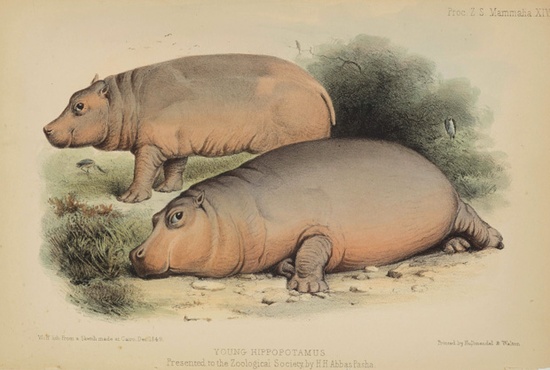
Adhela had three pregnancies, but only one survived, a female named Miss Guy Fawkes (named because of her birth near Guy Fawkes Day) in November 1872.
Obayasch died in 1878 at approximately 30 years of age, Adhela 1882 and their daughter miss Guy Fawkes in 1908.

An excellent recent book on Obayasch, his family and their various levels of meaning in Victorian Britain is Simons, John (2019). Obaysch: a hippopotamus in Victorian London. Sydney: Sydney University Press.
Obayasch is a potent example of a craze that famous animals in zoos and circuses have triggered. Frequently cited is “The Hippopotamus Polka.” The newspapers were for years filled with the doings of London’s hippos. Artists and photographers provided images.
One can explain the draw of hippos in Victorian England easily enough by
recalling that hippos were rare in European zoos and that England had the first. It was part of the evidence of imperial capabilities–the nation could arrange the capture and successful transport of such a dangerous creature from deep in Africa! Here was a nation to be reckoned with. This must be the British Century. The high interest in hippopotamuses is all the more remarkable since they are among the more lethargic zoo animals, perhaps right behind crocodiles. Elephants, apes, bears, and seals provided more “action.” and zoo visitors want a show.
Visiting the typical hippo display did not hint at the vicious personalities of hippos in their natural setting. Nor that they were, despite their bulk, swift sprinters on land where they foraged on grasses along rivers. They were capable of elaborate wide-mouthed threats to rivals, and they are the most responsible for human deaths of all African wildlife. The image of a docile bulk lazing in a stream was disproven often. Moreover, even that national treasure, Obaysch, could occasionally demonstrate his underlying aggression, though zoo officials played this down. After all, Obaysch was a sort of beloved pet, and it was best not to provide the public with whatever contrary impressions they wished to impose on the beast. The large cats were nasty, the apes were humorous, but the hippos were mainly huge. That they came to compete at all with the more menacing rhinos and elephants is remarkable,
So, what is it with hippos? What was it that drew my Uncle to them? What arrested my attention when I found the postcard with the 1852 photo?
Though hippos are known for their dumpy appearance, 18% of their impressive 1.5-ton weight is skin. Beneath this 5cm (2″) thick hide hippos have a relatively thin layer of fat. Hippos will regularly open their mouths to the fullest extent possible, revealing their tusk-like teeth, which are formidable weapons in the bellowing mating jousts in their native waters. Their feet seem undersized, and unlike the elephant, the rhino, and a variety of muscular buffalo, they have stumpy legs. Hard to believe that they can–and have–outrun humans over short distances.
Visitors to zoos hope to see hippos, swimming, eating, yawning, or just walking, but most of this time, a sedentary beast is all they see. That leaves their imposing bulk to be the most compelling feature. They appear to be the zoo’s obesity champions, though they are no as fat as marine mammals.
There is one other hippopotamus feature that is memorable and often shared with others who were not present. According to East African creation stories, hippos were first placed on the plains and forests and not in the rivers. The Creator God was fearful that they would eat all the fish, and the crocodiles were already doing so. So the hippopotamuses struck a deal with the Creator: they would not eat the fish and would scatter their dung so that the Creator could easily verify that were no fish bones present. Thus male hippos expel their loose bowels and, using their short, muscular tails as propellers, effectively scatter excrement.
Let me just add I have visited many zoos in the United States and Canada. That initial visit with the Uncle did create the momentum. So when I speak of the interest of the public in the defecation of hippos, as well as a few other zoo animals, I do speak from first-person observation.
I recall the delight of children observing the dung-scatter in a California zoo. They screeched their delight. “Look, Mama, it’s pooping!” while Dad yelled, “I got it! I got it!” meaning it was there on videotape to entertain forever. And do not forget, reversing the film is great fun.
There are less than 100 hippos in the United States and Canada, but not every zoo has one or two. When a zoo acquires a new hippopotamus, public interest is high. The birth of a new hippo is equally compelling. The importation of animals from Africa is no longer done with the former ease of arranging it with a compliant colonial government. Mostly, hippos with their lethargic patterns do not command great interest or affection.
To understand why the hippo is in demand, you have to recall their abundant presence in popular culture. The hippos craze in England subsided, but hippo imagery continues. In 1940, a successor to Obayasch as a star appeared as Hyacinth, the ballerina in the Disney classic, Fantasia. Hyacinth did her dainty steps wearing a lacey tutu to Ponchielli’s Dance of the Hours. It was a memorable hit and had audiences guffawing. Oh, the beatific expressions! Not a hint of the maliciousness every zookeeper keeps in mind. Moreover, they were funny–as only obese creatures tend to be when they are stepping out! So successful was the Dance of the Hours that hearing it always brings to mind those scenes.
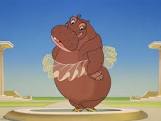
Other films or children’s television shows featured funny hippos (George and Martha, Gloria, and Peter Potamus). An array of children’s books appeared: Hippos are Huge by Jonathan London and Matthew Trueman and Fiona the Hippo by Richard Cowdrey are among the most popular. The latter based on the true story of a hippo born in the Cincinnati Zoo in 2017, which caused great excitement reminiscent of the arrival of Obaysch more than a century and a half earlier.

Gentle Reader: if you have stuck with this homage to zoo hippos thus far, I now spare you a lengthy listing of “stuff” with a hippopotamus inspiration. Personally, writing this has brought me closure on the topic. I have honored my Uncle, the hippo-fan. I have exorcised them. But one more thing.
Interest in and affection for the hippopotamus began with Obayasch in 1850. A century later, in 1953, a popular holiday song appeared in America. This was the plaintive I Want a Hippopotamus for Christmas. Here is a sample:
I want a hippopotamus for Christmas/ Only a hippopotamus will do/No crocodiles or rhinoceroses/ I only like hippopotamuses/And hippopotamuses like me too.
FINITO
 P.N.ZOYTLOW
0 Responses to “Series II #2 Encountering Hippos”