After I entered the forest, I had some worrisome thoughts, but cloaked in the self-assuring garment of an anthropologist, and I would not say I was insecure. That would come later. I have been doing that (dressing up) for some time since wallowing as a graduate at an [unnamed] easily recognized institution in North America. I succumbed to the lure of anthropology, whether physical (learned I was an animal), archeology (stuff beneath my feet), or cultural (good anecdotes and so liberating).

Forests are occasionally enchanted or cursed; some say it is always so. That is especially true if it is a dank and gloomy older forest with the muted sounds of unseen birds and adorned by spider-looped webs. My idea had been to walk a mile or so into this gloom, looking for mushrooms to photograph. There were few of these along the way and the pale brackets affixed to trunks was not what I wanted. About to turn back, I perceived that the path was ending and opening into an area where the sunlight was strong. Here was an unexpected road, smoothly paved. In the distance, I could see a house in a rustic style, and then another. Of course! This must be ______. [The reader will recognize this old-fashioned anthropological convention of affording a community some anonymity while one exploits its culture in the interest of the social sciences.] And possible academic glory if read at the annual conference.
Was this a forgotten village, a hidden upscale enclave of rusticity, or something else?
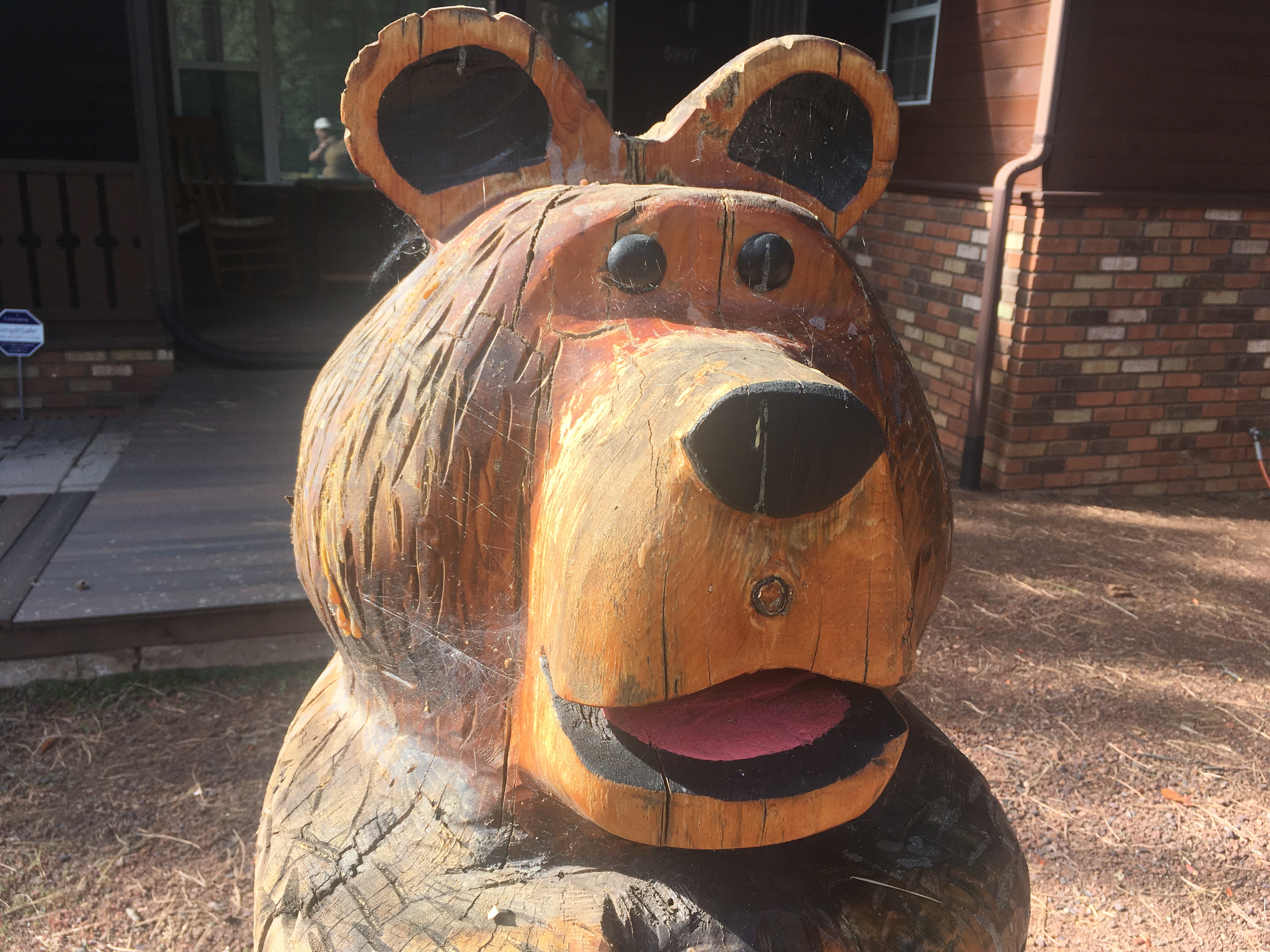
But enough of that. Over the next hour or more, I wandered the silent serpentine streets and kept expecting to see a fellow human, someone with whom I would be exchanging a reassuring wave. There was no one. A light breeze broke the silence in the pines’ tops; somewhere, a hidden woodpecker was hammering. I stopped facing another one of these “summer retreats,” as the locals liked to call them. Large “second homes” of “comfortable class” members worked in a distant city and who might appear on the weekend. What had stopped my stroll back to the forest path trailhead a mile off where I had left my vehicle?
It was a bear, carved by a chainsaw, which stood mid-yard in front of the house. One paw raised in greeting, a hint of grinning on its face, the bear stood about five feet tall and was an ebony color. I guessed this was intended to be a black bear since this species was most common or had been in this area. Over time, shrinking habitat and hunting seasons had significantly reduced their numbers. These yard bears had moved in, replacing them.

How had a missed seeing carved bears in nearly every yard? The ordinary ones were already noted, and then those holding a salmon or waving a flag. Some bears showed loyalty to a university; others were climbing up a tree. Others hung from the edge of a roof. One was dressed as a clown and did a handstand. I hoped to find someone to ask why the bears were so commonplace or even more baldly: “Why do you have a chainsaw bear in your yard?”
But there was no one available to explain this potent pattern., I began to muse about it and to float some theories. Everything happens for a reason. True?
Theory #1: Sold at bargain prices along the road. Buy one, and the second one of similar size goes for half-price.
Theory #2 The power of demonstration and envy: if the folks next door have one, so should we.
I just had to go deeper than that! Was this a nod to the indigenous people who had once lived here? And the acknowledgment that the bear population was decimated through habitat destruction and hunting? Or an even deeper, hardly perceived search for a solution for existential emptiness?
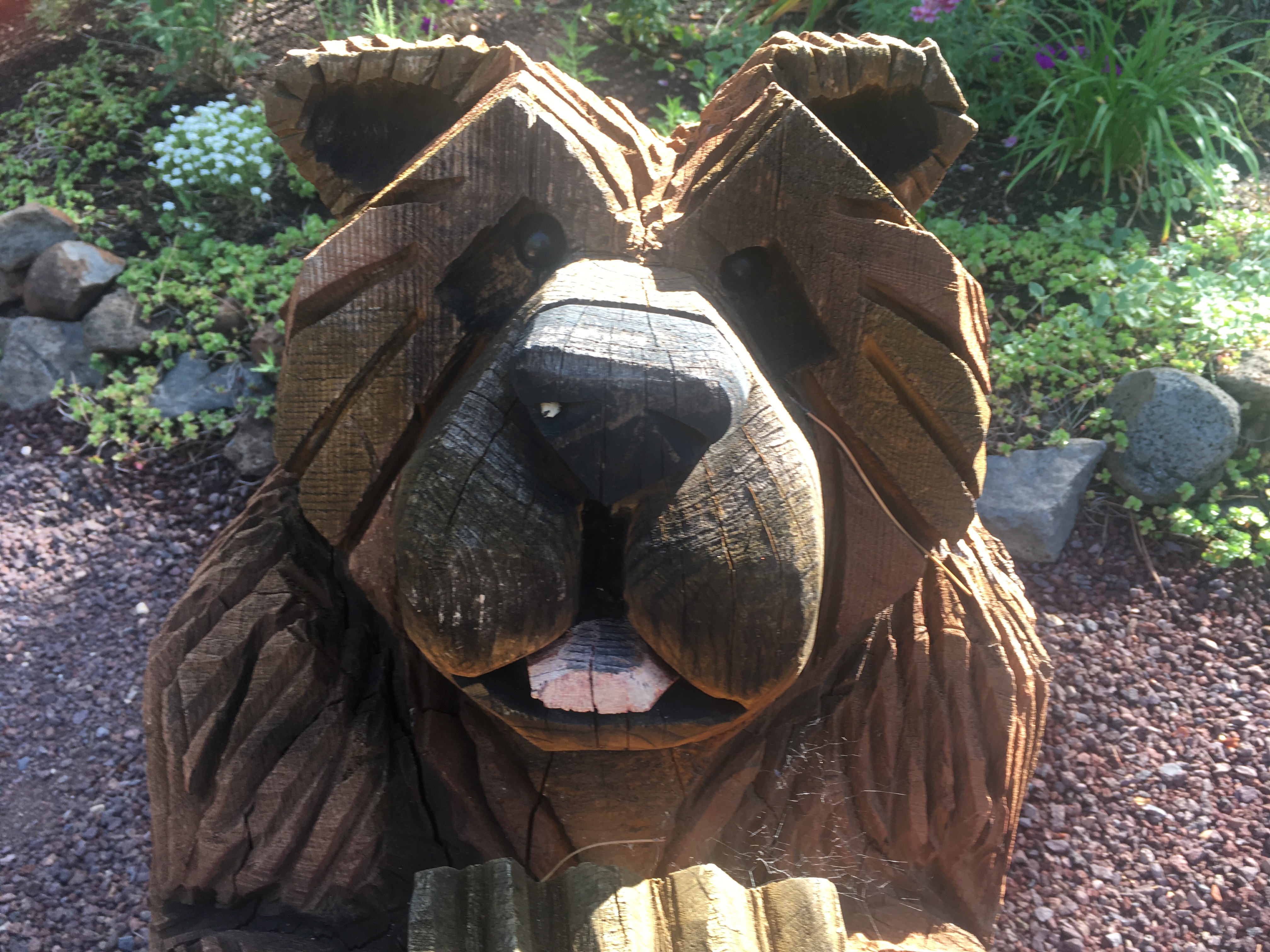
I had heard of neototemism. Could I be seeing it here, however, much of a parody it might seem? None of the bears seemed very serious, for the most part, though a few were leaning in the direction of being conduits to a likely spirituality. If this were so, then perhaps the better term would be protoneototemism. Well, I was proud of that term, especially since I could find it used or written anywhere.
Protoneototemism! How I amazed myself, but then recalled an unhappy incident while a sophomore at Ballast College. I had asked a coed out for breakfast. It was a spring morning, maybe Palm Sunday, perfect for something special like Eggs Benedict. (Who was this Benedict?) I ordered the Eggs Benedict and encouraged her to try them as well. But she preferred pancakes. With hindsight, I understood that my Eggs Benedict made her uncomfortable. After the orders arrived, she pulled a bobby pin out of her flaxen hair and, using the rounded end, began to probe into her left ear. “Itches.” That was what she said. And I said, “..bet your otorhinolaryngologist wouldn’t approve of that.” How I loved that word!
There is peril in such words: she became silent and unsmiling. I never saw her again.

I was still standing in front of the same property, staring at a wooden bear with a carved smirk on his snout. The afternoon shadows had altered his look: his smile was gone. I realized that my reverie about protoneototemism now meant that I had best find that path and avoid a night in a village inhabited only by totemic bears.
 P.N.ZOYTLOW
0 Responses to “Series II #3 The Silent Village of Bears”