by Philip N. Zoytlow
I am amazed to be writing something, however, minor, about the Zoytlow family. Despite an admittedly sparse readership of the Field Reports and the longer pieces found on http://www.pnzoytlow.com, there was a growing interest in my family history. I half-understand this curiosity; people are sure, without ever meeting any of us, that we are a family of odd ducks. Harmless eccentrics! Let me admit that I, too, am curious about my “family of origin,” but like many of us, I know little, and solid factual evidence is slight.
I can share with you, interested readers, an incident or two that was known to me for some years, and only in the last year did an unconnected event bring the topic to light emotionally.
I was born in 1950. My father, Philo N. Zoytlow Jr., was born in 1900 to a wine merchant in Atascadero, California. He died in 1972. He had a bother, Pharrell N. Zoytlow, the family rebel of whom I knew nothing for the longest time, just a few years before my dad passed. Pharrell died in 1949, and I do not know his age, but he was older than Dad. My grandfather, Philbert,
who died in 1926, was the one who had brought the Zoytlows to California. He worked for a mining equipment firm in Bakersfield before moving across the state to Paso Robles. “ Folks will be drinking wine long after the mines give out,” said he. He passed this confidence in the American need for drink to my father who skipped college and went into the business, Zoytlow Wine Distributors.
Philbert N. Zoytlow was known for his loathing for the President of the United States, Woodrow Wilson, who approved the 18th Amendment which threatened to prove Philbert wrong about alcohol. And “he got us into war” was the other source of his hatred. Thus: the SS Palo Alto, to Grandpa, was more evidence of the Presidents scheming, lying, low-down ways. When Wilson died, Grandpa celebrated for days and with so much stomping and hammering on a cast-iron skillet that the police were called.
As I mentioned, Dad was a wine merchant based near Paso Robles. During Prohibition, used his skills as a traveling man and sold other things up and down the coast. I was not clear what those “things” were, but he referred to them as “personal products” and “that was a long time ago,” which meant he didn’t want to return to that time or say much about it. Since he knew the Central Coast well, he knew what might happen from Santa Barbara to Half-Moon Bay. And that brought him to Aptos on January 16, 1930, the day the SS Palo Alto arrived on that stretch of beach.
It’s a long story, but I beg your indulgence, dear reader, since it is interesting.
Toward the end of the First World War, a shortage of shipping meant that the war might end more slowly than hoped. The problem was scarce fuels for the now-mechanized allies (think of those tanks!), and a novel solution was to build ships made of concrete, often erroneously called ‘cement” ships, though, as everyone knows, cement is just one component of concrete. Two of these ships were built by Vogelstein Shipbuilding Corporations in Oakland, California, the Palo Alto and the Peralta. The war did end before these tankers could be launched, but numerous reasons were found to continue the project,
On the day the work was to begin in the shipyard, the owner of the VSC came to the docks and addressed the men as follows (reported in the Oakland Leveler):
“A vice president went to the dockyards to address the men. It was a bit of bravado to tell the men they should ignore mocking comments from others working on nearby steel ships. ‘The Palo Alto,’ he told them, ‘ is a ship of the future, and it will help us keep the peace in Europe, too! And the taxpayers have invested 1.5 million in the project. So let’s show the nation what Vogelstein Shipbuilding and concrete men can do together!'”
A worn sepia print showed a group of 23 workers, all, with one exception, wearing the cloth caps of the era (no hardhats!), standing before a wooden framework of a ship-to-be. The date, penciled on the back, is 1919. The place: Oakland, California. The ship embryo was the SS Palo Alto. The stand-out in this photo was my uncle, Pharrell N. Zoytlow, wearing a broad-brimmed tropical hat he bought in Panama, where he had been a “concrete man” working on the Canal. Pharrell Zoytlow hated the chill Oakland morning, the men in the work crew, and the Palo Alto. He had enormous respect for concrete and felt that fashioning it into an ugly ship was a disgrace. It would probably sink anyway. Furthermore, as he told the story years later, he was the only crew member who wasn’t a wop or a mick.
That was Pharrell Zoytlow. He resented immigrants and despised the Palo Alto because he had heard that the hull would be built with added chunks of rubble from the San Francisco earthquake of 1906. “Bastard concrete will doom this ship.” According to my father, brother Pharrell Zoytlow believed in the necessity of concrete purity and little else. The other thing was to insist that the Zoylows had no other ethnicity except identifying as “Americans.” And what was critical in this regard was to know what you were not. “You don’t have to know what you are; you need to know what you are not!”
Pharrell Zoytlow was my father’s older brother and the family rebel. He was about 25 years old, maybe 30 when he signed up for the Palo Alto. If he got that hat in the photograph in Panama, well, who knows? My dad got along with Pharrell, but they were not close. Dad was almost a decade younger. Because the Panama story had some bragging rights, the family subscribed to it. Yes, Pharrell had been working on the Canal! End of story. We saw little of him for the most part, and when we did, it was always unexpected.
Pharrell N. Zoytlow was hardly alone in his poor opinion of ships made of concrete–forgetting that similar arguments had been voiced when hulls were made of metal. “It will sink like a stone because it IS a stone!” was often heard.
In 1921, Palo Alto did its trial runs in San Francisco Bay. It did not sink and, briefly became a topic of interest. But that seemed like the end of it, however. The Palo Alto was berthed at a dock in San Francisco, and there it sat, all 425 feet of her, unlovely and unloved for the better part of the next decade. Concrete ships, born in an atmosphere of ridicule and doubt, never rose above the level of curiosity. They required thicker hulls, which affected hydrodynamics and limited cargo space.

While this is a story of the SS Palo Alto, it also, more personally, involves my family. My grandfather knew the absent Pharrell had a job on it: he had seen the news photo and recognized his son and Panama hat. A decade later, this brings us to a cliff above the beach in Aptos, California. The date is January 21, 1930.
Philo N Zoytlows stood on the cliff with a blanket against the chill. He shielded his eyes against the silvery glare. Philo N., having learned what was to happen, made sure he had business in çSanta Cruz that day. As the sun began to warm the day, he folded his blanket around him and sat on the ground. Around noon, the event started.
The SS Palo Alto appeared! Not trailing a plume of smoke or braying her horn but being nudged by a tug that had towed her from San Francisco Bay overnight. The tug prodded her into a reverse position so that she pointed out to sea, then gently arranged her some 500 feet offshore, perfectly straight. When the persons on board the Palo Alto were satisfied, they descended into the engine room and opened the seacocks, allowing the ship to rest on the sandy bottom. Then the men were confident that the task had been done, and a cheer went up: “Hooray for the Palo Alto, hooray for Aptos! Viva California!
Philo looked at his watch and saw that he would have to leave soon to make his appointment in Santa Cruz. Then he noticed a man not twenty feet to his left, cheering the proceedings and waving a Panama hat.
Their eyes met, and they recognized each other.
“Brother Philo! Come to see the show?”
It was Pharrell, and my father was dumbstruck. He had not seen his brother in nearly a decade and was surprised that he was alive. “What the….”
“I’ve come to see my baby,” said Pharrell. He had somehow overcome his loathing for the vessel. “You know what’s happening here?” My father did know quite a bit: that the Palo Also was to become a pleasure boat with a dance floor, restaurant, observation posts, and a place for bands to play the hits of the day. All of this was the grandiose project of a group of investors who were betting against the Depression and for people’s need for distractions.
But Dad let my uncle chatter on and played dumb when Pharrell unfolded a yellowed news clipping with the famous photo of a work crew with one man in a Panama hat. “I know that ship, and I know where I put my initials into wet concrete on the bow and the stern!.” There was no mistaking his pride. Pharrell next produced a bottle of whiskey and suggested they find a place to have lunch. And so they did.
It was a splendid afternoon in the rear booth of a restaurant in Santa Cruz. They ate fish sandwiches and drank the bottle dry. His brother looked at the bottle and tried to look sheepish. “I can’t help it,” said he. “That ship drives me to drink, always did!”And when they parted, Pharrell suggested they meet as soon as the pier was built to connect the beach with the ship. Then, when some big band like Benny Goodman or Tommy Dorsey booked, they would bring dates and have “a swell time.” That did not happen.
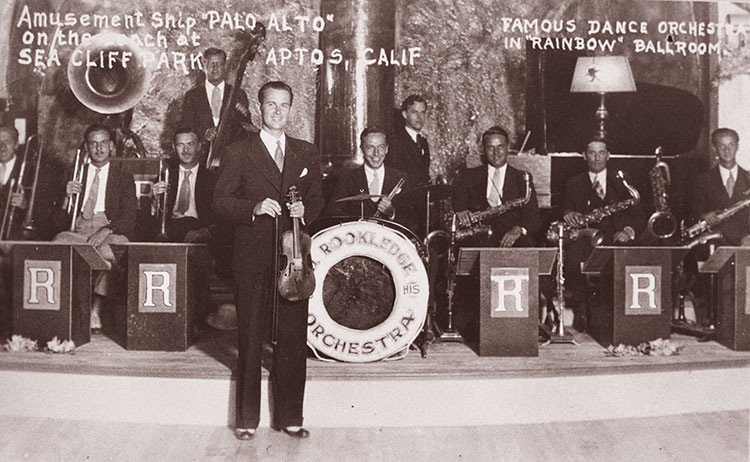
The SS Palo Alto provides an example. Once the ship had been positioned and stabilized on the ocean floor, the Corporation made good on its word and built an extensive pier that reached the stern. A dance floor, swimming pool, and a restaurant were installed.
Soon, the public responded, and Palo Alto became a unique magnet for classy entertainment that drew people to the Aptos Beach area. The State of California established a state beach. As Pharrell said, “I’m just so glad this chunk of concrete was able to become something. Such a happy outcome compared to the others.” By the others, he meant the dozen or so concrete ships serving as drab breakwaters elsewhere.
Father Neptune had other plans for the Palo Alto as well. After a year as a magnet for good times, a storm in the winter of 1932 caused the hull to crack, and the ship was no longer seen as safe for dance bands or investors. The ship became a fishing platform.
When I was about ten, my Dad and I drove up to Aptos early one Saturday morning to do some serious fishing off the bow of the Palo Alto. The deck was slightly askew as more storms had come to make some changes in what was happening on the sea floor. Large openings had appeared in the hull, and sea creatures made their homes and nesting areas there. On the deck, pelicans, cormorants, and gulls perched, squawked, and cussed you out if you disturbed them. The ship was theirs; one pelican became a totem for the ship, perched on the roof of the old wheelhouse and somewhat tame. It was a favorite of photographers. On a sparkling mid-summer day, the ship belonged there. It looked good, and it felt good to see it. Dad and I would talk about how Uncle Pharrell had played a role in it, but the hoped-for reunion with girlfriends and later families had not happened. Uncle Farrell died in 1949 in some accident somewhere in Nevada, and we never heard the details. After that, Dad liked to come up to Aptos as often as he could get away or as often as his job took him nearby. Although he never had much time with Pharrell, the ship was the place where he could still connect. And once, near the end of his own life, Dad did discover “PNZ 1920” pressed into the inside of the bow railing. He brought that to the attention of the local historical society, and they photographed it. The curator said it added a “human element” to the ship. Dad and I saw it as a monument to a strange guy who happened to be our brother and uncle. Some families bond over a house, or a town. Maybe even an automobile. We Zoytlows had the SS Palo Alto.
We went fishing off the Palo Alto several times, maybe six or seven. Dad got me up early, and we would drive up to Aptos and walk the pier until we descended the ramp and were on board. We headed to the little bait shop on the bridge and got a bucket of twelve of the little guys who would soon be dangled off the bow.
Dad thought the side of the bow that faced Monterrey and not Santa Cruz would be where they were biting. He was choosing a place he associated most closely with his brother, Pharrell. The first time I went with him, I was seven and had a bamboo pole just the right size to drop the bobber about eight feet off the bow. There were fish down there, and Dad said I would probably catch a mugwump. What do they look like? I asked. “You’ll know when you see one.” But whenever something did bite, and I managed to haul it up, it would not be a mugwump but a shandy, which was not its name, but that is what we called them, an average fish with no problem for me to lift out of the water. Dad caught some, too, and we took them home in a bucket.
We fried the fish at home, Dad and I did. I do not have a Mother. When my parents married, they learned soon after that they would not have children of their own. So they adopted me as an infant; before I was very old, my adoptive mother disappeared, and no one offered me an explanation, not that it mattered since I had no recall of her. Later, I fabricated a story explaining that she had drowned due to a rip tide somewhere south of Pismo Beach.
As I got older and bigger, I would cast off the bow, almost where my uncle had left his mark, and hope for a fish bigger than a shandy. Later I remembered about the mugwump while doing another adjunct stint at a college in Iowa. It was a conventional survey course in U.S. History offered to first-year students. Like most classes, I taught here, there, and everywhere, I knew too little about the subject, so I would buy a synopsis and augment the stuff with my ideas. That is how I stumbled across “mugwump,” and what fun that was to finally get Dad’s little joke.
But wait! This is not about fishing for mugwumps. It’s about the SS Palo Alto, a famous cement (I mean concrete) ship of Seaside Beach at Aptos. Right?
After Dad died when I was eighteen or nineteen, there was no more fishing. I revered our times, driving up to Aptos, walking the pier and using the gangplank, boarding the old SS Palo Alto. The deck had started to shift slightly due to waves and shifts in the sea floor. The gaps in the hull were more extensive, and divers confirmed that marine life was plentiful in the sheltering concrete. Then I read that the ship was off-limits and no longer considered safe boarding. Sea birds colonized the deck, especially the cormorants and the pelicans.

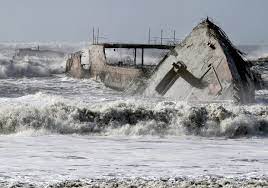
In 2020, though no longer in California, I was invited to give a talk at a high school graduation in Watsonville, and just why that is so is another tale. Of course, I seized the opportunity to see the Palo Alto, the iconic cement boat of Aptos, the not-to-be-missed curiosity of the Central Coast. After the ceremony and after shaking a few hands, I drove the short distance north to Aptos. I slipped the car into nearly the same spot Dad and I had used on our fishing trips. I walked to the bluff and sat on a bench. Then came the shock. The pier was gone. The ship was hardly recognizable. Winter storms had broken its remaining spine. What remained wallowed like a cadaverous hulk of some cumbrous sea creature.
I wept. This does not happen regularly to Philip N. Zoytlow, but I was overcome. Entwined with the ship was my grandfather, my uncle Pharrell, who was present at its hopeful creation. And without fail, my loving dad, Philo, who had raised me and shared the Palo Alto with me. We Zoytlow’s have some ownership here, here in these lumps of concrete.
And what of the SS Palo Alto and those baffling twists of fate that canceled a heroic career as an oil tanker in the noble war intended to save a world and encourage a better one? Or the quickly eclipsed brilliance as a place of music and dance. Even the most humble assignment, a place for fishing, was cut short. Then, a bird island and shelter for fish to nest. And someday, far beyond my own shrinking lifetime, the restless waters would make the Palo Alto vanish.
 P.N.ZOYTLOW
A pleasing little story. Thank you.