Manikins have long captivated Zoytlow and happily so. As a child, a visit to a department store was not complete without a visit to the clothing departments, which featured women, men, and some children. There they stood in all their poised elegance with lovely turned feet and with the artistry of their arms. And while beautiful, these manikins always seemed to look askance. Something had called to them from another dimension. None of them ever looked at the mortals who shopped nearby. The best ones stood on low platforms where the visitor had to look upwards. Later on, when Zoytlow was a young adult, he would have his favorites, and that was when he began taking their photos. Eventually, the collection grew to dozens of individuals. However, over time, the taste of merchants changed, and the range of expressions was more disappointing. Still, Zoytlow now fancied himself a historian of the phenomenon. He wants us to know that manikins deserve our attention and our respect.
Archive Page 2
Editor’s Note: Several readers have advised him (PNZ) not to attempt poetry since his talents are near-exhaustion with such prose as he has offered on this blog. (And, for what it is worth, he despises the word “blog” since, as he says, it “cheapens us all.”) He thanked me for my concerns and went ahead and bade me post a few of his poems, some recent, some not. He agreed to label them “minor,” which he called a “concession” which (he said) this editor, DGB, would regret.
Rats and Fleas and Germs
[2018]
Rats are the fall-guys for the Plague
Fleas are the fall-guys for the Plague
Germs are the fall-guys for the Plague
But who owns the Plague?
The First Part: The Rat Speaks
I caused this?
Did I know what was happening?
A hundred million putrescent human corpses!
And they say I’ve done it! Me?
Well, they never liked me anyway:
Was it the leaping out of grain bins?
The scurrying in the rafters? In the nursery?
My naked tail? Gnawed wires?
And those droppings! (heh-heh)
And who remembers that rats (tons of us!)
died along with people (by the generation!)
rat’s ass, rat pack, rat race, rug rat, sinking ship rats
to rat on someone, cry like a rat eating onions
Dirty Sneaky Vicious Ugly.
Sewer rats, Wharf rats, Roof rats.
Swung by the tail, pitched into the fire,
Sizzled crisp, the wages of sin.
Innocent fall-guys! Let me just say–
We did not do it.
The Second Part: The Flea Speaks
Here’s what I think, and here is what I
Have to say: Microbe!
Not my idea to get a hitchhiker.
I’m small, and the hitchhiker is smaller.
Folks see rats. We do too. Bite the hell out of ’em and ride along.
Rats die? So jump on people!
Folks, in my opinion, are just bigger rats,
And I bite ’em and vomit
in the bite and then, the main act: my germiness.
Love the way rats are blamed. Funny.
You human hosts, you laugh at us.
Imagine a flea circus, a flea market,
a flea pit filled with fleabags.
Never a kind word!
On the whole, except for the insults, it was a good deal.
Bite a rat, move on, bite a kid, move on!
It’s a short healthy life; ours is.
The Third Part The Word from Yersinia herself
What do you mean, herself?
So very human, this business of gender.
Why bother?
I am. That’s it. Keep it simple.
And the name is Yersinia pestis!
I earned the latter part, thank you.
That’s all.
It’s a busy enough life.
Keep the ball rolling.
Yes, I infect.
It’s my job, my sacred duty
To redress the imbalances.
And you’ve got to go! So sorry it can’t be
Tidier, but those are the methods I know.
Fever, lumps, necrotic flesh.
No forethought. Doin’ the job.
Whose idea, anyway: I mean the Plague?
I had a good run. Everyone blaming
Rats, Fleas, the Devil,
Sinners, Cats, Jews, and so on.
Then Yersin found me. Named me.
Antibiotics? Wheee..!
Bet I can beat them, too,
I am around. God is on my side.
Don’t I know it! That’s all.
_________________________________
It’s in the News
n.d.
In a bedroom rank with sweat and tabak,
olive anarchists adjust the little clock.
Obscured beneath the padded lady-seat,
Precise, shielded against cold, wet, and heat.
The frame: fuse, primers, powders nails within.
Tires crammed and sealed with paraffin.
Wheeled to the plaza and soon detonated.
That fearful flash. Innocents eviscerated!
A day away in a sunny breakfast hour
The Consul drinks espresso and basks in power.
Wife, children, kittens, maids, eggs, and toast.
Such days are tranquil and loved the most.
Alas! He drops the News and loses his aplomb,
“So now they have perfected the bicycle bomb!”
_____________________________
And to think
2020
Folks resent a quarantina. Yes, Quarantina!
Forty days! More or less. The Old Venetians were thinking Forty.
Got plague on board? Stay out of the harbor for 40 days!
But the Dalmations in Dubrovnik thought a trentina might work out, too.
****
Less for a kid with measles in the Forties— Posted that
old yellowy paper sign on the front door:
QUARANTINE ! DO NOT ENTER! MEASLES!
Seven days: A septina?
*****
Sicilians. Lots of ‘em! Ellis Island, 1891.
“Here’s one! Rheumy eye.”
Lady! Signora! Per favore! Over there!
No, there, wait there. Stay in Quarantine.
Quarantina!
Chalk mark on your sleeve.
******
Leviticus 13:45
“Then the priest shall command that they wash the thing wherein the plague is, and he shall shut it up seven days more: “[H]is clothes shall be rent, his head shall be left bare, and he shall cover over his upper lip; and he shall call out, ‘Unclean! Unclean!’”
*******
Meanwhile St Simeon Stylite sat atop a pillar for just years and years, Self-quarantine for no medical reason. Just plain old mortification. 2X per diem he stood and spoke to crowds that gathered. There is no record of what he said. The height of the pillar was increased from time to time. No one got near him. He refused to even look at his Old Mother.
******
And another self-quarantiner: The Unabomber in his Montana shack!!
Also refused to see his Mother. Like St. Simeon, a deep thinker.
*****
Advice to the Fourth Graders fearing Josef Stalin, 1952.
“Shelter in Place, O ye Milliions! Do not emerge lest the radiation
befoul thee. Yes, kid, you there! In the bomb shelter!
*****
The Trump, trapped in the Peoples House watching himself on Cable, gorging on Behemoth Macs and Salted Fries. Great Friend to Ketchup. A quarantined man in a foolish time. Unclean, unclean!
And to think.
Attila’s Lament
Excerpt from P.N. Zoytlow’s forthcoming and more extensive interview with the famous Hun.
I met up with Attila, quite by accident, at a highway convenience store in Idaho, en route to Miles City, Montana, to be the graduation speaker at a high school graduation. He was staring at the pump, which dispensed the usual three grades of petrol. The vehicle he was driving, a rental, did not require Premium, but he was filling the tank with it just the same. I wanted to be helpful, so I told him that he could get by with 87 Octane and save a few dollars. He waved a flyer in my face.
” I don’t want to be late, so I use the top grade. Now you know.”
I read the flyer and learned on the spot where he was going and who he was–Attila! I also knew that he was using an outdated calendrical system and was not due in Miles City for another few days. He was on Julian time, and Montana was not. Simple. I assured him he was in good shape to make it on time. Why not take in the nearby National Park (Yellowstone) on the way?
( I should point out that there will be those scoffers who doubt that this was the genuine article, namely Attila the Hun, and how could that be? The answer lies, of course, in the fusion of several widely misunderstood concepts, namely wormhole theory, time compression, and warp speed.)
And I should also like to mention that he, Attila, was dressed unlike any image of him you probably saw in the history books. Running shoes, tan Dockers pants, an oxford cloth shirt, and a white Clemson hoodie zipped open. He was clean-shaven and wore a white ballcap without any logo. I am telling you that you would never guess he was a barbarian leader capable of terrorizing Western Europe with his Hunnic hordes. He’s as handsome as a men’s store mannikin.

Convinced and grateful that he was no longer in a rush to reach the commencement, Attila invited me to a cup of coffee in the cafe attached to the fuel stop. We parked our cars met in a booth facing the highway.
“What’s your message to the high school grads,” I asked him. He fished around in a briefcase I had not noticed before and waved a paper for me to see. Its title was “Cultural Appropriation and Misrepresentation: Why Today’s Youth Needs to be Aware.” He saw I was puzzled. “I know what you’re thinking, that this is hardly the thing for high school graduation in North America. And you would be right! They think I will speak on the usual boilerplate topic like “What Youth Must Achieve for Self and Nation.” I accepted their invitation on false pretenses. I don’t care about these graduates, but I do care about setting the record straight.”
“You mean the stuff in Wikipedia? Maybe I can help you with that.”
“I doubt it. Anyway, with most of that stuff, I don’t have a problem. You know: battles, extortion, marriages. Mostly true. Even that fateful event in 453 when I died of a nosebleed on my wedding night. Very true. My fault, too. But let’s skip that.”
Attila ordered buttered whole-wheat toast and a hot chocolate.
“Comfort food?” I asked.
“Yep.”
“Is your full name Atilla Flagellum Dei and you come from where?”
“Wrongo! You people are so stuck in your identity needs. First name, last name, Social Security number, and so on. If you insist, my Pa’s name was
Mundzuk. Does that make me Mr. A. Mundzukson of Pannonia? No, a last name would have deprived me of the clout my first name has achieved. Think of how Mr. Mundzuk brought his “hordes” (never an army) to the gates of Paris and so on. About as impressive as saying that ‘Mr. Attila Mundzuk arrived at O’Hare on Delta today. So, no, if I am to be anyone, it has to be Attila the Hun, Scourge of God.”
“Are you a Hun?”
“Yep. And a lot of other stuff, too. I attracted a lot of the lumpen of what you call Eastern Europe. We had Ostrogoths and Bulgars, too. Anyone could join up if they shared our goals.”
“Which were?”
“Make a goulash of the Romans, or a hash, whichever? And that “scourge” business! Let me tell you; I had been dead some years before I figured it out. For the record, I was a bit interested in Christianity or even Judaism. There were no Muslims then, so I was strictly curious about the god or gods of existing religions, but only if they had some traction in Europe. Well, truth be told, the Jews were not high in the charts, but the Christians had already messed with the Romans so, what if I posed as a Christian? I sent out some feelers but was turned down. And years later, they gave the green light to Clovis Merovech, a Frank guy. Why not me?

No! I was designated as the Scourge! You know what a scourge is? It’s a whip! The Big Shots said god sent me to be his whip to lash bad Christians.”
Attila closed his eyes and shook his handsome head.
“Because you were a barbarian?”
“Now, come on!” But I’ll get to that if I have the time.”
“Can I order you another buttered toast? On me.”
Attila nodded, but I had yet to see him smile.
“This ‘Scourge’ thing–which I was not, is just a label which paints me as the worst of the worst. There were plenty of Christian chieftains who did worse things than I ever dreamt. I mean, the slaughtering, the butchering, the burnings, the defenestrations, the drawing, the quartering, the beheadings, the bashing of heads, the cannibalism, the flaying, crucifying, the drowning, the hot irons and the….”
“You made your point, but you must have done some of that, yes?”
He looked thoughtful for a moment and dipped his toast into the tepid cocoa. The butter fled the toast and formed an oily scum over his drink.
“Only this, we fought, we sometimes slaughtered, and I think I once bashed a guy’s head in and poked around a bit. But that is it. I’ll bet you can read a lot about me, but not about any particular torture devised by me. Think of some of your recent leaders, the ones who started that Iraq war, and what do you get? Water-boarding. Right? But who has heard of an ‘Attila” method? By the way, Cheney and that sort have been designated to the ‘Right of Attila the Hun.’ What can that mean? We had hordes and charisma, that’s it. And we got along just fine.
“Let’s go back to the Scourge of God business. Just another name for Satan. And that was me. Christians used me as a bad penny, a scapegoat, and the author of all evil. But that was not me! I even met with Pope Leo, and we chatted about this and that most pleasantly, so I got out of Italy, which was a nice gesture. Would Satan have done that?”
Attila was looking at his watch, a medium-priced French model. He was going to leave. He had made his point about “misrepresentation” but not about “cultural appropriation,” which could only mean motorcycle clubs with Hunnish motifs, mostly imagined. [For a further discussion of Huns, see my Field Report #8]
“Attila, do you recall any jokes that you and your people enjoyed back in the Fifth Century?” We did not joke around much except a few one-liners about Romans, like this one if I can remember it.
You know-how for a while, the letters S P Q R were carved in stone all over the Forum? Well, what does it stand for? Smart People Quit Rome.”
I was embarrassed, such a dumb thing, and my embarrassment grew when he guffawed until his cheeks were wet with tears. “Okay, not so good, maybe. What do you expect with a joke that’s 1500 years old? But here’s another:
“Attila (that’s me) wakes up and hears his wife starting a fire in the hearth. She calls to him, “Whadda ya want for breakfast, hon?”
Abruptly, Attila got up, shook my hand, and departed. I could find no news item on the graduation at Miles City. Either the event was cancelled or there is a news blackout. Or it was merely not news at all.
After I entered the forest, I had some worrisome thoughts, but cloaked in the self-assuring garment of an anthropologist, and I would not say I was insecure. That would come later. I have been doing that (dressing up) for some time since wallowing as a graduate at an [unnamed] easily recognized institution in North America. I succumbed to the lure of anthropology, whether physical (learned I was an animal), archeology (stuff beneath my feet), or cultural (good anecdotes and so liberating).

Forests are occasionally enchanted or cursed; some say it is always so. That is especially true if it is a dank and gloomy older forest with the muted sounds of unseen birds and adorned by spider-looped webs. My idea had been to walk a mile or so into this gloom, looking for mushrooms to photograph. There were few of these along the way and the pale brackets affixed to trunks was not what I wanted. About to turn back, I perceived that the path was ending and opening into an area where the sunlight was strong. Here was an unexpected road, smoothly paved. In the distance, I could see a house in a rustic style, and then another. Of course! This must be ______. [The reader will recognize this old-fashioned anthropological convention of affording a community some anonymity while one exploits its culture in the interest of the social sciences.] And possible academic glory if read at the annual conference.
Was this a forgotten village, a hidden upscale enclave of rusticity, or something else?
But enough of that. Over the next hour or more, I wandered the silent serpentine streets and kept expecting to see a fellow human, someone with whom I would be exchanging a reassuring wave. There was no one. A light breeze broke the silence in the pines’ tops; somewhere, a hidden woodpecker was hammering. I stopped facing another one of these “summer retreats,” as the locals liked to call them. Large “second homes” of “comfortable class” members worked in a distant city and who might appear on the weekend. What had stopped my stroll back to the forest path trailhead a mile off where I had left my vehicle?
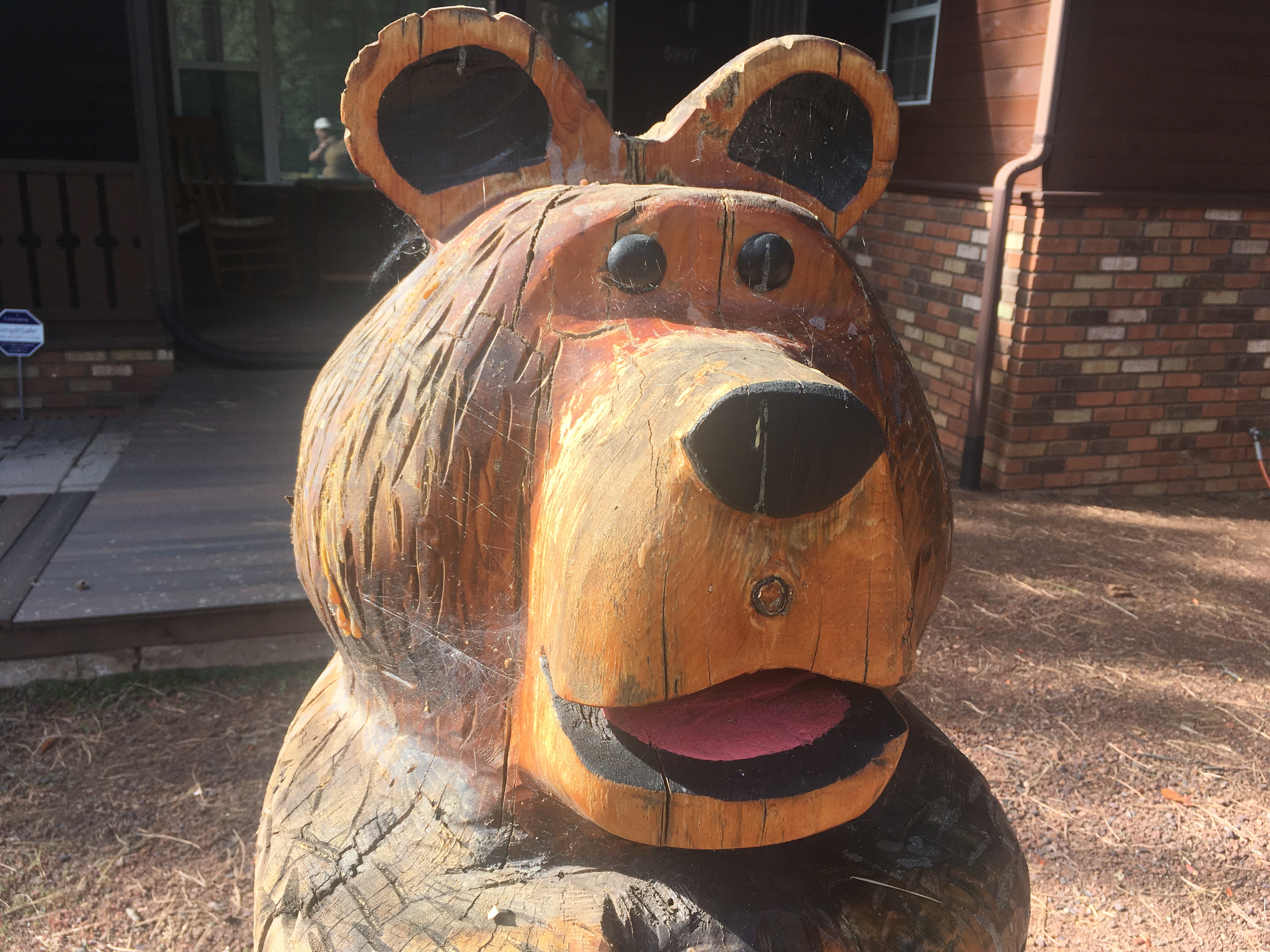
It was a bear, carved by a chainsaw, which stood mid-yard in front of the house. One paw raised in greeting, a hint of grinning on its face, the bear stood about five feet tall and was an ebony color. I guessed this was intended to be a black bear since this species was most common or had been in this area. Over time, shrinking habitat and hunting seasons had significantly reduced their numbers. These yard bears had moved in, replacing them.

How had a missed seeing carved bears in nearly every yard? The ordinary ones were already noted, and then those holding a salmon or waving a flag. Some bears showed loyalty to a university; others were climbing up a tree. Others hung from the edge of a roof. One was dressed as a clown and did a handstand. I hoped to find someone to ask why the bears were so commonplace or even more baldly: “Why do you have a chainsaw bear in your yard?”
But there was no one available to explain this potent pattern., I began to muse about it and to float some theories. Everything happens for a reason. True?
Theory #1: Sold at bargain prices along the road. Buy one, and the second one of similar size goes for half-price.
Theory #2 The power of demonstration and envy: if the folks next door have one, so should we.
I just had to go deeper than that! Was this a nod to the indigenous people who had once lived here? And the acknowledgment that the bear population was decimated through habitat destruction and hunting? Or an even deeper, hardly perceived search for a solution for existential emptiness?
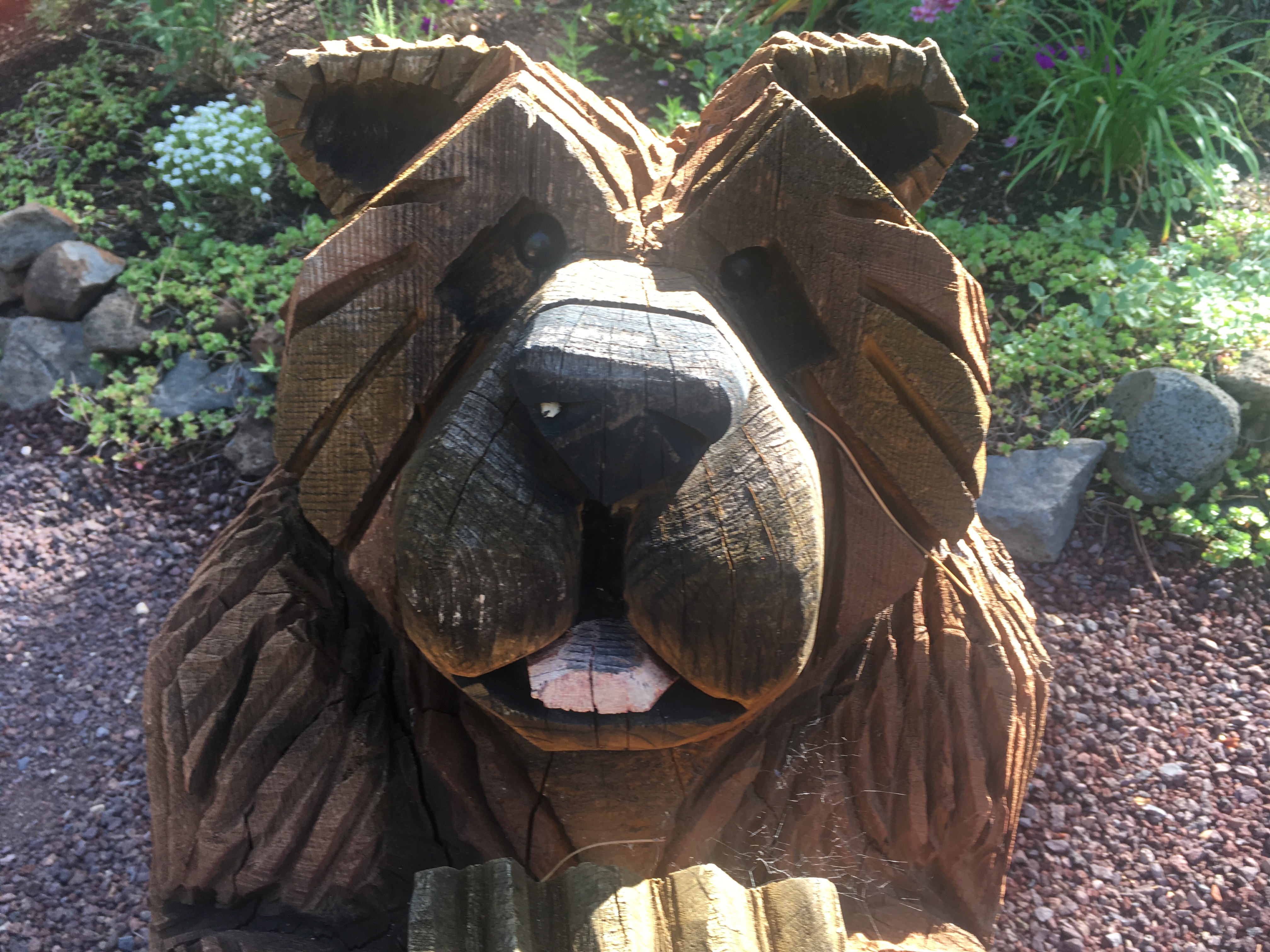
I had heard of neototemism. Could I be seeing it here, however, much of a parody it might seem? None of the bears seemed very serious, for the most part, though a few were leaning in the direction of being conduits to a likely spirituality. If this were so, then perhaps the better term would be protoneototemism. Well, I was proud of that term, especially since I could find it used or written anywhere.
Protoneototemism! How I amazed myself, but then recalled an unhappy incident while a sophomore at Ballast College. I had asked a coed out for breakfast. It was a spring morning, maybe Palm Sunday, perfect for something special like Eggs Benedict. (Who was this Benedict?) I ordered the Eggs Benedict and encouraged her to try them as well. But she preferred pancakes. With hindsight, I understood that my Eggs Benedict made her uncomfortable. After the orders arrived, she pulled a bobby pin out of her flaxen hair and, using the rounded end, began to probe into her left ear. “Itches.” That was what she said. And I said, “..bet your otorhinolaryngologist wouldn’t approve of that.” How I loved that word!
There is peril in such words: she became silent and unsmiling. I never saw her again.

I was still standing in front of the same property, staring at a wooden bear with a carved smirk on his snout. The afternoon shadows had altered his look: his smile was gone. I realized that my reverie about protoneototemism now meant that I had best find that path and avoid a night in a village inhabited only by totemic bears.
Series II # 2
[EDITOR’S NOTE] Followers of P.N. Zoytlow, who watch this site with great care, were thrilled to see his recent submission, “Rubbery Cuds of Manhattan.” He must intend to be more low-key, for he slipped it by this editor and posted it. I was offended and hastened to ask him for in interview along the lines of the last interview we did together, the one in Limon, Colorado. However, PNZ refused and said that his work would have to speak for him. The format of the past, the 75-minute rapid research, is abandoned and that whatever he offers in the future would not have a specific format. “Expect anything. Expect nothing,”said he. That is classic Zoytlow, of course. He elaborated: “could be reports, could be fiction, could be photos, could be poetry.” Whatever happens, it will stand or stumble on its own.” That said, he submitted to this editor, a new submission.
###
Many years ago, I sold part of my soul to a hippopotamus. When I realized it, I was astonished, but gradually it just became a part who I am. Today it no longer seems so remarkable. Furthermore, it is a fading issue. That is how things are, of course, the fading impact of phenomena. Remember a graduation ceremony? A kiss? The hotel stay in Amsterdam? Are you sure they happened? So, did I really entangle with hippos? Or was it just a conflation of my many zoo memories?
When I was four, my Uncle took me to the zoo in Milwauand we (my parents, my sisters and I, the youngest) were visiting. I was keen on all animals then (as now) and since we did not have a zoo in the smaller city where we lived, a visit to the zoo would be a rare treat. The Uncle was a slender man in a gabardine coat and a matching fedora. This was in October after the War and all men wore hats all the time. How did men in America move from fedoras to ball caps? The zoo was somewhere in a more extensive city park. We walked from the bus stop past a lagoon with summer boating and entered the zoo. It was free. Milwaukee was happily still under the spell of its Socialist mayors. Uncle sped me by the monkey island, then the pens with the various deer-like creatures, and those icons of Africa, the zebras. “We’ll start in that building over there,” he said, indicating an ivy-covered dark brick edifice.
Inside, the air was moist and thick with unfamiliar odors. It was fetid! Walking more slowly now, we passed some apes ranging from baboons to an ancient chimpanzee gone grey, but no gorillas. Some of the cages were empty because the weather was still pleasant (it was October and the doors open to the outdoor pens. A lone rhinoceros slept in the doorway, its head in the sun and hindquarters in the indoor gloom. And then we were there: the hippos. My Uncle loved hippos, and it was his conviction that every visit to a zoo should start at the hippo exhibit and then work backward to the entrance. At the time of our visit, there was a pair of hippos at the zoo, replacing a solitary male named Yakob who had filled the space for nearly 30 years. The replacements, Tony and Cleo, had drawn crowds of school children for months after their arrival but, once evident that the pair did very little that could be entertaining, the visitors dropped off. On the day we were there, it was minutes past feeding time and they ate alfalfa and loaves of day-old bread donated by grocers. Watching them roll that bread around their mouths was a joy for the Uncle. Watching hippos eat is probably the most exciting thing they do. They do not swim: they walk on the bottom of rivers, these river horses.
≠ ≠ ≠
Now move back in time some fifty years. I am looking at a rack of postcards and there it was:
Juan, Comte de Montizón was the photographer, an early amateur working at the dawn of photography. The photo was taken in 1852, about two years after the hippopotamus, Obaysch, arrived in the Regents Park Zoo London. Prince Albert purchased the photo as he and Queen Victoria were Obayasch enthusiasts. The hippo was said to be the first such animal in Europe in historic times. The photograph has remained popular (and sells well as a postcard). That photo drew me in. I needed to learn more, and so I began to accumulate details about the life of Obayasch, a male Nile hippopotamus named after an island near his place of captivity. He was injured by his captors; the scar is visible on his left side in the photo. When he arrived in London, he was a sensation, and zoo attendance increased significantly. Newspapers gave updates on his daily routine. Citizens bragged about how many times they had seen him or what he had done. However, basically, like most zoo hippos (and those in the wild) he slept, he ate, and he moved in and out of the pool provided for him. He was (like hippos generally) known to be aggressive and a danger to humans. But what a source of pride for the British public! What other nation had a hippo of their own?
Sketching out the life of Obayasch yields the following milestones:
Captivity in 1849 in the White Nile near Obayasch Island.
Arrival at the Regents Park Zoo in May 1850.
Obayasch provided with a mate, Adhela, in 1854.
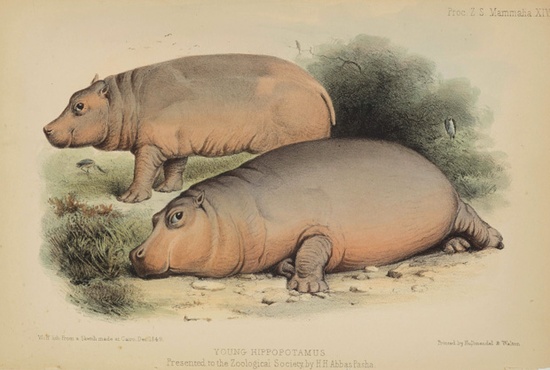
Adhela had three pregnancies, but only one survived, a female named Miss Guy Fawkes (named because of her birth near Guy Fawkes Day) in November 1872.
Obayasch died in 1878 at approximately 30 years of age, Adhela 1882 and their daughter miss Guy Fawkes in 1908.

An excellent recent book on Obayasch, his family and their various levels of meaning in Victorian Britain is Simons, John (2019). Obaysch: a hippopotamus in Victorian London. Sydney: Sydney University Press.
Obayasch is a potent example of a craze that famous animals in zoos and circuses have triggered. Frequently cited is “The Hippopotamus Polka.” The newspapers were for years filled with the doings of London’s hippos. Artists and photographers provided images.
One can explain the draw of hippos in Victorian England easily enough by
recalling that hippos were rare in European zoos and that England had the first. It was part of the evidence of imperial capabilities–the nation could arrange the capture and successful transport of such a dangerous creature from deep in Africa! Here was a nation to be reckoned with. This must be the British Century. The high interest in hippopotamuses is all the more remarkable since they are among the more lethargic zoo animals, perhaps right behind crocodiles. Elephants, apes, bears, and seals provided more “action.” and zoo visitors want a show.
Visiting the typical hippo display did not hint at the vicious personalities of hippos in their natural setting. Nor that they were, despite their bulk, swift sprinters on land where they foraged on grasses along rivers. They were capable of elaborate wide-mouthed threats to rivals, and they are the most responsible for human deaths of all African wildlife. The image of a docile bulk lazing in a stream was disproven often. Moreover, even that national treasure, Obaysch, could occasionally demonstrate his underlying aggression, though zoo officials played this down. After all, Obaysch was a sort of beloved pet, and it was best not to provide the public with whatever contrary impressions they wished to impose on the beast. The large cats were nasty, the apes were humorous, but the hippos were mainly huge. That they came to compete at all with the more menacing rhinos and elephants is remarkable,
So, what is it with hippos? What was it that drew my Uncle to them? What arrested my attention when I found the postcard with the 1852 photo?
Though hippos are known for their dumpy appearance, 18% of their impressive 1.5-ton weight is skin. Beneath this 5cm (2″) thick hide hippos have a relatively thin layer of fat. Hippos will regularly open their mouths to the fullest extent possible, revealing their tusk-like teeth, which are formidable weapons in the bellowing mating jousts in their native waters. Their feet seem undersized, and unlike the elephant, the rhino, and a variety of muscular buffalo, they have stumpy legs. Hard to believe that they can–and have–outrun humans over short distances.
Visitors to zoos hope to see hippos, swimming, eating, yawning, or just walking, but most of this time, a sedentary beast is all they see. That leaves their imposing bulk to be the most compelling feature. They appear to be the zoo’s obesity champions, though they are no as fat as marine mammals.
There is one other hippopotamus feature that is memorable and often shared with others who were not present. According to East African creation stories, hippos were first placed on the plains and forests and not in the rivers. The Creator God was fearful that they would eat all the fish, and the crocodiles were already doing so. So the hippopotamuses struck a deal with the Creator: they would not eat the fish and would scatter their dung so that the Creator could easily verify that were no fish bones present. Thus male hippos expel their loose bowels and, using their short, muscular tails as propellers, effectively scatter excrement.
Let me just add I have visited many zoos in the United States and Canada. That initial visit with the Uncle did create the momentum. So when I speak of the interest of the public in the defecation of hippos, as well as a few other zoo animals, I do speak from first-person observation.
I recall the delight of children observing the dung-scatter in a California zoo. They screeched their delight. “Look, Mama, it’s pooping!” while Dad yelled, “I got it! I got it!” meaning it was there on videotape to entertain forever. And do not forget, reversing the film is great fun.
There are less than 100 hippos in the United States and Canada, but not every zoo has one or two. When a zoo acquires a new hippopotamus, public interest is high. The birth of a new hippo is equally compelling. The importation of animals from Africa is no longer done with the former ease of arranging it with a compliant colonial government. Mostly, hippos with their lethargic patterns do not command great interest or affection.
To understand why the hippo is in demand, you have to recall their abundant presence in popular culture. The hippos craze in England subsided, but hippo imagery continues. In 1940, a successor to Obayasch as a star appeared as Hyacinth, the ballerina in the Disney classic, Fantasia. Hyacinth did her dainty steps wearing a lacey tutu to Ponchielli’s Dance of the Hours. It was a memorable hit and had audiences guffawing. Oh, the beatific expressions! Not a hint of the maliciousness every zookeeper keeps in mind. Moreover, they were funny–as only obese creatures tend to be when they are stepping out! So successful was the Dance of the Hours that hearing it always brings to mind those scenes.
Other films or children’s television shows featured funny hippos (George and Martha, Gloria, and Peter Potamus). An array of children’s books appeared: Hippos are Huge by Jonathan London and Matthew Trueman and Fiona the Hippo by Richard Cowdrey are among the most popular. The latter based on the true story of a hippo born in the Cincinnati Zoo in 2017, which caused great excitement reminiscent of the arrival of Obaysch more than a century and a half earlier.

Gentle Reader: if you have stuck with this homage to zoo hippos thus far, I now spare you a lengthy listing of “stuff” with a hippopotamus inspiration. Personally, writing this has brought me closure on the topic. I have honored my Uncle, the hippo-fan. I have exorcised them. But one more thing.
Interest in and affection for the hippopotamus began with Obayasch in 1850. A century later, in 1953, a popular holiday song appeared in America. This was the plaintive I Want a Hippopotamus for Christmas. Here is a sample:
I want a hippopotamus for Christmas/ Only a hippopotamus will do/No crocodiles or rhinoceroses/ I only like hippopotamuses/And hippopotamuses like me too.
FINITO

“Rubbery Cuds”of Manhattan
This story begins on a night flight from Omaha to LaGuardia in New York. Does anyone like the middle seat? Zoytlow does not! However, he does operate along the lines of whatever happens effects change. Not “affects” though that may be true, too. However, this is not about probability or outcomes or causalities. That said, what if one had taken an aisle seat—or taken the next flight? Alternatively, not had a reason to go to New York City (and I have lately forgotten that reason). The man in the window seat was one of those who could sleep, and he did, leaning his bulk against the window. There would be none of those little upbeats with him. One might hear “going to New York? (Obviously) “Family there?” and likely “great place to visit, but who can afford it” and so on.
The woman to my left, on the aisle, appeared to be in her early fifties, well-dressed, unscented, and wearing the smallest pair of lemon tinted granny glasses I had ever seen. She was reading a business journal, the page opened to a column by a well-known commentator titled “Crunch Time for Chewing Gum Moguls.” Skipping the usual patter,
this observer dove in with “what a clever title, but to what does it refer?” She gave a confident smile of incandescent whiteness while lightly exhaling a slight hint of the blended mint on her breath. Yes, she was chewing gum, and in a manner so discreet that her jaw hardly moved.
Her name was Malvis…something. She was a lawyer for a consortium of confectioners. Under discussion in the big city was a proposal to tax chewing gum manufacturers for damages. “What damages?” “The spots,” she answered and rolled her eyes.
* * * *
Zoytlow believes that every story has a backstory and that every backstory has a backstory and so on until we reach ultimate causality. In New York City and urban areas in other cities and countries, spat-out chewing gum achieves an afterlife on sidewalks as flat black spots. Imagine tar spots. These dark moles on the city’s epidermis are nearly everywhere, but they mass together near the entrances to subways, bus stops, or at the entrances to bars, stores, and apartments. Once situated, they remain for years. The grime of the city and the unintended pressure applied by pedestrians assures them unexpected longevity.
Zoytlow thinks that the gum issue evolved from its very beginnings on Staten Island in the 19th Century. Staten Island? What about the origins of chewing gum with Native American groups, especially those in southern Mexico and Central America where chicle occurs as a latex-like substance from the sapodilla tree.
In 1865 the ex-President of Mexico, General Antonio Lopez de Santa Anna, lived on Staten Island, where he hoped to raise an army for a return to Mexico, something he had managed to do, from time to time, throughout a long military and political career. Santa Anna chewed chicle, something noted by his American secretary, Thomas Adams. The General imported more than a ton of chicle in hopes of interesting buggy manufacturers into adapting the substance to their wheels. This failed, but Adams founded the chewing gum industry, producing Chiclets. Later he joined with William Wrigley, and chewing gum became widely available. Chewing gum became astonishingly popular, but not technically addictive. Gene Autry, singing radio cowboy for many years, was sponsored by Wrigley. He told listeners that while he was doing tedious work like “riding fence,” a stick of Doublemint sure did help pass the time.
Zoytlow had no problem finding spotted sidewalks in New York City. Had he not sat in the middle seat on the Omaha-La Guardia flight, he would have mistaken the spots for roofing tar, concluding that the high-rise roofers who built the city were unabating splatterers. How could that be? Hours spent in the New York Public Library yielded an Italian study of public spitting, but nothing specific. Perhaps gum spots were part of a continuum of expectoration that included, among other things, tobacco, catarrh, and pumpkin seeds. While many chewers do dispose of their gum in a waste container, some even using the original wrapper, the lazy or socially irresponsible ones do not. Encouraged by the evidence of spat gum before them, they eject their wad. Some do swallow their gum, but though harmless, most prefer not to as its unclear role in inviting a dreaded bezoar.
This information pleased Zoytlow, but it was not an answer to the question: why do chewers spit it out on sidewalks? “East Side, West Side, all about the town! The boys and girls together, spitting out their gum!” Alternatively, so Zoytlow was moved to sing to himself quietly in the great reading room of the library. Also, when he came across a rich field of black spots.
He did learn that in 1939 Mayor Fiorello La Guardia began a campaign to end the disfigurement of the sidewalks of his city. The New York Times wrote, on December 4, 1939, that the “rubbery cuds” were a problem in need of addressing. The public was invited to enter a contest to compose a slogan to remind the public of its civic duty. Winning entry: “Don’t Gum up the Works.” by a Brooklyn high school teacher.
Removing gum spots is slow, arduous work. Perhaps futile. Eighty years after Fiorello’s effort, the spots are still with us.
[The interview was conducted by the agent/editor at a place selected byP.N.Zoytlow, the Flying J Travel Center in Limon, Colorado. The time was mid-afternoon and Zoytlow was seated in a booth with a view of the Interstate. He was drinking a small coffee out of a disposable cup. He was wearing jeans and a t-shirt purchased at the place of his last Field Report (FR), Why, Arizona. After a friendly greeting and a handshake, Zoytlow signaled that he was ready and the recording device was turned on.]
DB: You’ve no doubt noticed in the correspondence I’ve forwarded to you from your readers that some of them see you in the tradition of the hidden writer, like B Traven. Some have wondered if you exist at all and I myself have been accused of using you at a front.
PNZ: [Frowns] And this surely bothers you?
DB: Why no, not at all. But I’m hoping that you can reveal enough of yourself here to put some of those questions to rest.
PNZ: Have they read that bio section, what’s it called? On the blog, I mean.
DB: About.
PNZ: About, OK., they know I was born on June 15, 1950. But not much more, as I recall. Well, here’s more. Galena, Illinois. Went to NIU at DeKalb. Journalism. Then to Iowa, Rural Sociology and in 1983 had my first academic posting as a researcher for the Institute for….well, let’s leave it there. But you may surmise that my interest in field research begins in those years.
DB: Yes, you make no secret of wanting to make a notable contribution in some area that you vaguely refer to as the “social sciences,” but isn’t it really Anthropology where you hoped to make your mark?
PNZ: “Hoped?” What’s that supposed to mean? It’s pretty clear that in 24 FRs I nailed down one paper after another. What do my readers say?
DB: Without denying that your work is, ah, unique, many seem to think that you reveal a deep loathing for yourself and for academia which, if I may be so blunt, marched to a different tune than you were hearing. One of your readers said that she could not endure your obvious talent for taking a dynamite research idea and as she puts it “messing it up, big-time.” I hope this doesn’t come as a surprise to you?
PNZ: What does?
DB: That your work seems flawed, perhaps tragically so, and that you yourself…
PNZ: [coughing] …I myself am some sort of paradigm for tragedy? Well, now, that WOULD be something! It rather pleases me, that turn of phrase, rather elegant! Hah! Nice epitaph, I’ll call the obelisk makers in the morning. [Laughs.]
DB: Let’s turn now to your oeuvre.
PNZ: My what? [Shakes head.]
DB: Your stuff. How did you decide on the Field Reports?
PNZ: I was curious if I could extract a useful amount of information, an impression really, of a place or situation in seventy-five minutes of observation time. Like going into a large art museum, tearing though the place in an hour, then lingering at some painting or drawing that sort of bulges out at you and says: this is what this is. In every 75 minute FR, I had to hope that something would “bulge” and show me what I had been doing there in the first place. Now some of these FRs were really terrifying for me. I had to contend with the possibility that nothing really happened and that I would be held up to derision by the world.
DB: We can talk about that later, but I have to tell you that your FRs on the bloghave not gone anything near “viral” as the expression goes. Go back to what terrified you. And by the way, what does the “N” stand for in your name?
PNZ: Nepumuceno. I got very scared with FR # 7
DB: The Beethoven House in Bonn?
PNZ: Un-huh. Nothing seemed to be happening and then everything seemed to be happening. But that’s how human culture operates, everything at once and from there I learned that stuff is happening all at once all the time, like some sort of molecular movement, only this is cultural. Look over there [points to a family looking upwards at the food service menu] there is an amazing report over there, or maybe we should just call it a story. If I sat here for 75 minutes, a hell of a lot would be happening but would I be smart enough to have a feel for it? And would I be able to convince you that you were part of it to?
DB: You’ve been unhappy with some of your FRs? Were there some you could not squeeze the essence out of?
PNZ: The one on wine tasting haunts me. Something eluded me. I still don’t know what it was. But that was pretty effortless, too. I was already there and it fell, too easily right into my head. Take the one on the Iceman Oetzi–there was one I drove especially to see the thing, Bolzano. I was very keyed up because it just had to be a good topic. Poor devil and more so the poor devils who were there to see him. [Sighs deeply.]
DB: Do you include yourself in that category?
PNZ: What do you think? Sure, doing FRs leads to a conceit. You’re always in thedriver’s seat and then the road narrows and becomes a grass track and thenyou’re in the sand. Wheels spinning and all that dust…
DB: OK, OK, I follow that. What were the FRs you might have done had you not, ah, retired from this work? You did think of it as work, yes?
PNZ: The “work” was deciding if my instincts had been correct in choosing a FR. Butonce I chose a topic, I would stick with it to the end for reasons that I think I have explained, meaning everything has a hook.
DB: A hook.
PNZ: Yes, it gives you a flash, a brief insight which says “follow the Yellow Brick Road” or something like that. It tells you it is worthwhile and that if you play your hunch carefully enough,there will be be a payoff, a fully-evolved revelation which I called “Field Report.” Now, as to those “hooks” that it would have been a fine thing to be presented with, let me think on that.[Pauses] Remember, I did not chose the FR so much as I always thought it chose me. Recall the FR on the motel culture, or whatever that was. A bland, ordinary thing which suddenly just asked me to think on it. I always sensed an attraction to, let’s see….churches, those quick oil change places, poetry readings, and the kitchens of restaurants or hotels. But I never got to those places or if I did I wasn’t bitten. People would suggest FRs to me, but that never worked. I could not love their muse. Easier to be motivated by a half-dead sea cucumber and by the way, that one was so wonderful. This small thread of idea and then…..Jesus!
DB: Some of your readers are indifferent to the news that the FRs have reached an end. Others seemed disappointed, at least mildly so. A few wanted to know why.
PNZ: I gave it up because I wanted to, that’s it. Time to do something else. Anyway, as I must have made clear, none of the FRs ever quite reached the point where I thought some social science journal would get excited over it. I knew all along that I could not discipline myself to keep the subjective stuff out, keep it at bay. So, no surprise that each FR, in its own way, just reaffirmed that.
DB: So what’s next, Phil?
PNZ: I don’t like it when people call me “Phil” and I thought you knew that. And this thingyou call an interview reminds me of the bad times I had trying to figure out thepoint of a FR.
DB: Just like your readers?
PNZ: So, that’s the way it’s going to be, is it? Look, I’m out of coffee and I don’t want more. What’s holding me here? My joy in travesty?
DB: Your call, but if you want to continue–what’s your thinking on the likelihood that readership of the blog has been, uh, light.
PNZ: Scant?
DB: Sparse.
PNZ: Too many blogs, too little time. I only read about six myself.
DB: So, what’s next Mr. Zoytlow?
PNZ: You’ll see. Don’t expect me to lay a curse over it by telling you “what’s next.” I hate that expression.
DB: Of course not. Whatever it is, good luck with it!
PNZ: And if “what’s next” is nothing, just empty time and space?
DB: Thank you. We’re done.
Note: I had made no plan regarding how the interview might end and this seemed to work for both of us. Zoytlow seemed indifferent. We shook hands. I stayed in the booth and watched the traffic for a few moments longer. Zoytlow wandered over to thepostcard rack and, moments later, was gone.
[Editors Note] I was surprised to see P.N.’s almost casual reference (contained herein) that this would be the last Field Report. Subsequently, I called him and he refused any relevant details. However he did promise to sit for an Interview (something that has been in the works for some time, readers may recall) and perhaps as early as this June. Most on his mind was his success at avoiding any use of the word “why” except with reference to the subject, Why, Arizona. “If you find one, don’t tell me about it!” said he with a laugh.
Followers of these Field Reports will note that once again, the Reporter/Observer has chosen an obscure place for an investigation. The reason is obvious: the place has a peculiar name, amusing to some, deeply serious to others. For Zoytlow, it was a mix of both but the point was to go and verify that such a place (Why, Arizona) existed at all and was not merely a bit of cartographic whimsy. Zoytlow, as is well-known, takes these types of investigations seriously and especially so if they touch on geographic locales. Proof simply must be found, backed by photographic evidence as required to support either the existence or the nonexistence of Why.
To begin, documentary sources suggested that Why would appear just east of the boundary of the Tohono O’Odham Reservation, ten miles south of the town of Ajo, and thirty miles north of the Lukeville border crossing with the Mexican Republic. What may lie to the West is open space, many miles of parched, trackless desert until one might reach Yuma. Zoytlow, rising that morning with the task of driving to Why, felt the vague unease that desolate highways bring.
Zoytlow saw the first road sign with “Why” on it about 30 miles out. He was on the narrow highway that bisects the Reservation, a place with names like GuVo and Hickiwan which were somewhere out there, unseen, left or right at rare intersections. Such inhospitable, hot country. 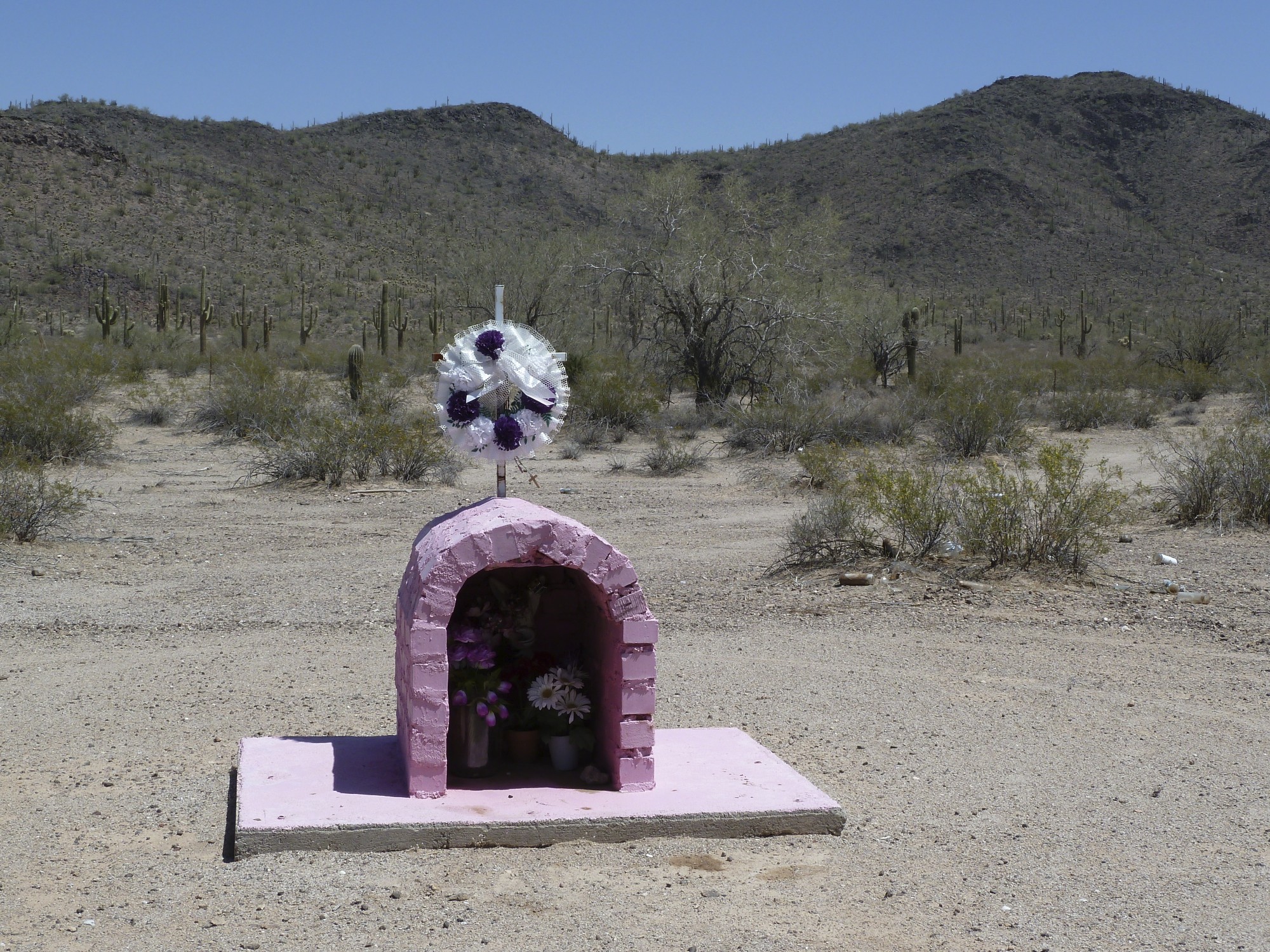 As if to confirm his apprehensions, Zoytlow noticed many descansos as the roadside memorials to those slain along the road are called. Most are simple affairs, a grotto with flowers or icons, but others may include hubcaps, flags, sorrowing madonnas and photographs of the deceased Zoytlow was glad he was not on this road at night. Ten miles from Why another sign appeared and shortly thereafter and indication that the seniors of the town had “adopted” a stretch of road. This was reassuring: all over the country groups had for years been volunteering to pick up the trash that seemed to fly out of passing vehicles. That there should be such a group in Why reassured Zoytlow. Why existed. It was probably as benign as old folks who gleaned the junk.

When Zoytlow arrived at Why he saw that it was not much of a place, really. A ten minute drive along the main street confirmed this. Not far south of Why was a Border Patrol checkpoint with cheerful looking Labradors eager to please and sniff cars. In recent weeks they had apprehended significant cargos of marijuana coming up one of the numerous drug pipelines from Mexico. On he north side of Why stood a complex of buildings, a regional Border Patrol HQ with many of the familiar green and white trucks unfailingly encountered on and sometimes off-road in these parts.
This cursory survey through Why told Zoytlow that the ganglion of the place was at the Texaco station, the Why-Not Travel Shop. The place was surprisingly large and cool inside. Under a low ceiling and along rows of shelving, lay a remarkable range of groceries, camping equipment, and souvenirs. The place appeared empty except for a short man at the counter. He had a serious beard which covered the first word of a message on his tee shirt so that all that could be read was “can count to 10.” Zoytlow put aside an impulse ask the Bearded One to lift that hairy sheaf so that the first word or words of the message could be read. It would have to be something like “my horse” or ‘“even idiots,” but supposing it simply said “Why.” Instead Zoytow began with an apology: he had come to Why to ask about the name, probably a near-predictable request? The Bearded One smiled (a relief to PNZ) and motioned him to a glass counter beneath which was taped a yellowed news article on peculiar Arizona place names. Prominent among them was Why. Zoytlow read the relevant paragraph.
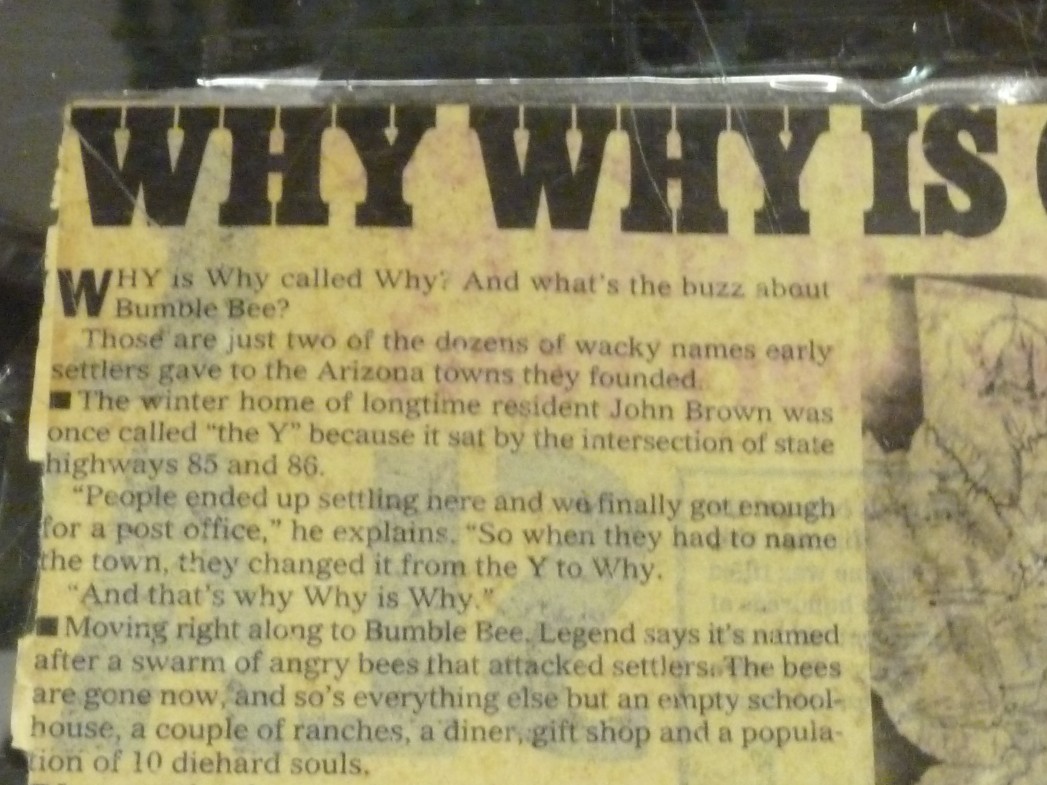
While he was doing so, the Bearded One loudly announced that there was a rat running about outside near the gas pumps. Laughter followed and Zoytlow abruptly realized that there were four others in the store. The “rat” in question was a patron’s miniature dog, a Chihuahua with a grey muzzle and a limp. Now woman appeared from the back room of the store. Her badge said “Manager” and she joined in the laughter. “Oh,” said she, “that rat!” Zoytlow said, to no one in particular, that Why seemed to have a good humor to it. All four patrons and the two employees agreed. “Why not?” said one. More chuckling. The patron at the gas pump entered the store carrying the dog/rodent. It growled and the laughter began anew. Why has a year-round population of less than 100 persons, perhaps more like 42. Winter saw some increase due to refugees from the Cold Zone elsewhere. Zoytlow learned that the best method of taking the census here was t to count the number of active water meters. Anyway, with six humans and one dog before him, it was likely that more than ten percent of Why was enjoying a few moments of presumable rapport in the Why-Not.
This laughter was genuine and innocent and refreshing. There was nothing to suggest simple-mindedess and none of the obvious or cynical ironic twists so necessary to get a laugh in other venues. The ice being broken (ice in the hot desert!) Zoytlow felt at ease to ask more questions including whether the town had a festival of any sort such as a “crazy days” or a “homecoming” or a “pioneer weekend.” Nope, was the answer, and then, unselfconsciously, the woman with the dog said, “Why make a fuss?” Then everyone laughed, and Zoytlow, forgetting the seriousness of Field Reporting, laughed loudest of all. Seconds later, another laugh: the Why water supply came from deep wells that some years ago had tested positive for arsenic. “Tasted great but it will kill you, so we dug a new well.” Kind of like tequila? Zoytlow volunteered, and they rewarded him with another honest cackle (for such it was). Zoytlow felt good about Why.
Back to work: regarding Why, it hung on, yes because it lay at the junction of two highways, but also because it was only minutes from the northern end of a national park, Organ Pipe Cactus National Park. You are standing, said the owner of the still-growling Chihuahua, in the Wal-Mart of Why! Now, here was the missing irony. Alas, business was down: the recession, the drug trouble in nearby Mexico, the ominous presence of the Border Patrol, and so on. People used to drive this way to go to Puerto Penasco a.k.a Rocky Point, a tourist destination at the top of the Sea of Cortez. Now they were afraid, though the media was roundly condemned for making matters worse.
The lack of a customary flow of tourists to the Park or into Mexico meant that keeping the store stocked was constant guesswork. The Bearded One told Zoytlow that they only stocked “thrice requested” items. Zoytlow pointed an overflowing box of candy suckers with real scorpions trapped inside, amber style. “Bet you have a hard time selling these,” PNZ commented. “Not so–very popular” said the manager who was dusting some cans of SPAM in the next aisle. “Lots of folks like them,” she said, “the kids say they taste like salted nuts.” Zoytlow thought that Why, lacking a community festival day, might still have managed a to agree on a favored snack? However, the Bearded One averred that he would never eat one, he’d stomped on too many of them and knew the color of their guts. (Laughter)
Readers of these Field Reports may assume that with a place like Why as a topic, the usual 75 minute of research time, so crucial to the methodology, would, in this case suffice. That is also what Zoytlow thought. He left the store with ten minutes of research time left and spent it slowly driving the scant and dusty streets. Down Why Road, up Mesquite, along Higgins, and back using Sonoita. He noted the Howling Coyote Campground, the small Casino on the edge of the Tohono O’Odham Reservation (small compared to others elsewhere and with very few vehicles in the lot), the absence of churches, the discovery of a second gas station and, most curious, a restaurant which closed on Saturdays and only Saturdays. Any reason for that? Zoytlow noticed on a nearby house a weather-worn Star of David with small lights, the sort of thing you might use as yard decor during Chanukah. Could it be that the diaspora of the Israelites had reached Why? Too many new questions, so little time.
Leaving Why, Zoytlow stopped briefly to give a final scan to the topography, the setting of this, his last research effort. There, in the distance mountains, southwest of Why and so obvious that no feat of imagination was needed, sat The Buddha.
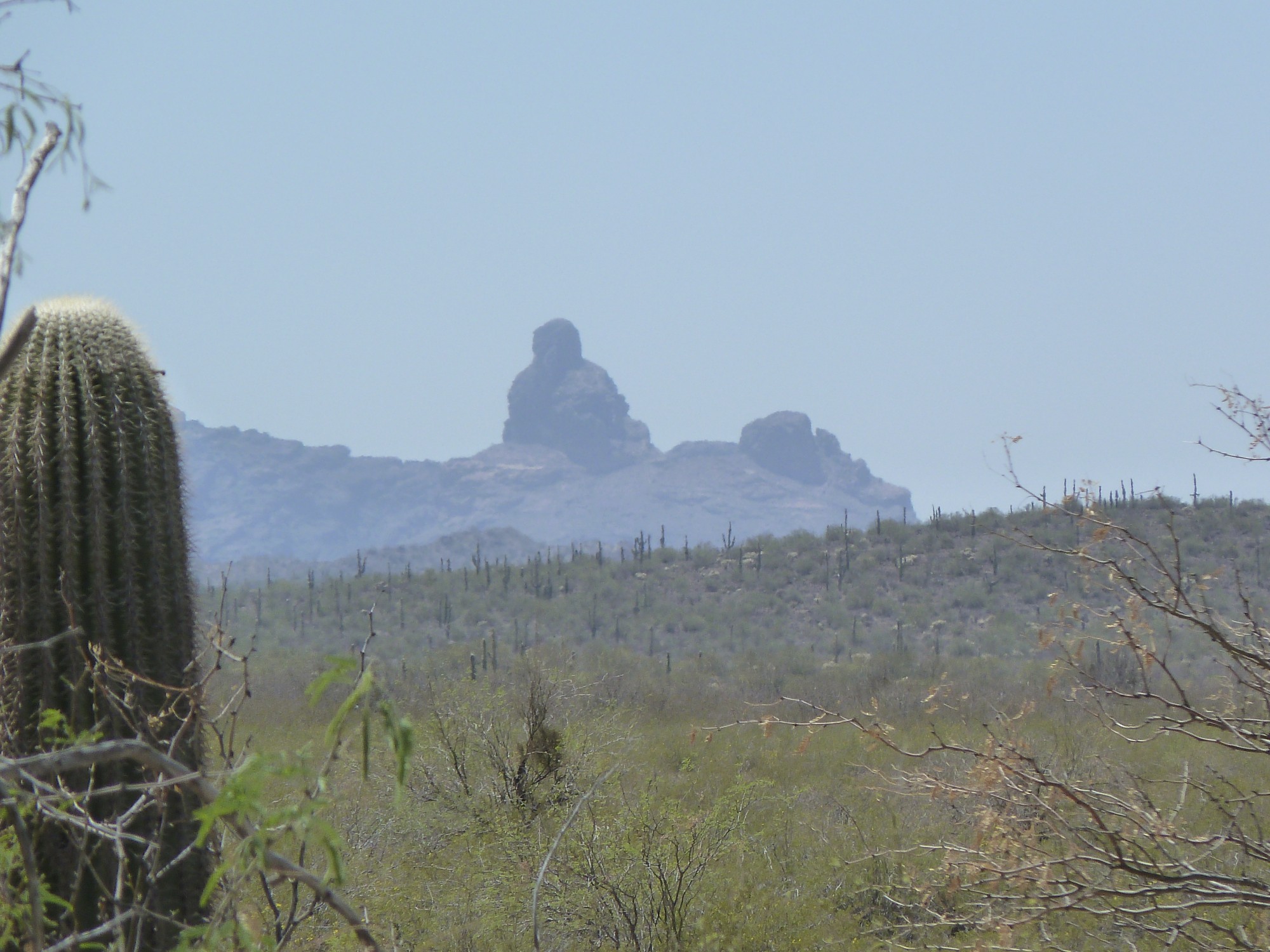
The Great Buddha of Why
 Editor’s Note: I received this Field Report from Zoytlow just the other day. It was sent by ordinary surface mail, postmarked San Felipe which I took to be something of a joke coming from a man named Phillip. But the more I read the handwritten pages torn from a wide-ruled notebook, the more I suspected that he was unaware of the connection between his name and the name of the place. It had taken three weeks for the letter to reach me, not unusual when one posts in a more remote part of the Americas. In addition to the manuscript, he attached a small note written on a note pad supplied by a place where he had apparently stayed. From that I gathered that Zoytlow was in Central America, but he had scratched out the name of the hotel and directed me not to refer to it. As for the Field Report he left only a brief comment: “ See what you can do with this. It’s not a true piece of legit (sic) social science of the sort I aspire to, but see what you can do with it. Please title it as I have done. Thanx. PNZ.” And that was that. I rather liked it, but fail to see why he took such pains to disguise the location. Presumably it is a different place than the one referred to in the report which follows.
[ Eds. note: The Reader may skip this paragraph.] Looking back on it now, I should not have gotten so close to “social studies” in grade school which then led to that fateful course “Social Science Panorama” in high school, and then the me’lange of courses in college that put me into bondage to the the likes of psychology, sociology, and, worst of all, anthropology. I say worst of all since it was here that I was nearly forced to nail my left foot to the floor so as to keep the right foot from wandering off into the full-blown and seductive humanities. But never mind that. During my stay in Termino Real, no thought of disciplining my feet came to mind. I fear I have betrayed the social sciences once again. There is some irony here since Termino Real seemed perfect for writing a masterwork in cultural anthropology. But it turned out differently.
How did I come to the small village of Termino Real? I had wanted to pay a winter visit to one or another of the small and warm Central American nations. Termino Real just happened along, appearing at the end of the road at the tip of a peninsula deep in a howling tropical forest. How to render even a small village into a credible Field Report oppressed me. It was likely that Termino Real had never been described or even noted. This thought electrified me; imagine a scoop in terra incognita.
Such a strange name. I learned, from a sign affixed to the iron gate of the small stuccoed chapel that the full name of the village was San Felipe de Los Remedios Terminados . The sizable expat community had little patience with all this and referred to their adopted neighborhood as Termino Real or just “TR” and many had forgotten (for they were much given to oblivion) what the name of the town actually was.
I met my first expat, a Welshman, the moment I exited the dusty taxi that brought me the sixty or so miles from a grass airstrip to the north. Paved roads gave out after just eighteen miles, so the journey had been lapidary, in the true sense of a pebble (me, P.N. Zoytlow) being ground about in the back of the cab. The Welshman, who did not offer his hand but called himself Arthur, greeted me with a hearty “Welcome to TR!” and asked where I intended to lodge, the shadows having become long in the meantime. “Sun sets early and quite suddenly in the tropics. No street lights here. Got a torch?” I felt a growing unease. No torch. Where might I stay? “My place. Hotel Batz, down the street 200 meters.”
I slept like a dog under the ceiling fan and to the accompaniment of forest squawks, barks, and the occasional scream from things with feathers. Inside, hidden geckos chirped. I was in the tropics. But in the morning, after a breakfast of black beans, rice, and scrambled eggs, I also knew I was in trouble. How to render an entire village, not just an event (as most Field Reports tended to be) into a meaningful lump of information? Arthur sat at a nearby table (there were only three in the dining room of the Hotel Batz) watching a fuzzy soccer game on a small TV situated on the bar. I decided I had no choice but to reveal my intent to do a brief study of Termino Real for a journal of the social sciences. Arthur betrayed no particular reaction to this, as if I had already been the fifth person to appear that week for that purpose.
“Do this. Walk west on the road here,” he said, raising his arm slightly, “and each time you get to a corner, turn right. Turn four rights and you’ll end up back here. This should cover about a mile and take you, I would think, forty-five minutes. You’ll see what you need to in that time. Think of it as ten blocks on the…I mean in… Termino Real. Then, with the time left–you said you had one hour, fifteen minutes, yes?” (I nodded.) “Then go down to Mauricio’s and have some lunch. The village will come to you in that place especially the expats.” Arthur’s plan was better than no plan. “One thing,” he added, “never extend your hand to a gibbon.”
I took this last advice as a jest. I knew that gibbons were Old World monkeys. I returned to my room and stared at the ceiling fan. The remark about gibbons gnawed at me: the man must think me a fool. I decided to scrap his suggestions and just establish myself at Maurice’s for a strict 75 minutes of observation time. Never mind the village walk. Never mind the village! My head was clear: the subject was now the expatriates of El Termino!
At 11:00 AM I walked to the restaurant. More than once I was overcome by the dust of traffic: a taxi, five fat-tired all-terrain vehicles driven by bare-chested young men whose mouths were covered, bandit style, with kerchiefs. These were norteamericanos. Some wore rakish googles that recalled the look of Japanese pilots in their Zeros. The foliage along the road had turned a powdered grey and would stay that way until the seasonal rains washed them and turned the road to mud.
Maurico’s was a small block building with an large yellow awning over the the gravel dining area. Two small picnic tables and benches and one folding table made up the seating. Just beyond the dining area, facing the road, was a dirt parking area for cars, ATVs, motorbikes, and oxen. A large tree with wide-spreading canopy branches, a remnant of the forest that had been here twenty years earlier, provided the shade. High up, parrots shrieked and grackles made their irritating sounds, the same ones they brought far to the north some months later when it was time to nest. I saw in them something of the hedonism of the local kids on light motorbikes blatting up and down the street trailing the adobe brown dust. I remembered that Termino Real was a cul-de-sac. The road ended here: there was nothing more to see beyond Mauricio’s. End of the world would have been a better name for the place.
I sat in a plastic garden chair near the end of a picnic table and ordered a bottle of tamarind drink. Impossible to describe that flavor. I’d wait until the lunch crowd came and observe what they ordered. The menu itself revealed nothing so much as a triad of fish, rice, beans with some tomatoes or squash fritters on the side. Behind me, the small older man I took to be Mauricio and his family were chopping, frying, boiling, rattling, clanking and talking. The radio played an old Mexican tune. Then, by ones, twos, and threes the customers arrived for their lunch. An old couple took seats at the other table which, it soon became apparent, was the table preferred by the Spanish-speakers, natives to this locale, citizens of the realm. The table I sat at now filled up, according to tradition with a collection of expats whose lingua franca was English. In truth, they were North Americans, Belgians, Swiss, Dutch, and a couple from Argentina who preferred the company of English speakers This must have been why Arthur of the Batz steered me here, to experience in concentrated form the expats of Termino Real. Arthur did not appear, nor had I expected him, but I could not explain why this was so.
Most of them greeted me with a disappointing lack of curiosity. Stray tourist, they likely concluded. Were they wrong? A few asked where I was from and one asked if I knew someone named Jack Something. Besides the eight or so ex-pats who sat at the table there were five others just standing around sipping chilled coconut water through straws after Mauricio had lopped the top off with his machete. Most of the talk centered on building materials, the search for reliable and cheap labor, and cheap ways to leave the country for the three days required to renew quarterly non-resident visas. The Americans all seemed to have been in the building construction back home; Long Island was mentioned repeatedly. A Swede seated next to me whispered that all Americans will tell you the same thing: a builder from Long Island. What was the real story? And why when it came time to renew visas, did they never combine that with a trip “home”? Later, one of these “builders” told me that the Swede was “so far Left that even the Swedes threw him out.” A Luxemburger told me he was homesick for real cheese, but little else. A woman in the darkest sunglasses I had ever seen warned me that the Hotel Batz got rowdy on the weekends. Overall, the expats exercised a wary civility towards each other. On average, they had been in TR eight years. They professed to have tired of the places they had left and seldom followed the news. Local news, more interesting to them, was by word of mouth, and they kept an eye on any and all things in “TR” e.g. who was getting a well drilled and how much of a bribe was needed to speed up the necessary paperwork. But land was cheap, labor was cheap, and building supplies were available in a town three hours to the north.
Mauricio’s food was excellent: grilled fish, rice, stewed plantains, black beans, a salad. As my table-mates dug in, I took a furtive look at my wristwatch, now clouded with humidity. Only a few minutes left. I felt a familiar anxiousness: where was this Field Report going? Another opportunity dribbling away? I decided to gamble on one one last question: did they assume that the local folks appreciated their living so much better than they did? Had I spoken too softly? No one responded or even looked my way. I felt foolish, my face reddened; I sweated beyond the expected sweat of these hot latitudes. Later in the afternoon, waiting for my cab in the bar of the Hotel Batz, I revealed to Arthur my moment of discomfort at Mauricio’s. “Ouch, that was the wrong question, mate,” said he in a voice slurred by drink. “Know what I think? How’s it go? Something about being guinea pigs in some huge laboratory. Meet any gibbons at Mauricio’s? Remember not to extend your hand?” With this he began to giggle, resting his head on the bar, and then throwing it back in guffaws which left him wheezing and gasping “Oh, Sweet Jesus!” The cab arrived. I left Termino Real.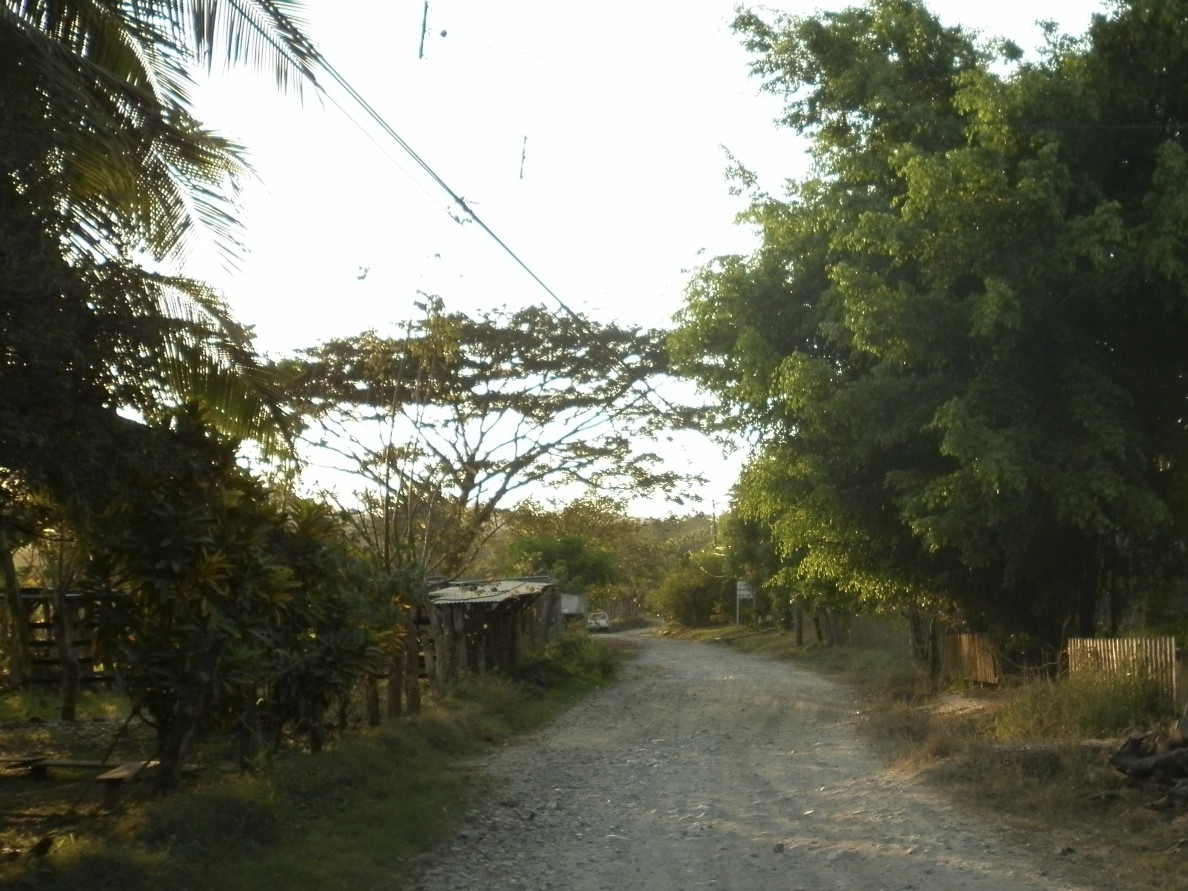
[Eds. Note: I could never get Zoytlow to elaborate on any of the details of this Field Report which, he admitted, had “gone off the rails.” I thought I could make him feel better by doing an internet search on the one person in the account who had both a first and a surname: Arthur Batz. I learned that Batz had worked briefly in a small college in Wales and was known locally as a fierce promoter of Tennessee Williams. I also learned, quite by accident, that “batz” is an indigenous Central American name for the howler monkey, a creature sometimes mistaken for the gibbon, an ape of the Old World.]
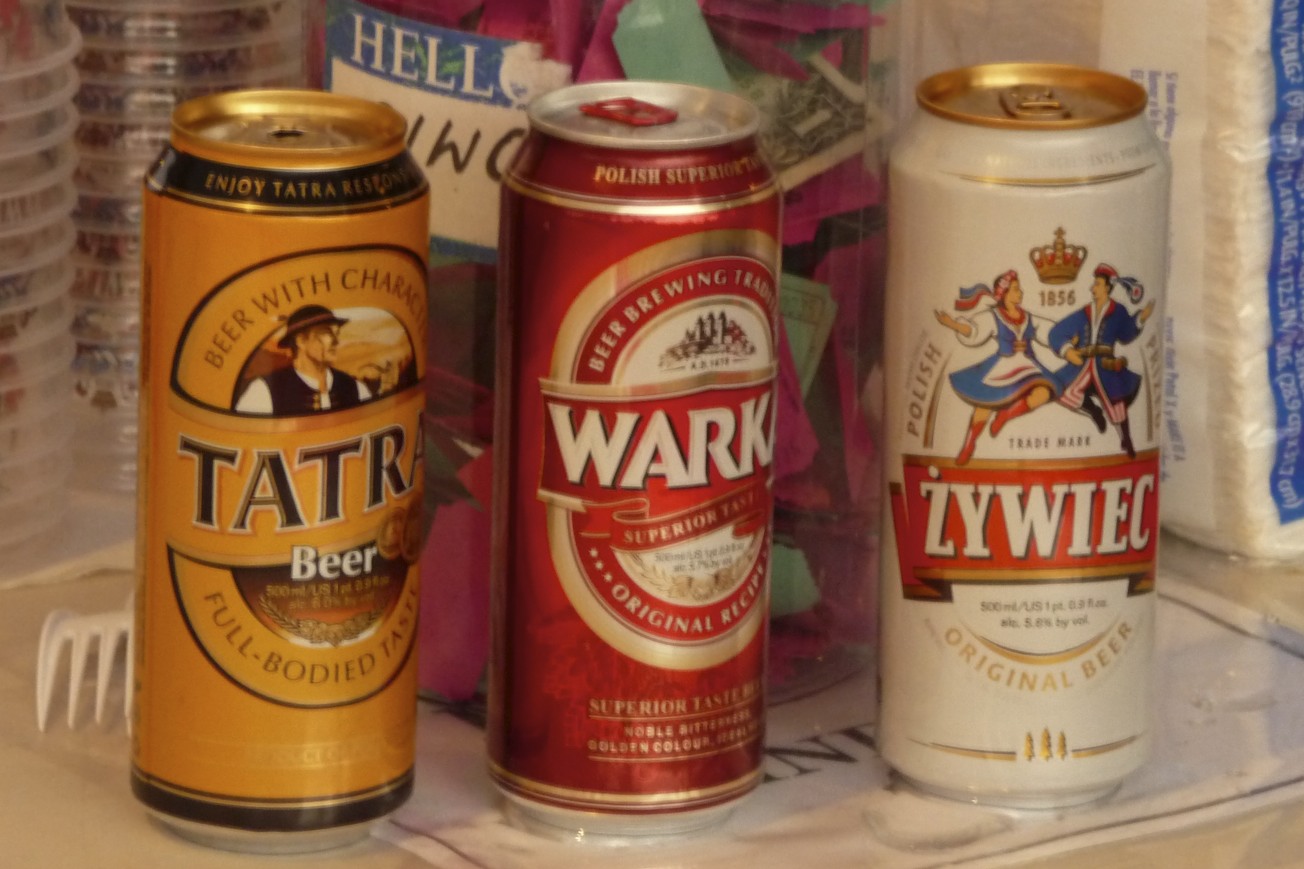
Three Polish Beers
Attending yet another folk festival did not call strongly to Zoytlow, yet this is precisely where he found himself in mid-October. Each year, depending on where he travels, Zoytlow has opportunities to wallow in the Ethnic Soup. Over the years, without losing an appreciation for the efforts of ethnic groups to share their culture with others, he concluded that a certain formulaic approach hangs like musty drapery over most folk festivals. Music, food and drink, dance, and a display of dated cultural artifacts: that’s the stuff of folk festivals. Here and there enterprising merchants attempt to peddle something suggestive of the Old Country to the visitors. Supporting it all are the volunteers who move things around, cook the food, take the tickets and dress up looking ethnic and friendly. Really, there is nothing wrong with the concept, just don’t attend too many.
So it was that P.N. Zoytlow attended the Fifteenth Polish Festival on the grounds of the Polish Roman Catholic Mission Church of St. Maximillian Kolbe. He was persuaded to attend and observe for the best of all possible reasons: curiosity. For years (whilst in town) he had often passed this small and simple church in San Diego and wondered about its unexpected appearance so far from the better-known regions of Polish settlement in the United States e.g. Michigan, Pennsylvania, Wisconsin and Illinois. No, St. Maximillian Kolbe had put down its roots in a part of San Diego better known for its surfer subculture and just a few streets over from a modest Hare Krishna Temple. San Diego is only about 2% Polish, probably half of them immigrating since 1980. Compare this to Posen, Michigan with its 61% Polish population.
The church (specifically a “mission” serving the particular cultural and linguistic needs of Polish Catholics) is named in honor of St. Maximillian Kolbe, canonized in 1982 by Pope John Paul II who called him a “patron saint of our difficult century.” He is considered the patron saint of prisoners, particularly political prisoners. Kolbe was killed at Auschwitz in 1941 after volunteering to die in place of a prisoner who had a wife and children. He had provided spiritual comfort to others and did so until the moment he was given a lethal injection by his Nazi captors. Besides Kolbe, the modest church features a few other of the venerated: the Black Madonna of Czestochowa, Patroness of Poland, and a cramped portrait of Blessed Mother Theresa of Calcutta. The church also gives testimony to the sufferings of the Poles under both fascism and communism and, in particular, the Katin Forest Massacre in 1940.
Leaving the somber little church, Zoytlow passed through a gate onto what is usually the parking lot. There stood a tall, slender man with an enormous cap of tawny-colored bear skin (presumably) a regular forest aristocrat from the land where European bison still wandered dense ur-forests. He wore a wooden pendant with the image of the Dark Virgin, the Madonna of Czestohowa. Another visitor had just inquired about this object and this Noble Pole, with glittering eye, was giving testimony to the miracles ascribed to this image: how the Hussites had put two slash marks onto her cheek and how her visage had become so dark, and how she had protected Poland against the Swedes and so on. These tales were well told, but told at some length against the competing allure of music and cooking smells and so PNZ was reminded of some distant poem, decades ago in high school English class in which some old fellow keeps a polite younger man from going to a party. Something like that.
As folk festivals go, this one attempted too much in too small a space. The church itself was smaller than most upscale California homes in this region. In the parking lot (with a cramped capacity of 17 vehicles-a small congregation) the event attempted to squeeze six food tents, a stage and dance platform, a section of folding chairs for an audience of perhaps 150-200, an inflated play area for children to flop and hurl themselves, several vendors, a few stand-up tables for eating, and a beer tent. Under these conditions one’s sense of personal space might edge into the range of elbow-to-elbow, but not yet cheek-by-jowl
The food was classic Polish fare: pierogi, kielbasa, golabki, bigos, and placki . Zoytlow (whose name may or may not suggest a Slavic connection) found these words intoxicating and began with the pancakes (that’s the placki) and was soon flabbergasted and possibly gobsmacked, realizing that they were, without doubt, the best he had ever eaten!! This was unexpected. The search for perfect or near-perfect potato pancakes had been a quest of many years. Had he found the pancake apotheosis? Wonderful to think of it that way, but Zoytlow also felt a lingering sadness that the search was now over. This kartoffel quest had taken him from his mother’s table to street vendors in Europe through countless American breakfast joints and now this—these plates of burnished amber: the Poles make the best potato pancakes!! Dutifully, he sampled the other fare (mostly permutations of pork, potato and cabbage), but looked in vain for a slice of dewy-moist poppyseed cake to finish the meal. Due to the small space and few tables available, most visitors ate leaning against fences or simply weaving on their feet, disposable plate in one hand, plastic fork in the other.
On stage, a father-daughter duo played accordion and sang tunes advertised in the program as “best-loved Polish songs.” A small audience filled the chairs and two couples had ventured on the stage to dance. The dancing appealed mostly to those who were middle-aged and portly, if not outright obese. The audience was delighted at how nimble these dancers were and one might say even elegant during a tango, one of those “best-loved” tunes along with “Besame mucho” sung in Polish. But there were others which came right from the Polish heartland, songs about beautiful places with chestnuts and fields and rivers. Because Zoytlow continues to be faithful to the 75 minute rapid-research concept which has produced these Field Reports since the beginning, he was not present to hear the more contemporary music of Zbigniew G. who, it was said by a man enjoying his bigos (a cabbage stew) to be the one to see tonight. (“You don’t want to miss him!”). But, Zoytlow would be gone by the time Zbig lit up the night.
Behind the church was the area designated as the “beer garden.” This, Zoytlow quickly concluded, was not a beer garden. He recalled the blunt statement found in the beloved Wikipedia:
The characteristics of a traditional beer garden include trees (no sun umbrellas), wooden benches(no plastic garden chairs), gravel bed (no street pavement), and solid meals (no fast food).
No problem with “fast food” here–everything was slow cooked; in all other respects this “garden” failed. Geography was destiny. This beer venue was forced to absorb a section of a public alley behind the church, obviously some municipal permission had been required. The result was a ten yard square section of concrete surrounded by a temporary six-foot steel cyclone fence. Capacity was set at 130 persons, inadequate for a Festival which had touted Polish beer a the beer garden thereby creating high interest in this corner of the scanty fesitval grounds. To enter in, one had to wait in line until enough patrons left. Once cleared by security officers you passed by a
counter where three brands of Polish beer were offered–in cans! No fresh brewski on tap! . And each can cost $5. But the line of expectant communicants for this Polska piva never lessened despite these hardships. Tatra, Warka, and Zwieck were the three brands available. Saying these words sounded (to Zoytlow) like anincantation to summon (Holy Parking Lot notwithstanding) a demon or to placate the stone-faced security men guarding the entrance and egress of the ever-restive beer zone.
The Poles had always had challenging geographical problems but had always survived and here, on this postage stamp of California real estate, they once again demonstrated that geography need not be destiny. Everywhere, from beer dispensary (not “garden!”) to the stage now awaiting the arrival of Zbigniew G. and his band, were men, women, and especially comely maidens of Polonia-in-America wearing t-shirts, usually red with white eagles, proclaiming “Polska.” And they were happy. The good humor of the Polskas moving through the throng was contagious. Zoytlow was half-giddy and also pleased with himself for remembering that someone has once quipped that Poland was a “geographical expression.” Emboldened by this small but seemingly clever idea, he asked one of the ubiquitous maidens if she perhaps knew of that signature polka “Kiss Me, I’m Polish.” To avoid any confusion regarding his own possibly goatish intent, Zoytlow smiled innocently and waved towards the musicians on stage. She smiled back a tad uncertainly, but no, she had not heard of it, and hurried on to the kitchen somewhere in the church basement. A man and his wife, overhearing him, tried to recall such a tune. It sounded familiar, but it also sounded, said she, “like a lotta things.” Cheerfully, her husband called to a man in a brown Polska shirt serving up pierogi in the food tent. “ Hey, Zarek, you know “Kiss Me?” Zarek looked up, shrugged, sure they just played it, you know, “Besame Mucho.”
Zoytlow looked at his watch. No more time left and if Zbigniew G. and his band were doing “Kiss Me, I’m Polish!” he would never know about it–but such are the pitfalls of a rigorous methodology in field research.

[Editor’s note: PNZ told me that he had found “Kiss Me, I’m Polish!” on U-Tube, mostly in Polish, performed by the Grammy winner Eddie Blazonczyk and the Versatones somewhere in the true Polish-American heartland back East. (http://www.youtube.com/watch?v=QIQBVQ8P8FU&NR=1) California, he added sourly, was not a good place to look for the real thing.]
 P.N.ZOYTLOW