Archive Page 3

Field Report #21 A Desecration Remembered (August, 2010)

It was noon on a summer Sunday in front of the bronze doors of Berlin’s seven-century old Marienkirche [St. Mary’s Church].  The service had ended and the huge old church was emptying. Members of the congregation passed by the bent Roma woman waiting for them at the door, paper cup in hand.  From inside came the last notes of the organ, once played by Bach in 1747.  It was “Israel Sunday,”  an annual event when this Protestant congregation invited members of the Jewish community to participate in a service dedicated to acknowledging common roots and aspirations.

Spread out around the church was Berlin with its weekend sounds of families at the nearby Neptune fountain, the clanging of yellow trams on Karl Liebknecht Strasse, and distant street musicians strumming guitars and tootling saxophones.  Perhaps a hundred persons, members of the congregation or the curious, now gathered in a loose circle on the worn concrete before the church as two white-robed clergy passed out long-stemmed dark red roses.

Street sounds occasionally made it difficult for all to hear the brief comments of the ministers of the Marienkirche, but none seemed to be unaware of the significance of the ceremony; this was an unusual event, an act of remembrance and contrition.  A representative of the city’s Jewish Community read a traditional Jewish prayer in German before asking the slender Cantor at his side to sing it in Hebrew.  The emotion of the cantor’s voice was unmistakeable: lament, sorrow, loss, but also healing.

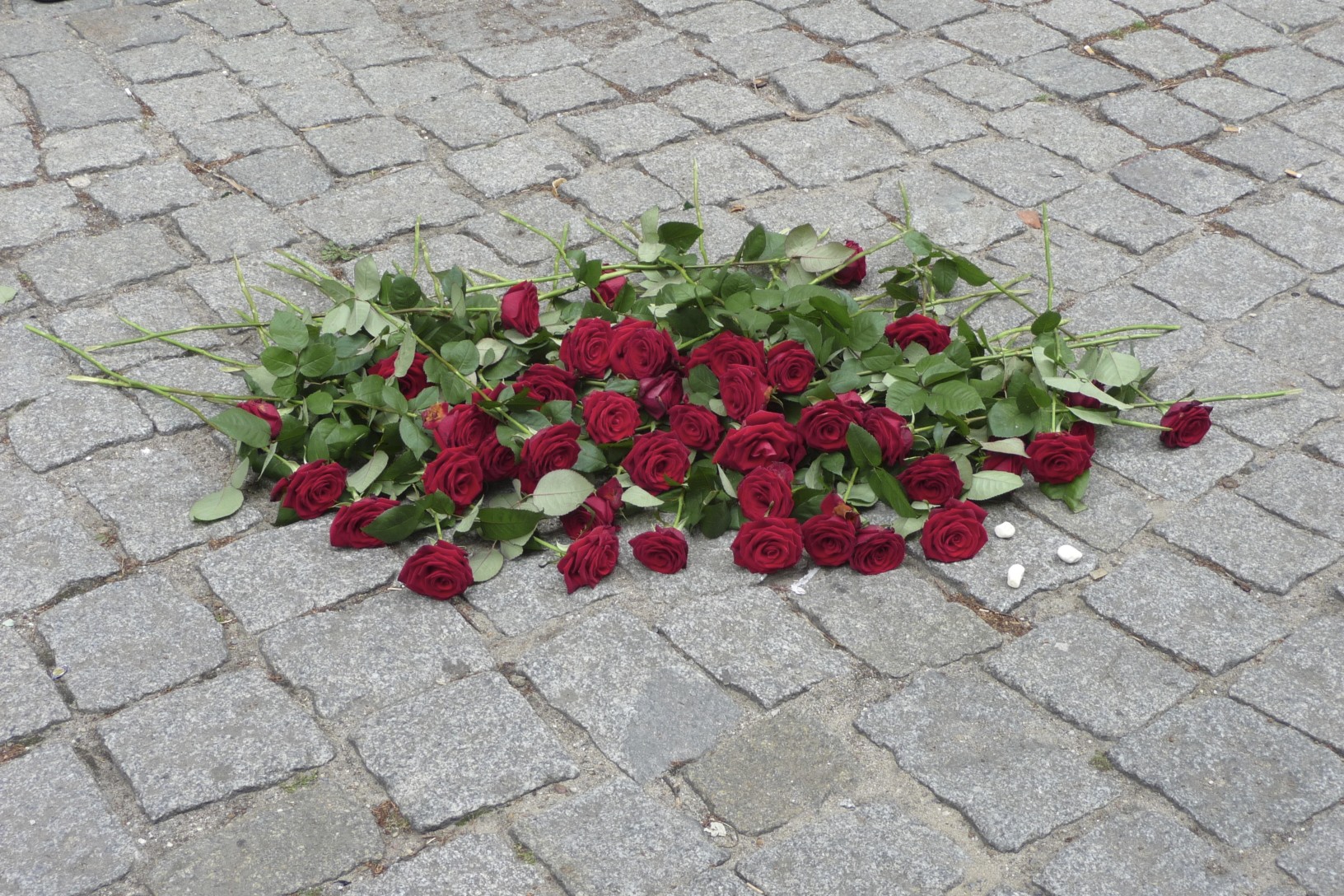
Precisely as the Cantor ended, a single bell of the church began a lento tolling.  Members of  the congregation, one at a time, stepped forward and placed a red rose in the center of the assembly.  Some stood briefly with bowed heads.  The great bell high in the steeple tolled 42 times as 42 roses were placed on the concrete. A moment of silence followed and many present were moved by the simple dignity of the proceedings.

Passersby might reasonably have concluded that this gathering was a commemoration for victims of the Holocaust, common enough in a city with memorials both great and small to that hideous scar of the last century: the murder of European Jews.  However, this brief ceremony commemorated another event:  the trial of 4 Jews and one Christian in this very place before the Marienkirche in the year 1510.  In those days this church towered over the low buildings and the market place of a much smaller city, one still far from realizing its future importance in German and world affairs. The verdict of that trial half a millennium past:  death to all, either by burning or decapitation.  Moreover, the execution was followed by a widespread expulsion of Jews from the city and from the Province of Brandenburg. Reflecting on this event, who would not also think of the horrors of the death camps and other lapses into murderous intolerance over the centuries?

The accused Jews of 1510 heard no Cantor as they faced the flames, so these moments in August, 2010 were for them as well as for us.  In Spandau, a western section of the city, a museum had arranged an exhibit explaining the trial in context.

Briefly told, here is the story, based on the only document of the time The Sumarius [Frankfurt/Oder,1511].

During a night in early February, 1510 a certain Paul Fromm, who made his living repairing metal vessels (in German, a kesselflicker, and in English, a tinker) stole a number of sacred objects from the village church at Knobloch, in the Province of Brandenburg, west of Berlin. Among these objects was a brass container with two communion wafers. As it happened, these ritual wafers had been consecrated and thus understood to be, in effect, the body of Christ. This outrage was soon widely known and suspicions fell upon the Jews of Brandenburg. However, some four months after the theft, Fromm, a Christian, was apprehended. He immediately confessed and stated that he had himself eaten the host. Open and shut case?  Hardly. The Bishop of Brandenburg, apparently had his own motives for complicating matters and ordered a further investigation of Fromm which included torture. The tinker now changed his story: he had only eaten one of the sacramental  breads. The other had been sold to a Jew, Salomon of Spandau.

Salomon was quickly apprehended and under torture stated that he had desecrated the host verbally with curses and then by stabbing it with a knife. Then, broken into pieces, it was given to a number of other Jews who similarly misused the holy object. Within weeks some 100 Jews had been arrested, incarcerated, and accused of having played a role in this grave insult to Christendom.

Host desecration has a long history in Christian-Jewish relations. Jews were traditionally (and often continue to be) seen as responsible for the death of Jesus. Worse, they presumably  sought to continue the pleasure by stealing and defiling communion bread.  Superficially, this seems to make the Jews adherents of the Roman Catholic doctrine of transubstantiation in which seemingly ordinary bread becomes the flesh of the founder of Christianity.   Communion wine (the blood of Christ) is seldom mentioned as an object of theft and a feature of desecration. However, Jews were often accused of abducting Christian children in order to bleed them for those Jewish rituals which required the blood of a Christian child, usually a male. Not surprisingly, this accusation became part of the charge against the arrested Jews in Berlin in June, 1510. It mattered not at all that no child had been reported as missing during this period–authorities preferred to believe that the clever Jews, desperate for Christian blood to make Passover matzos, had likely chosen their victims from among transient or peasant populations less likely to come to the attention of church officials in Berlin.

On the 19th of July, 1510 before the doors of the Marienkirche, a crowd had gathered, to watch the show trial of 41 Jews who had been deemed the guilty parties in the desecration of the host and the wanton use of Christian blood. In short order, all were condemned to death by public burning. Two of the Jews had opted to be baptized as Christians; they escaped the flames and were “mercifully” beheaded instead. Only one Jew escaped the death sentence, a man who had a reputation as an eye doctor–he was allowed to live out his life in a monastery.

The execution took place a mile and a half away at a place called “Rabenstein” associated in those times with public execution. At that time, it was presumably a more open space than the area near the Marienkirche, thus less danger of fire spreading to the houses.  The bound prisoners, most likely wearing pointed caps signifying their status as culprits, were marched through the crowds who now looked forward to a spectacle.  Paul Fromm, the Christian tinker whose crime had begun this horrific fever of anti-semitism, was carried in a cart and along the way tormented with hot irons by the townspeople. He would be burned to death in a pyre of his own. The 38 Jews were arranged on a three-layered platform of wood, straw and pitch. Customarily, their ashes would be dumped in the river Spree or on nearby fields. Incineration was deemed most appropriate to discourage any notion of an afterlife. Such executions were popular and served to strengthen the Christian unity of Berlin.

Who were the victims? No list of names was provided in The Sumarius of 1511. Using other sources, the possible names of those burned to death that day were identified only by their first names e.g. Mosche, Mendle, Salomon, Nathan, Meyer, etc. and the Spandau exhibit represented them with a series of empty picture frames: persons scarcely known to history.  At their end, what thoughts might have come to these terrified victims concerning a world so lacking in compassion and justice?

Shortly after the executions, which affected many families among the estimated 400-500 Jews in the Province, the survivors, whether incarcerated or not, were expelled and many reportedly moved east towards Poland. No Jews were officially welcomed or allowed in Brandenburg for nearly thirty years. Here, as elsewhere, there is potent evidence that economic motives and envy of the Jews help explain this event.  These were often deliberately obscured by traditional Christian religious rationales for mistreatment of Jews.

Now, 500 years later almost to the day, the brief ceremony outside the Marienkirche ended. The officiants shook hands and the participants dispersed.  The roses remained on the ground before the church. The old Roma woman stayed as well. When the ceremony ended the church was again open to tourists, and she stood beside the door and held out her worn paper cup to them. Several days later, the roses, now faded and dry, still lay where they had   been placed.
Field Report # 20 The Demonstrators 7/2010

[Editor’s Note]

P.N. Zoytlow called his last Field Report (#19) “a debacle, not at all what I had in mind” and wished he had ignored the Picacho Peak Civil War Event. When pressed why this was the case, he offered no comment. Just a shrug. I took the opportunity to take him to task: why this torment over achieving his exalted goal of producing a Field Report admired and published by one or several branches of the academic world? I had heard him rage on other occasions that he no longer cared which discipline accepted his work (“I’d even be happy with a Political Scientist’s approval!” he once fumed.)

As editor’s go, I may have more hubris in the area of “knowing my man” than others. In the case of Zoytlow, each Field Report seems more nervous, more desperate. It shames me to admit that I briefly considered putting some old professor up to merely footnoting one Report somewhere. Or I myself would write a reference on the wall of a men’s lavatory e.g. “Read Zoytlow!”

That said, and having said that, at the end of the day (two neo-cliches much in vogue of late), it is time to cross our fingers and offer another

Field Report (#20 The Demonstrators).

Her name (as indicated on the name tag) was Minna. Of all the persons interviewed for this Field Report on the tireless workers who dish up samples for us in food stores, she was the one I like to remember. On seeing her name, I thought immediately of Mina Harker, the terrified wife of Young Jonathan (?) Harker in Stoker’s Dracula. Despite the difference in spelling, I wanted to ask her if there was a connection between herself and the heroine, perhaps a parent who had liked the book or the film, but I stifled such unsuitable curiosity. Today, perhaps more than on any other day whenI embarked on a Field Report (so like a carriage ride into Transylvania) the strictures and the ethics which drape themselves on the statue of the Goddess of Research were solidly with me. Or so I hoped, for this is the Muse I had worshipped with wretched abandon before.

[Editor’s Note] STOP! Hold on there! I have retained that paragraph so that the reader may see what a fevered state Zoytlow was in as he began this “do or die” project. I prevailed on him to breathe more deeply, not try so hard and to trust himself more. And so he continues…]

Minna appeared to be about 70 years of age. She was a small woman with deep creases in her cheeks, a slightly humped back, and pale blue eyes magnified by her glasses. She stood on a rubber mat behind her stainless, movable “demo station” with a microwave oven on her left and a tray of warm corn dog samples directly in front of her. To the right, two packages of the product: Pluck County Corn Dogs. Minna was dressed in white, wore plastic gloves, and an oversized hairnet which billowed over her ears and down to her collar. I approached her station just as she was beginning her patter to a dull-looking couple who had eyes only for the corn dog slices. These were, she said in a kindly voice, either a snack food or a dinner. The sausages were all beef hot dogs with a batter that was either “original flavor” or “salsa.” Five minutes, from freezer to table. Two boxes at a special price. She invited them to try the product, each morsel already speared with a toothpick. The couple did so, chewed the sample thoughtfully, thanked Minna, and then moved on to the next demo station, featuring a small piece of breaded fish with a bowl of tartar sauce nearby. And beyond this station, another offering small paper cups one-quarter filled with “Chicago Style” beans cooked in a luminescent yellow cheese sauce.

It was a good day for sampling food and I had come to learn about the labors of what I had initially called “sample ladies.” However, those who provide samples prefer to be called “demonstrators,” a term intended to convey a level of pride and professionalism. The food store in which Minna sliced corn dogs for eight hours (but subtract 30 minutes for lunch and two 15 minute breaks) was renowned for the number and range of its demonstrators. On a weekday there might be five or six demo stations; on Fridays and Saturdays up to fifteen. Such stores are considered, with some admiration, as places “a guy can put together a lunch just on samples alone.” Other stores might not have as many demo stations, but they might be offering more upscale fare such as a small piece of cheese cake, or something associated with a holiday such a small portions of corned beef and cabbage with a few square inches of soda bread for Saint Patrick’s Day. Minna’s store was not of the upscale sort, but was well-regarded for its dependable sample selections.

A word about methodology here. With the usual 75 minutes of research time, I thought it best to interview anywhere from 12-15 demonstrators spread over a number of stores and in different regions of the United States. Thus, the interviews would have to be fast and to the point. Standardized questions. Five different stores in three states were visited, but the names and locations of these will be obscured because some anonymity must be insisted upon here; however, I have used the actual names of the demonstrators. Overall, I found nearly all the subjects easy to engage provided they were not distracted by their tasks or by a customer. I have seldom been more confident of myself as a social scientist and, quite frankly, following my time with Minna, looked forward to the broad dissemination of this research.

Of the fifteen, Minna was the oldest and had been on the job for 23 years. No, she was not tired of it because she swore to me that she loved meeting people and teaching them about products they might otherwise miss. It did not matter what the product was, even if it was something that she personally did not care for. Working with a microwave oven or an electric frying pan added to the challenge of being prepared for a large number of people to pass by her station at once. It did not bother her if she ran out and had to tell people to come back in a few minutes. “Why, if you want to try something good, you have to be patient.” Some products (chicken or other meat products) were frequently probed with a thermometer and no sample would be let go without a careful scrutiny with this instrument. Minna was a professional and her answers, friendly and to the point, suggested a devotion to duty and a focused seriousness that one might not have associated with the distribution of greasy corn dog morsels, a food item originally associated with county fairs and sometimes disparaged by the health-conscious.

Gwen (pumpkin bread) was half Minna’s age and had demonstrated for seven years. She wore a large button with a photo of her son, about ten years old. Like her older colleague, Gwen had a welcoming demeanor and seemed to enjoy my questions. Yes, this was fulfilling work. How many customers would become pumpkin-bread converts that day? She hoped she would hear from management that they had a good run on the one pound loaves. And if she did not? I asked how she could blame herself when it was the product in the mouths of others that had to do the selling. This opinion was the wrong approach with Gwen and she lost her smile. Obviously she thought of herself as the one critical element in the sale of pumpkin bread. Quickly I asked a barrage of distracting questions: her favorite product to demonstrate? Cottage cheese on Ritz crackers with some reddish seasoning salt on top. Why? because it looked nice, sort of cheerful and she tried to make every one of them look identical to the last and placed in careful symmetry on the serving dish. Then there was the added stack of cocktail napkins on each side. In fact, everything at the demo station was in perfect symmetry. “You know,” she said, “it’s really so interesting when a customer takes one and I have to rearrange everything again. Then three more come and it really gets challenging, especially if I have to make up new ones, or the cottage cheese gets low, or the seasoning runs out. It’s very interesting to keep a balance, to keep it under control, you know what I mean? I love that.”

At the next demo station stood Lupe (sausage pizza) rolling the cutter over the pie. She had noticed me talking to Minna and Gwen and already expected more than the usual interest in her product. She warned me that the pizza was hot and could cause a burn (another feature common to demonstrators: avoiding lawsuits). After learning that Lupe had been on the job only eight months, I expected little new information from her, but here I was wrong. “Know what’s good about this job?” she asked and continued in the same breath, “it’s the discount when I shop here.” With three children and single parenthood, Lupe needed a break wherever she could get it. The worst thing about the job was customers who asked her where to find an item somewhere else in the vast store, a complaint I heard from others as well. “I mean, do I know where the vinegar is at? Or how ‘bout the birthday cards? I’m a demonstrator, not a one-woman information desk,” she stage-whispered to me although there was no else present. And glancing at where Minna was doling out corn dogs, she sighed. “Poor old lady. She really hates it here. She just about dies at the end of the day. Husband left her fifteen years ago and she can’t make it without this job.”

I decided to switch stores and and stopped at a well-known source of specialty foods, wines, cheese, and affordable gourmet items. It was smaller than the average food supermarket and sought to attract a more educated “demographic,” though not necessarily an affluent one. The approach to demonstrating here was unique and successful. Instead of small demo stations, a back corner of the store was given over to a small kitchen where more complex samples were prepared. These sometimes reflected seasonal choice so at Christmas a small paper cup of egg nog and two cookies might be presented on a small plate. St. Patrick’s in March meant a piece of corned beef, a slice of fingerling potato, and a piece of Irish soda bread. Thanksgiving meant a piece of turkey breast with cranberry sauce and a small dinner roll. All of this was prepared by one employee who was dressed in a tropical shirt and no head cover other than a ball cap. [Are hair nets mandatory, or are they just a ploy to make a store look more health conscious? And what about those notices posted in the restrooms stating that employees MUST wash their hands before returning to their duties.] Gregarious and well-spoken, these cook/demonstrators know they are a prime focus in the store. Get to the store early enough and you get a token breakfast of mango juice, granola and skim milk as well as cheery good wishes to “Have a nice day!”

But that was high end. Low end would be those stores that have done away with demonstrators but have not given up the idea of offering something. Here, the human presence (and its payroll burden) is absent and samples appear on trays placed strategically in the aisles. They are covered with dome-shaped plastic “sneeze (or spit) guards” with a small opening (“the cutout”) allowing removal of the sample. Typically, small paper cups with nuts, snack items, banana bread, or pieces of fruit are available. The advantage to this sample i.e “demonstration” station to the shopping public is that, unless there is awareness of the TV camera observing them from the ceiling the customer feels no awkwardness and far less opprobrium in taking two or more samples at once. A store famous for an unsupervised tray of 34 mm. doughnut balls must tolerate those customers walking off with their coat pockets full.

At a well-known food market in Colorado a demonstrator whose badge said “Frieda W. 12 yrs of service” on it stood and ladled marinara sauce over 20 mm. meatballs. A paper cup held them both and a small plastic spoon was supplied. Frieda had attracted a small group of hopeful customers, drawn by the scent of something warm and tasty. “This,” she said, “is Carnavale Marinara Sauce, based on a family recipe. It’s the only way to eat spaghetti. All natural ingredients and I wish I could say the same about the meat ball. Don’t know what’s in that, but we have to demonstrate the sauce with something. Who knows what they put into meat these days….but you’ll love the sauce, trust me. It’s your business if you eat the meatball.” A woman asked why she didn’t just use breadsticks or elbow macaroni instead of the noxious meatballs, but Frieda W. ignored the question.

I looked at the meatball, about 13 mm. in diameter, and waited until the consumers (“clents” in professional demonstrator lingo) had moved on before asking Frieda W. why she had disparaged the little meatball, noting that I never heard a demonstrator bad-mouth a product before. “Because I wouldn’t feed this crap to stray dog.” But that was only the beginning. “Hell, why should I care? If you saw what I have to put up with! Take these meatballs. Management knows how many are in a bag so they think they can check how many we give out. If you don’t make the goal for the day, they put you on pineapple next day. But the people! Give me a break! Where do they get these people? Kids dropping food all over–these are the kids whose parents send them for another portion because, after hitting me up for three, they finally have some shame. And no one says thank you. And all the slobs that pretend they are interested with a phony “my, my, what’s this? it looks so good!” and all the time they could care less about what it is they’re gonna stuff in their pie-hole as long as its free.” She shrugged. “And don’t think you’re special just because you asked me a question. You can tell the manager for all I care. I’ve only pushed one sack of these poison meatballs today, so it’s off to pineapple tomorrow.”

[Editor’s Note: And with that, Zoytlow lost his will to continue. Three additional demonstrator interviews had been planned, but as he explained it “something in my gut told me Frieda W. was right and who would believe anything I offered as a conclusion. I wanted certainty and I got doubt. I can’t submit this for publication to any social science journal, that’s clear.” As this Field Report shows, he lacked the interest to even enquire as to the significance of pineapple in the world of demonstrators.]

Field Report #19 The Blue And The Grey (Again) [March, 2010]

A large nimbus of pure white smoke rose and drifted over the battlefield as if in benediction.  The spectators, draped on a nearby rocky hillside, shielded their eyes to follow this phenomenon.  P.N. Zoytlow shook off the suggestion that he had drifted into the wrong event, perhaps a religious pageant, but here were too many screaming Johnny Rebs and gruff Blue Jackets of the Grand Army of the Republic present to suggest Jesusalem. No, it was 1862 again and he was at the Spring Reunion of Civil War Reenactors at Picacho Peak in Arizona.  Picacho Pass had been the site of a “skirmish” [meaning a quite minor event] in April, 1862 between the Blue and the Grey, the westernmost incident of the War Between the States which ravaged the American nation between 1861 and 1865. The ring of smoke came from the firing of a cannon and not the bellowing of a wrathful Jehovah.

Zoytlow was attracted to this annual event not because he had an interest in the War itself but rather to ask why people dedicate time and treasure to such activities. His modus operandi would be the same as in prior Field Reports: seventy-five minutes of observation time, but this time it would have to be non-sequential, meaning that blocks of fifteen minutes could be assigned to various promising elements. The scale of this event was larger than any other he had yet attempted, larger by far than the overwhelmingly difficult attempt to encapsulate the University of California at Berkeley for the first Field Report. He was a younger, more confident researcher then, less inclined to sweat over methods as he clearly did today, his damp canvas Stetson hat betraying the heat of the afternoon but mostly his unease. For Zoytlow, each Field Report caused him to fret more about the ambiguity of the so-called “real” world. To ask why people pretended they  existed 150 years before the present was simple; to get at the truth of it would not be so simple. At least that is what he assumed. As always, the elusive goal of just once crafting a fine, praiseworthy, publishable piece of research caused dread deep in the bowel.

On this Saturday afternoon in March, the theatrical battles with their mounted cavalry, foot-soldiers, clouds of smoke, popping guns and booming artillery drew a large, oddly diffident crowd. The Reenactors had prepared themselves to present three battles here on the meadow before towering Picacho Peak, the ragged tooth of a landmark between Phoenix and Tucson. Zoytlow observed portions of two of these but quickly concluded that his sparse observation time would be better spent elsewhere. The brief “battle” of Picacho Pass was the only authentic one presented as it had taken place nearly on that spot. The Battle of Glorieta Pass occurred hundreds of miles away from this place. Nevertheless, only a purist would express displeasure at such deviations from fact. The latter battle, Glorieta Pass was the largest event of the day with perhaps a hundred or more men in the field (and a few women combatants passing as men, hair tucked under their caps). The soldiers marched to the field looking oddly defeated. Perhaps the weight of the past had descended and they had become tired veterans, in this case doomed to fight each battle over and over in a loop of tedium. But duty called and once in the field they surged forward, then fell back as the outcome of the battle seemed to hang in the balance. Now and then a man would give a groan (of relief?), slump forward, fall to the ground and arrange his wounded or dying self into a comfortable position. For him, as they say even today, the war was over though the melancholy of that chorus from the old song “Just Before the Battle, Mother” was happily irrelevant here:

Farewell, mother, you may never
Press me to your heart again,
But, oh, you’ll not forget me, mother,
If I’m numbered with the slain.

Meanwhile, the crowd on the hillside watched with impassivity. Perhaps no one knew what to make of this obvious simulation, so tame when compared with unflinching tempest of blood and viscera in films today.  The attempt to provide commentary by means of a few loudspeakers was drowned out by the guns and barking of orders on the field.  What was going on? Without a frame of reference and defeated by the “fog of war” whole families began to drift off to Sutlers’ Row where eager merchants awaited them.

Sutlers’ Row meant vendors of period “stuff” from over-priced sarsaparilla drink to clothing appropriate to the era such as sunbonnets or military caps.  Replicas of firearms for small boys and a few girls were selling and so did the sacks of caramel corn whose fragrance had already suffused the battle just ending. These vendors (“sutlers”) had an authentic place here for in earlier wars merchants followed armies into the field for commerce between the battles, sometimes augmenting what the army had failed to supply.

Further on, the general Encampment of many tents brought to mind that Civil War hit, “Tenting on the Old Campground” with its mournful lyrics “Many are the hearts that are weary tonight, wishing for the war to cease…”  Seeing those tents provided Zoytlow with one of several moments when he felt the war, but no one tenting here wanted this war to end. Reenacting it was too much fun, to which everyone he interviewed that warm afternoon gave cheerful testimony. No one took sides here and there were no obvious lingering 19th Century sectional loyalties. Nor had any of today’s partisanship crept into the Encampment. “Oh, no, no politics here,” said the man selling plastic swords.  Religion? The large man who sat before the Chaplain’s tent wistfully intoned that on Sundays “some of these good folk” joined him in the larger band tent where they sang period hymns and generally prayed for deliverance from evil.

Overall it was the womenfolk who were the more informative. From them Zoytlow learned that while many had been brought into Civil War Reenactment because of the interest of their menfolk, the battles were less central  than one might think. In fact, very few women in their often spectacular outfits (think Gone With The Wind) even attended the battles. They were, many of them, back in the Encampment having tea, quilting, cooking stews in iron pots, or listening to the band play tunes from those times. What motivated many of them, men as well as women, was more than the chance to dress and pretend it was 1862; it was to learn about that past. Some had come to see their role as educators and to share their reverence for the past with the public. Others had an ancestral connection with this war that many Americans know of and (oddly) love.

Zoytlow, walking along the rows of tents, observed men playing games with dice, cleaning guns, or just sitting and staring vacantly at the horizon as men everywhere do. Their women were making pills and lotions or assembling hoops to wear beneath their skirts. At each tent he learned more of their motives for spending a weekend in a canvas tent with few of the amenities of life today.  Of course, most of them knew each other and they gathered like some species of plump fowl, parasols in hand to protect their prized milky complexions, passing along gossip. These were indeed the women whose honor men strove to protect!  They were serious people. Not without humor, but no parody allowed; respect the past, and learn from it. Before a tent displaying various corsets which had once painfully lashed women into a fetching hourglass shape, Zoytlow learned of the evolution of women’s foundation garments. Serious stuff: did everyone know that even pregnant women wore specialized corsets to help maintain femininity? Did they realize the health dangers corsets posed to women, and all because wasp-waistedness was “the look” of the times?

If the smoke and thunderous blasts on the battlefield did not always engage the interest of the visitors, the display on Civil War field hospitals did. Here was the grisly detail of which bullet did the worst damage (the Minie ball) and required the consequent development of equally gruesome instruments of amputation.  Worse yet, the rapt audience learned that the anesthesia could only be administered once; thus if the overworked surgeons were delayed reaching the soldier with the shattered limb….the horror of it all…he endured that rasp of the saw or toothed cable plain and simple.

Having nearly exhausted the permitted research time, Zoytlow turned in the direction of the parking lot and, on impulse, spoke to a woman in a sunbonnet with three daughters. He complimented her dress which caused her to life her skirt very slightly and apologize for her inauthentic though comfortable athletic shoes. Her youngest daughter, perhaps ten years of age and barefoot delivered a curtsy in a natural and unselfconscious way.  A classic curtsy, she had gently touched the sides of her frock, lowered her gaze, and bent her knees slightly. It was the first curtsy Zoytlow had experienced in his lifetime and it caused him a pang of nostalgia, but for what?  He thanked her for her gesture, conscious that she had provided him a better representative image of the event than the one he had been turning over in his mind: the Rebel colonel with bits of mucilaginous caramel corn throughout his lengthy beard.

The curtsy turned out of be a key to the Reenactors. Most of the participants had that dignified quality of wanting to appreciate and enjoy the past. Some may have wanted to escape the present. For the long weekend, there were no obvious sources of outside news, no hateful politics, domestic or foreign–just the quotidian hum and companionship of life in an earlier time. It was a fine fantasy to be part of, and everyone came home from the battles.

[Readers kindly note: in case you missed it in the “About” section, P.N. Zoytlow has postponed the long-awaited interview. Except for this obdurate attitude, he appears to be in good health and spirits. While he realizes that the latest Field Report once again fell short of “praiseworthy social science” he seems confident that the next one will, as he put it “turn the corner” for him. Stay tuned.]

Field Report # 18 A Sea Cucumber [Feb. 2010]

For Observer Zoytlow, there was no other way to describe it than “a long and stormy week.” For days the wind had lashed the sea and the tides were higher than he had seen them before on this stretch of the California coast. Daily, great loads of kelp and debris were dumped on the otherwise inviting sands. When the storms of late January ceased, Zoytlow took a walk along the water’s edge. Rocks, shells, and human junk were abundant. On the beach lay plastics in all their contemporary forms: toys, rope, containers and obscure fragments. And wood: soggy lumber, branches from somewhere, and the occasional yellow pencil. Also cloth: shirts, a piece of blanket, hats, a canvas shoe. Each item raised a question: whose were you? Where did you come from? Most of the curiosities were woven into heaps of yellow-brown macaroni that had been part of the offshore kelp forests. In a few days, caravans of equipment and dump trucks would haul it away.

Zoytlow had not undertaken his beach combing with any thought of a Field Report. No, in his researches, he usually hoped for more drama than mere debris; a beached whale, for example. Then he came upon a thing which did not belong on the beach, a thick, flat black slug-like affair nearly a foot long and two inches across. It looked like a large piece of rubber, perhaps a section of a fastening belt off some cargo vessel. It lay there, posing the question: am I organic or inorganic? Have I expired? Zoytlow tapped it with the edge of his sandal and it squirmed and half-contracted briefly in a repellent way. Such an ugly thing, worse than the nightcrawlers that lay on wet lawns on a summer night, prone to elongate and shrink in inhuman ways. But this thing was still alive and not likely to find its way back to the receding tide. Zoytlow was reluctant to touch it directly, recalling that the most unlikely creatures had irritating secretions or hidden stingers. Yet to let it expire? At a moment like that, Zoytlow reflected, anything that one had ever heard about the defense weaponry of the natural world came to mind like a klaxon. He nudged it back to the sea and watched. When the creature lay rolling about in the shallow surf a number of transformations began to take place: the rubbery elongation was replaced by a stout, cylindrical shape while the color changed to a more mottled surface of browns with red highlights. Here and there, small protuberances appeared: feet, horns, antennae? Each receding wave favored its return to the sea and soon it was gone. Initially, he called it a “sea slug” and then refined it to “sea cucumber.” Or was it a sea hare or urchin?

Zoytlow was troubled. How could he be sure the thing was what he assumed? Worse, he had already felt the tug of a new Field Report and this dispirited him. As readers of earlier Reports well know, the Observer has persistent hopes of writing something that would find its way into a respectable social science journal; such a publication would crown his efforts and his method (rapidometrics) with approval from other scholars. Men and women like himself who toiled in the unknown. Like them, he was a soldier in the Army of Reason, bound to the sacredness of “pushing back the barriers of superstition and ignorance” as a biochemist had once soberly expressed it. Too late now to reject this lump from the sea: it was worthy of a Field Report. Of course, Zoytlow never saw that particular “First Cuke” (as he came to think of it) again. Now, more than an hour of the allotted 75 minute research time remained and the chances of seeing another sea cucumber on that beach, unless equally moribund, were slim. Since there was a famous oceanographic institution with an aquarium nearby, his research must take him there.

Standing at the tidal pool among several dozen seventh graders, Zoytlow wished he had come earlier in the day. As it was, the creatures in the tidal pool (a simulated concrete affair) were due their weekly feeding. The crowd leaned over the edge to watch the various starfish, crustaceans, and anemones as the attendant dropped whatever it was into the pool. As the reactions from the pool to these nutrients were too subtle to sustain the interest of the students, they drifted off and Zoytlow peered into the pool looking for something that resembled the creature on the beach. Across the pool, perhaps a meter distant, stood a docent who was also peering into the pool and, as it happened, Zoytlow had first seen the reflection in the still water. It was a young woman, decades younger than Observer Zoytlow (at least that was his sense of it) with flaxen hair, a light blue shirt, dark jeans and the near-mandatory tan UGG boots favored by women in Southern California. Botticelli’s Venus, out of a tidal pool. Her name, according to her badge, was something Irish with the words “Science Intern” in slightly smaller letters beneath it. In the time that Zoytlow spoke with her, the present Field Report twitched to life again.

This Fiona (as she will be referred to in this Report) had a passion for the things of the tidal pool and quickly pointed out a “Warty Sea Cucumber” and stated that in all likelihood that was the life he had saved, an act he liked to imagine brought him into her favor. They were favorite gull fodder, she continued, and if he had not saved it then a gull would have dispatched it anyway. Part of the food chain, you know. Somewhat deflated, Zoytlow rapidly (rapidometrics, remember?) asked more about the sea cucumber (the Holothurians as science identified them). They were, he learned, the gleaners of the sea floor, essentially nothing more than a mouth, an anus, and a tube between them, Like earthworms, they process matter and expel it. Movement is by means of small tubular legs. They are important to the health of the ocean floor and are as mild-mannered as soft, blind, spineless and brainless creatures ought to be. Their only defense mechanism is self-evisceration: they blow out some guts to distract enemies. Some of these secretions may be sticky. Having performed this partial disemboweling they either shift to an alternate set or quickly grow another. There are many varieties of sea cucumbers, some smaller and some much larger, and they are found in all the oceans. Finally, there is really nothing about them that suggests cucumbers but the term appears in a number of languages.

Zoytlow, was quite taken with all this biological palaver, but he remembered that he was, after all, a social scientist. He asked Fiona what interest the social sciences might have in sea cucumbers. Her answer was terse and he concluded that she had tired of him. “Folks eat them,” said she, “go to a sushi bar.”

There are many sushi venues in the city, and Zoytlow learned that in the tourist districts their menus were slight compared to what was offered in an ethnic enclave. Look for namako in Japanese sushi bars, and ha shen in Chinese restaurants. The Chinese will not serve sea cucumbers as sushi, but there are a number of dishes prepared with it. Zoytlow did not wish to spend the time looking for such places and he contented himself with the description of cooked or raw ‘Holothurians” tasting like nothing more than tofu, quite dependent on what it is cooked with for flavor. Besides, visiting a restaurant just to ask about namako or ha shen seemed too silly and crossed some ethical boundary for this Investigator. [Digression: for a collection of nearly 1000 haiku poems on the subject of sea cucumbers, see Rise, Ye Sea Slugs! by Robin D. Gill which appeared in 2003.]

A better idea, and less compromising, would be to pursue the matter at one of several large Asian foods supermarkets. The one Zoytlow had in mind featured an enormous variety of live, fresh, frozen and canned fish. The heart of the fish department was the long counter where four slender men in black rubber aprons stood and hacked at fish like talapia, sea bass and catfish that had moments earlier been crowded together in glass tanks. Each of these fish had a different style of tank occupancy as did the crabs and lobsters further off. Talapia swam back and forth with their silver sides showing The catfish, black with white mouths all faced front, hundreds of them, each more than a foot in length and with their barbels waving in the current. They were gulping and their homely mouths gave them the appearance of a silent chorus, desperate and accusatory. It was hard to look at them.

Zoytlow approached a man arranging plastic trays of refrigerated minnows in a case. Did they sell sea cucumbers? The man was either deaf or had chosen to ignore the question, or he did not speak English. Zoytlow asked again and the man shook his head as if he wished to free himself from an irritant. Back at the counter, over the din of living fish being clubbed to death (how fortunate for us, thought Zoytlow, that fish are voiceless) he noted a Mr. Fang (“fish manager” according to his badge) speaking accented but obvious English to a woman holding up a squid. Did he have any sea cucumbers? There followed a rapid consultation with a worker slitting the belly of a catfish lately of the tank choir. Yes, in the frozen section. On the way, he verified that no sea cucumbers were in cans. Among the frozen things, he found bags of the subject of this Report either from Taiwan or Fiji. The black sea cucumber seemed to be cheaper than the white and the most similar to that First Cuke washed up after the storm. They were flattened out as well leading to the conclusion that dying sea cucumbers relax their novel endoskeletons. Nothing caught local, presumably, although only a few months ago two Chinese men had been stopped at the U.S-Mexican border with 343 pounds of sea cucumbers (dead) in suitcases which they were attempting to move into the United States where their contraband might have sold for $45 a pound. Or perhaps their fate would have been to be dried and sold as a medicine. Good for arthritis, circulation, cancers, and or as still another presumed aphrodisiac. The men were fined, denied visas, and the cukes were turned over to Fish and Wildlife. [Digression: In 1913, French composer Erik Satie wrote “Desiccated Embryo of a Holothurian” which was inspired by a sea cucumber. It is less than three minutes long and seldom performed.]

Let’s wrap this up, thought Observer Zoytlow. For a moment he had considered finding out what a Federal Agency might do with dead contraband sea cucumbers, but what stopped him more than anything was the realization that anything you get too curious about has no real beginning nor an end. He was peering into a tunnel, gray and endless with permutations of the sea cucumber in politics, art, economy, and (who knew?) philosophy. In truth, the sea cucumber had lead Observer Zoytlow to an epiphany. Hard to ignore was the thought of the Big Bang and this chance encounter with a little-known (to him) creature on the beach. Older than humankind, there it was, by the millions at sea bottom, nearly brainless, endlessly foraging and defecating, ancient and, once one got used to the idea, venerable. Going backwards, somewhere between the Bang and the today’s sunrise, humankind and the sea cucumber converge. Had P.N. Zoytlow not been the rigorous social scientist he was, he might have wept.

Field Report # 17 Codfish (December 2009)

The following Field Report was received from P.N. Zoytlow on the 15th of December 2009.  In many ways it is typical Zoytlow reportage and follows the usual formula that we associate with him.  It may be that Zoytlow is in something of a rut. Number 17 is now the third North Dakota Field Report in half a year. This is not a complaint, just an observation that Zoytlow has become more sedentary or has found an irresistible vein of material in a region he himself labeled “mysterious.”  On the other hand, his use of the first person to relay the information is unusual for a purported social scientist and may signal a break in his methodology. Time will tell, of course.

There are two methods of welcoming and enduring winter in Eastern North Dakota and I have tried them both. First, the only true means of enduring the darkness that descends along with the thermometer near the Winter Solstice each year is to purchase a quart jar (must be glass) of genuine Korean kim chee. A generous spoonful in the evening will suffice to balance off the gloom. However, it is equally important to find a means of embracing winter. While others may use the well-established extreme of ice fishing, in my opinion the consumption, once in December and once in January of lutefisk has a general palliative effect with unexpected resonant overtones no other method can match.

There are many who know of lutefisk only as an ethnic joke, one of the several things that makes Scandinavians of the Upper Midwest humorous to others and also to themselves.  There is a tradition built around the notion that codfish soaked in lye and served hot is amusing; bumper stickers, T-shirts, aprons, and so on all give testimony to presumed mirth associated with this fish.  After Ole and Lena jokes, lutefisk is probably the second most common topic of thigh-slapping fellows.  I suppose anything can be rendered humorous and joke-worthy, but for purposes of this Field Report, lutefisk will not be considered one of them. Serious business.

“Codfish soaked in lye and served hot.” Was that a fair summation of the stuff which I will argue here is the “piece of cod that passes all understanding.”  That line was read on a t-shirt some years ago and may be responsible for my reporting on lutefisk as a sacrament celebrated in church basements, community centers  and at Sons of Norway lodges.  I wish I had originated it but whoever did was risking the opprobrium of High Lutherans for its flagrant parody of Philippians 4:7 (i.e. “peace of God.” Can lutefisk be understood only as an improbable object of consumption or is it more?  Only attendance at a Sons of Norway lutefisk dinner can possibly provide an answer,  though the ultimate meaning of such gustatory behavior may indeed “pass all understanding.”

So what is lutefisk?  Translated from the Norwegian as “lye fish” suggests something about the texture and odor of cod prepared in this specialized manner, but not why it occurs as a pillar of Nordic cultures. There is no agreement on the antiquity of the practice of reconstituting dried and split cod (called stockfish in this form) by soaking it in a bath of sodium hydroxide, or lye. Lye causes the fish to swell, lose some of its protein, and acquire a gelatinous texture. The soaking must be done in several stages until the caustic quality is reduced to the point where it can be, after cooking, safely eaten. Another food prepared with lye is hominy where dried maize is reconstituted and swells. Both lutefisk and hominy retain a hint of lye. This taste is perceived though cultural and highly personal lenses, something I am desperate to try to explain here.

At the Sons of Norway lodge in Fargo, and at similar lodges in other towns and cities, winter is a time of lutefisk dinners. In Fargo, these occur regularly on the first Sunday of the month with peak months being the two dreariest, December and January. Serving is done beginning at 11:45 until 1:30, timed to serve the many coming with appetites honed by piety from their respective houses of worship. Oh, the growling gullets of these solid folk as they entered the Sons of Norway clubhouse, and the discipline as they waited for their turns to enter the serving line. Such are the crowds that nearly everyone has to wait in a dining cohort, perhaps twenty persons whose assigned number entities them move forward from a holding area (the bar, defunct on a Sunday) together towards the serving line. Most of the diners are middle-aged and beyond, though not a few have brought younger members of the family along. They may have to wait for half an hour in which time the topics that appear to be most commonly exchanged in this nearly homogenous group of Nordics are apt to be (1) how cold is it and how cold has it been and how cold will it get?  (2) memories of lutefisk consumption past (3) recent illnesses and deaths noted.  This passes the time nicely. Occasionally some fellows will trade good-natured wit about how the smell coming out of the kitchen made them wonder if they should stay or how much butter it takes to make lutefisk edible.

The Sons of Norway lodge is meant to suggest all that is good, and strong about Norway itself. As with many descendants of immigrant groups, memory has not kept pace with modernity in the “old country.”   How many of those waiting for lutefisk know, or want to know, that Norwegians eat significantly less lutefisk than Norwegian-Americans?   Lodge decor includes references to the Norsemen (the S of N logo features a Viking ship), kindly portraits of past and present Norwegian royalty such as Kings Haakon and Olaf and Queen Maud. A miscellany of trolls, gnomes and other gremlin types complete the decor of the place. Remember: in sagas such as Beowulf folks sat about in lodges drinking, boasting, and gorging.

Attending a Sunday lutefisk feed alone as I am doing is atypical as the eating cohorts are mostly acquainted, made up of couples, and quickly recognize commonalities. In order to promote the normal behaviors at these events, I kept myself (with my lack of Scandinavian roots) apart and listened carefully for my cohort’s number to be called. It would not do to try to blend in: I was alone, Zoytlow is a peculiar name, and I could not claim membership in any of the usual Lutheran churches. Nor was I native to Fargo or some outlying community. This is not a critique of the insularity of ethnic groups generally, just a recognition that as a relative stranger I would have tainted the purity of this event and, who knows, knocked it into an unseemly aberration such as a food fight. Granted, this may only be a fantasy induced by waiting twenty-six minutes in a room dominated by troll imagery.

Half an hour into my visit (and with forty-five minutes left given the rules of these reports), I began to relax. There would be enough time to do a responsible Field Report. A bell rang, a number called, and now I was in the steaming serving line where the cheerful servers asked how well each guest liked lutefisk. The answer might be any of the following or some variation thereof:    “Oh, you know, normal.”  “Pile it on, and don’t spare the butter”  or “You know, ah, I’m here for the meatballs so just a taste of the lutefisk.”

In fact, most lutefisk events feature meatballs and gravy in unspoken recognition that not everyone can abide the fish. Tales abound of those who carelessly came out of curiosity and, with the merest of samplings, recoiled in shock at the alien taste and the mucosity of the texture. The most amusing variations featured persons from outside the region who had been invited to attend. With each telling of such anecdotes, the bond of lutefisk for many Norwegian-Americans becomes stronger. Though they would reject the analogy, this was another type of Communion on a Sunday. I listened with full attention to the banter about the potatoes, the lefse (yet another communal feature), and the way the grandparents used to serve the lutefisk and on and on. Over each table of six or eight diners,  a mist arose from the primal slime before; a good slime of love and recollection.

In the main dining hall, S of N ladies in folk costumes helped seat each cohort or cleared away the dishes of the departed. A certain tension becomes evident the longer a group sits at table knowing that there are those famished ones, distant kinfolk perhaps, still languishing in the bar. On average, a sitting at lutefisk might take forty minutes including the ice cream desert and coffee.

I glanced at my watch. Less than fifteen minuted of the permitted seventy-five minutes of research time remained. The three couples at the table were finishing up. It was obvious that I was one of a very few to attend alone and so this table for eight had an empty chair to my right. Thus far I had alternated looking at my plate or listening to the table talk. Most of it was a continuation of that triad of topics noted earlier: weather, illness, and lutefisk memories. One interesting fragment appeared, a long tale of a “nice Lutheran girl” who was getting serious with her Italian boyfriend (“and he was a Catholic, wouldn’t you know?”). Well, the parents decided to discourage this and invited the couple over for dinner one January Sunday. They prepared lutefisk and made sure it was made from stockfish (dried cod) which is more odiferous and has a stronger taste than other fish such as haddock. To heighten the drama, plastic knives and forks were set to make the point that lutefisk corrodes normal flatware (true mainly of silver).  The story ended with “and they never saw him again!!”  (Laughter and comments of “that was mean,” etc.).

I plunged in and asked the question that seemed to hang over the whole affair: why lutefisk?  Since dried fish was prepared all over the world without the use of lye, why did some Scandinavians prefer it to the simpler(and more nutritious) cod without benefit of a fearsome chemical? The question seemed to surprise my table-mates and one could conclude they had never thought about it. But the reason for their reticence was that I had asked a question so obvious as to induce a stupor. Finally, the woman to my right offered the view that “we like the way it looks, and tastes and feels when you eat it” and she made her point by causing her fork to jiggle a gelatinous lump that remained on her plate. De gustibus non est disputandum!

I could have saved myself the effort of coming out on a frigid Sunday, gamely shoveling down some lutefisk, and disturbing the tranquility ofsome nice folks had I just recalled that obvious well-known Latin phrase which is probably older than lutefisk.

Field Report # 16 Roller Derby [November 2009]

For those who have never been in Fargo, North Dakota nor have attended a Roller Derby, the combination of the two must have a synergy filled with  promise and spectacle.  Fargo on a Saturday night (for this is when the Roller Derby appeared) offers the usual tired diversions on the town or the option or simply staying home to endure the lackluster offerings of television or yet another rented film.

So it was that weeks before the scheduled Saturday in November word spread that the first-ever (in the memory of most) genuine all-female Roller Derby event would take place in a downtown sports facility.  The “girls” of Fargo-Moorhead would stand against those of Winnipeg, the considerably larger and reputedly sophisticated Canadian metropolis to the North. Hardly an inconsequential event, this. Although Canadians are not seen as problematical like so many other foreigners, they remain plainly not-one-of us.

The Roller Derby as sport began in the late nineteenth century and took two forms, both on oval tracks: the faster banked track and the flat-track which (given the forces of gravity and centrifugalism) lacks the speed. Today, most would have an impression of roller derby based on films such as Kansas City Bomber (1971), heavily dependent on the body of the then relative newcomer to Hollywood, Raquel Welch. More recently a film called Whip It (2009) helped developed an interest in the sport. The Fargo-Moorhead skaters benefitted from (and encouraged) the view that a roller derby bout was an intimidating event in which angry, competitive she-devils delighted in colliding with or tripping up their opponents. Although it was not their spoken intent to maim the Canadians, everyone understood that this was not a genteel sport such as lawn bowling or golf. No, Roller Derby was first cousin to the baleful likes of hockey.

PNZ was further moved to attend by the proliferation of posters advertising the event. There she was, a regular Roller Derby Queen, muscular and tattooed of thigh, and with suitably Nordic braids emerging from under a blue helmet. And the look on her face as she leaned into a turn, arms extended for balance: scowling determination, yes; malice, maybe.  Nor was a hint of cleavage absent. Apparently many others, despairing of nothing else to do on a Saturday, were similarly inspired by an event that promised sex, speed, aggression and the pathos of wincing pain.  Arriving thirty minutes early, PNZ found the ticket line nearly two city blocks long and, once inside the building, a further serpentine of the curious stretching along a number of interior hallways. PNZ spent nearly as long in this line as he had so see a cadaver (of Oetzi, see FR # 8). As in that report, waiting in line took up far too much of the alloted research time, but it had its rewards. In both cases the long lines were made up of those who wished to see something that few had seen before.  In each case, it was more than simple curiosity. While one crowd looked forward to a more than five thousand year corpse and possible homicide victim, the Fargo crowd hoped to witness what insults to mind and body the Roller Derby girls might inflict on each other. PNZ was ever hopeful that significant social truths lay all about him, waiting to provide him the longed-for chance for publishable fame in some branch of the social sciences.   Brow furrowed, he scrutinized the crowd around him and concluded that they averaged about 30 years of age, wore mainly dark colors,  and perhaps 40% showed some obesity, thus confirming all the recent dire research about the expanding girth of Americans.

Despite rumors that there were no seats left and that hundreds would be expelled into the night, PNZ successfully paid the $12 admission and climbed the steep stairs to find a seat overlooking the action. He stood on the first landing and despaired for at first no empty seat was obvious. Spotting one some distance above, he signaled to the persons on either side who confirmed that the seat was available. The bout was a quarter of an hour underway by the time he was seated, but given PNZ’s nearly total unfamiliarity with the proceedings this hardly mattered. Above the din of the crowd, he asked the large woman to his right what he had missed. She shrugged; two national anthems was the answer, for she was not certain either with what she was seeing on the concrete oval below.  “It’s kinda slow,” she volunteered. To his left, another broad-beamed neighbor offered a program which had a condensed version of the rules, none of which could be absorbed in time to make sense out of much of anything–in fact, the program described the rules as “a bit overwhelming to the unfamiliar eye.” Clearly, two groups or seven women were skating, rather slowly, around the oval. At times, although there was some forward motion, the entire group seemed to come to a stop. This was normal. Sustained fast skating is impossible on a flat track. That much must have been known to this crowd of nearly 1800 “unfamiliar eyes.”

Wedged into his seat high above the action PNZ tried to pay attention. Despite the often plodding pace that characterized most of the bout, there were occasional departures as when a relatively sylphlike “jammer” passed the beefier “blockers” to score points despite the wary postures of the latter. Auto racing came to mind in that the tedium could be broken only by a daring plunge past other drivers or (better yet?) by a dangerous move which resulted in a collision or spin out of the track. Inescapable was the impression that the Fargo crowd saw this parallel quickly and cheered loudly if (a) a jammer made a dash past others and (still better) knocked down another who then slid and tumbled about until she could regain her feet. However, the (best yet!) was when a collision or miscalculation caused a girl to careen past the boundaries of the track into that part or the crowd in the “suicide seats.” PNZ observed one such tumble into the suicide seating area. The people seated there on the ground, mostly young men, had little warning as a large blocker lost control and skated directly into them, falling on and among them. The crowd rose as one and yelped. Now this was Roller Derby!  Now we were getting somewhere!  Woo-hoo! PNZ was not surprised at this reaction. Not only had Girls Roller Derby developed something of the panache of women’s “professional” wrestling with all its hair pulling and so on, but the printed program contained a warning about the danger of sitting in the suicide seats:

“Sit at your own risk! Be prepared, you might end up with a skater in your lap tonight…Paramedics are on hand in case any injuries should occur. Don’t worry though, the bruises you incur from a derby girl in your lap will be a great conversation started anywhere you go!”  Of course, by sitting there you did absolve the Fargo-Moorhead Derby Girls from “any and all responsibilities for any injuries…”  No mention of death, at least, but the attempt to evoke an ambience of peril and pain was promoted throughout the event. For example,  most players choose a pseudonym, printed on the backs of their jerseys; thus playing for Fargo-Moorhead were the likes of Athena Barbitol, Donna SoreAss, Maulflower, and Shock Therapy.  The Winnipeg team featured Sourpuss Slasher, Killendula, Countess Bashory, and Gunna Die to name a few. After the bout (as stated in the program) at least some of these girls would be at a nearby bar where all spectators were invited to “meet the skaters…at your own risk.”

Plenty of hype and all in good fun. For PNZ,  too much of that fun had been forced, especially by the annoying duo (“personalities”) who stood on a stage, microphones in hand, bellowing intended witticisms in non-stop fashion. None of it was interesting or clever to PNZ who was quite simply beyond enjoying himself and only twenty minutes after taking his seat.

Always mindful of the strict requirements of his discipline, PNZ was watching the clock and felt relief as the 75 minutes of observation time came to an end. Though 15 of those minutes were assigned to the experience of standing in line, the rest had taken place in the sports center.  He squeezed himself out of his seat, bid his neighbors good evening and descended towards the large exit that in Roman times would have been called the vomitorium.  It was half-time. On the floor, three young women dressed in black and twirling long pink boas strutted and then inexplicably lay on the very concrete that scant moments earlier had seen the dueling Sourpuss Slasher and Maulflower maneuver around each other. These were the Saloon Girls, apparently a fledgling group of three burlesque dancers. Halftime entertainment, an afterthought.

The Fargo-Moorhead Girls beat Winnipeg 101-55. PNZ, home long before the bout ended, assumed that the crowd was pleased. The Roller Derby had arrived. Nothing else like it on a November Saturday night in Fargo.

Field Report #15 At The Center [July, 2009]

On a day as close to the Summer Solstice as could be arranged by this Observer and The Driver (who happens to be a geographic romantic), an exploratory effort was launched to get to the Truth of the Matter Concerning the Geographic Center of the North American Continent. To do so meant to spend long hours on the roadways of North Dakota, a place of ineffable mystery unusual in the United States. Many may look to Monument Valley of Arizona or the Staked Plains of Texas as American Loci of Mystery. The most consistent mystery is the near entirety of the State of North Dakota, a topic too broad for a Field Report.

The small city of Rugby in the North Central region of that state, population at the last census approximately 3000, was founded in the 1880s as a point on the Great Northern Railroad. The oddly English name reflects the tastes of railroad executives of the time who wished to attach European connotations to places on the frontier in hopes of reassuring immigrants, the hoped-for developers of the Great Plains. Rugby became a center of Scandinavian and Germanic settlement as did most of North Dakota.

What does it matter just where the center of a continent is?  In this case, one must be curious about curiosity itself, for there seems no other reason for anyone to bother finding the midpoint of a continent other than its merely being there.  We must assume that the United States Geological Survey had a reason for establishing, in 1931, the middle of the North American Continent. That reasoning is admittedly flawed, for many authorities agree that the middle of any continent is quite likely impossible to determine. To do so one must assume that the continent is a flat disc, like a dinner plate. Imagine that you must now balance that plate perfectly on a nail. Probably you would hold your breath and avoid moving your hands too quickly lest some wisp of moving air disturb the project. But these are minor problems when it comes to balancing a continent. Still, at Rugby, there stands a stone monument with a golden ball on top which might, in theory,  suspend a static and centralized continent at its midpoint. Forget about the disturbing questions: just what are the boundaries of North America?  What about islands off-shore thought to be part of the continent? What happens if the shape of the continent changes due to geological activity such as volcanos, earthquakes, or deposits at river deltas?  The unsatisfying nature of this “center” was underscored by a nearby directional sign which pointed out that the visitor stood 1450 miles south of the Arctic Circle in Canada, 2090 miles north of Acapulco in Mexico and, respectively, 1100 miles east a point in Washington State and 1500 miles west of a place on the coast of Maine. Purists would want to know how Panama and Alaska figured into this calculation.

One has the sense that Rugby has made its peace with these questions.  At the Cornerstone Cafe, on whose parking lot the monument to the Center stands, this Observer, assisted by The Driver, attempted to interview some locals as to the significance of sitting scant yards from the balancing point where the mass of cities, rivers, mountains, swamps, and suburbs that made up a continent might by perched on the golden metal ball.  However, authentic locals were not in abundance. One learned that the Cornerstone Cafe was run by a family recently arrived from California and lately self-reinvented as Dakotans. An employee (from the South) refilling ketchup sqeeze bottles grumbled about the cold winters and the coldness of Dakotans. She spoke of a forthcoming visit to the hot and humid lands back home where one could acquire a “savage tan” as she put it. These people had little interest or affection for Rugby’s fame as a singular geological place excepting the three elderly men seated in a booth, throwing dice with a leather cup. Yes, they nodded, this is the place, though one recalled how the monument had once been on the other side of the highway and had to be moved during some construction to widen the road.  It did not seem to matter where it was placed. These gentlemen were reluctant to talk much about this feature of their hometown, perhaps an indifference born of many years of answering questions from oddly intrigued visitors from the non-centered portions of the continent (meaning everywhere else).   Furthermore, added one, a deeply-tanned man with a Cenex Oil cap, the true center wasn’t in Rugby at all: it was to the south, somewhere near a place called Balta.

This was not news, but you did want to hear it from the locals. Their diffidence disappointed the Observer who had hoped for a sort of swagger by these True Centrists. It begged a question: why this concern for geographical centers anyway?   Nowhere in the literature of the various earth sciences was there any suggestion that any of it mattered in any sense.   A zero.

To the Rugbyites who spoke of the matter at all, the duality of sharing the truth and selling mementos about Rugby-as-Center was not a problem. At the tourist office across the highway from the cafe, the polite staff readily concurred that the Center was near Balta, specifically in a lake west of that community. Supposedly there was a marker in the lake which might be visible if you had a boat and if the water was low enough this year. They were most helpful and even provided a small map which would direct purists (which we were) to the spot.  Whatever Rugby really was, it was not the home of charlatans and cover-up artists.

So, on to Balta. Fifteen or so miles south along the corn and wheat and we were there. Population about 62 and declining. No humans or dogs were in sight. Noted as one enters the town was a sign announcing “Balta. Gateway to Adventure and Beyond.”  Of the village’s four or five streets, three were named after places in Poland (Lublin) or Ukraine ( Kiev, Volga). At the crossroads, a tavern, and down the street a church without a name, presumably Catholic.  A small concrete figure of a seated African American holding a potted plant was the only representation of a human being in the place. [Digression: why does a town which the census reports as 98.6% Caucasian have a Black garden statue as its most singular adornment?] The Black man with the red hat and the blue shirt at the Center of the Continent!  Who would have imagined such an arguable incongruity there, holding up the center of things? But, recall the earlier statement that North Dakota is a place of mystery.

Yes, Balta is as desolate and as stunningly empty as much of North Dakota. Quiet to the point of soundlessness. Lingering in Balta is uncomfortable. On the southwestern corner of tin the center of this village stands an old school bell mounted on a slab of concrete. “Balta, Home of the Bobcats” and the inscription:

“Balta School Bell. Dedicated To All Alumni Who have Answered  Its Call and Carried Its Message Throughout The Years”

With all this signage at the main intersection, would one not have also hoped for some show of interest in Balta’s critical location in the grand scheme of planetary relationships?  Nor were there any signs pointing the way to that swamped marker in some shallow pond somewhere west of town, the area that must be the “beyond” that sign announced. Beyond: there be Monsters in those Parts. Somehow, walking into the Balta Bar and Grill on the corner across from the school bell seemed intrusive and not likely to yield any more Centrist boosterism than Rugby had shown.

The time was up. Most of it had been spent in that false center, Rugby, and not much more seemed required in the disturbing solitude of Balta. In the souvenir shops in Rugby one learned that the abstract center was a draw for tourists, those crossing the vast continent who wanted to contemplate, in some way, their momentary centrality in time and space. It was less than that for those who lived there.

Returning, away from the Center, The Observer and The Driver were again  immersed themselves in the expansiveness of the landscape. The shadows of small plump clouds in procession across the fields, the flatness and occasional undulations of this open country, the earth-toned ribbons of roads under a sky so vast that you knew this was a planet, a ball in the cosmos.

Field Report #14 Las Vegas Buffet 3.2009

Las Vegas is a rich in the mythology of America. Located unexpectedly in the bleak desert of southern Nevada, it is nevertheless a magnet for many and its reputation for electrical excess and overpowering sensory glitz is unparalleled. Those living there know other facets to the city of more than half a million population: university town, retirement destination, family neighborhoods, and natural areas. But for most who come to visit by the millions each year, “Vegas”  means shopping, gambling, and entertainment.   Dozens of iconic casinos dominate the urban landscape, their names (Caesar’s Palace, Bellagio, MGM Grand, Tropicana, and so on) as familiar as those of baseball teams.  “The Strip” is an American cultural Mecca which many feel obligated to see once in this lifetime. To do so gives one that special edge of sophistication: “Sure!  We’ve  been to Vegas!”

For this particular Field Report, the focus is on one of the many magnets that the visitor may have in mind when visiting Las Vegas: eating. Really eating. More specifically, the Las Vegas Buffet. Every major casino features a Buffet, usually Lunch, or Dinner and sometimes Breakfast.  So do less magnificent venues of gambling, the result being that on any day somewhere between 70 and 90 Buffets are offered as an attractant to those who would not only eat, but hopefully gamble as well. The gambling industry attempts to appear generous in the bestowing of benefits and rewards while at the same time skimming cash out of the wallets of  patrons who sit before the slot machines or at the gaming tables. Naturally, casinos compete on all levels to draw in the guest: plush rooms and service, fantastic architecture, big-name entertainment, sex, and food.

Using the customary scrupulous standards which govern these Field Reports, this Observer chose a particular casino, Tumbleweed Junction (name changed) to visit a Dinner Buffet. In keeping with the strictly established time constraints, seventy-five minutes of research time was allowed.

The Tumbleweed Junction is not in the prime location of “The Strip” the favored two or so miles of Las Vegas Boulevard with its replicas of famous structures from Rome, Paris, Venice, New York and the pyramid that is the Luxor Hotel. Rather, it is a satellite casino, built several miles further out and easily seen because it dominates its neighborhood.  Tumbleweed Junction is a sprawling, fiercely illuminated complex of stores, lodging, and places to eat. Central to it all is the casino, a series of great chambers whose floors are devoted to gambling. These are noisy places, for the slot machines give off a great bubbling  brew of sounds which may include train whistles, hit tunes, carnival sounds, or various electronic beeps, warbles and hoots. The sound level, while not exactly painful, has the effect of entrancing those who sit hunched in front of the consoles, observing the mad rollings and pulsations of the machines. For those with the will to look elsewhere,  there is the appeal of being in a Mediterranean setting with Italian Rennaissance faux-building fronts all around. You are in a Venetian piazza filled with a carnival of slot machines. And, should you look up, there is a most pleasant ceiling, the colors of the evening sky with a few puffy clouds to convince you that, after all, you are living on a lovely day in a gorgeous world.

Tumbleweed Junction has a number of restaurants and snack bars, offering different cuisines at different prices. The centerpiece is the Buffet and to reach it you must pass through lanes and avenues of slot machines and roulette or poker tables. The management hopes you will be seduced by this hedonism to stop and play. Can you really just come to the Tumbleweed to eat? They are betting you can’t.

The Dinner Buffet may begin as early as 4:00 PM and serve late into the evening to accommodate the starving. No one wants to stand in line, but that is what most must do if arriving at five or thereafter. In the case of the Tumbleweed, the wait was ninety minutes, a long ordeal given the din of the nearby machines. But ahead lay the seated bliss of unlimited food in a less raucous setting.  Once the patron reaches the head of the line a number of clerks process the cost of the Buffet, a type of negotiation whose variables included whatever coupons, reward certificates, or special privilege cards (for “loyalty” to the casino) one might have. In this case, the normal cost would be $18.00 per person. A Buffet on the Strip at a “luxury” casino would cost more.

Such is the volume of guests in this huge space (perhaps 300 to 400) that the hostesses communicate  via two-way radios. “I got four. (Over).”  “OK, almost ready in Section B. (Over).  Six coming up, need two highchairs. (Over).” “Got it. (Over and Out).”  Still chattering away, the hostess will lead you to the table which now becomes a kind of Operations Center for your presumably voluminous feasting.  An unspoken rule: If you don’t intend to overeat, don’t come here! A Las Vegas Buffet differs from a cafeteria in that one does not push a tray along from point A to point B. Rather, one may address the food from any angle, point A to point Z.

Like many Buffets in LV, the Tumbleweed features enormous quantities and varieties of food spread over hundreds of feet of counters where food is displayed and occasionally prepared (such as an omelet). More than one hundred choices were available at six major “stations:” Soups and Salads, Desserts, Asian, American “favorites,” Italian, Roasted Meats, Seafood, and Mexican items. An examination of the Italian station revealed:

tomato, artichoke & spinach pizza; sausage pizzas,  Canadian bacon & pineapple pizza, fettuccini Alfredo, spaghetti Bolognese, spaghetti carbinara and marinara with meatballs; baked penne pasta; chicken parmigiana; chicken cacciatore, cioppino; Italian sausage and grilled eggplant; several standard soups, roasted garlic, garlic toast.

Similar ranges of offerings could be described at other stations. The American station is usually the least interesting at any Buffet and features items that do not fit in other categories or are more suited for children such as macaroni and cheese, corn-on-the cob, hot dogs,  and some sort of pink gelatin fluff with marshmallow bits. The one surprise in this area at the Tumbleweed Station was a pan of steaming, buttered, ham-infused collard greens, a tradition in the South with origins in slavery. Although it is not the purpose of this report to judge the quality of the food, it so happens that this was a clear winner. Make a note of it.

Unlike a conventional cafeteria with guests standing in line, telling a server his or her choice to fill up a tray, here each guest fills a plate, takes it back, eats, goes back to the line, fills a new plate, repeats the process as many times as may be required to be sated. There are very few servers to observe one’s choices: your over-indulgences are your private business alone. The wise eater begins with a survey of all that is available, evolve a strategy for where to put the early emphasis, e.g something like Chinese barbequed ribs, and what sort of secondary choices, e.g crab legs will be chosen. The experienced eater will avoid bread or other filling carbohydrates. The worldly eater will choose only those rare offerings which may be difficult to obtain elsewhere, emphasizing those victuals which are more costly in the market.  And remember, you will eat until you cannot do so anymore. Leave room for several deserts. The crude amateur will attempt to eat something of everything offered and may be overheard to say to others at the table, “I didn’t see the eggrolls;  gotta go back.”

Tumbleweed Junction’s Friday Buffet (and this was in the time frame known to Christians as Lent) had a focus on fish and seafood. The big draw this evening was the ever-popular crab legs, dispensed from a huge mound by a kitchen worker. Next to him stood a woman wearing surgical gloves as she scooped up fistfuls of boiled peel-and-eat shrimp. This section of the counter was the only one at which guests had to wait, The rest of the offerings were easily accessed.  Nearby was a pile of raw oysters, Oysters Rockefeller, and clams. Further down the line, hidden among the Asian and Italian offerings were variations on salmon and tilapia. Nearly every table had at least one guest cracking and ripping apart crab legs.  Purists in the know will point out that there are several species of  “snow crabs” and the name is used carelessly to disguise use of less costly ones. No one at the Tumbleweed was interested in such details.

In addition to the kitchen staff, the hostesses with their radios, and the payment clerks,  the Buffet also had a crew of overworked wait persons whose principal tasks were to serve the drinks (water, lemonade, coffee etc) and to clear away the plates that piled up between guests’ trips to the food counters. During the period of observation for this Field Report, the help plainly could not keep up with the volume of consumption and tables began to accumulate tottering plates of food that had, in many cases, been only partially consumed. Wasting food is a strategic and inevitable necessity in keeping with the culture of excess that is Las Vegas.

By inconspicuous wanderings through the place, a number of conclusions were possible. Due to time and space limitations here, only three tables could be examined. Of course, extreme discretion was mandatory here as no one wants to be a research subject during something as personal as gorging.

Table 1.  A couple approx. 40 years of age. On a third chair was placed a large stuffed elk-like creature. The man had consumed two plates of crab legs, a plate of turkey and gravy on white rice,  spaghetti, and had two glasses of ice water in front of him. Corn on the cob was also in evidence. His companion, a woman with tri-colored hair, had a plate of clams, several slices of meat-covered pizza, and a slab of prime rib with sweet potatoes on the side. She drank a carbonated soft drink.  None of the clams had been eaten and  had been pushed to the side.

Table 2.  Lone man, rather young (30-35) but very obese. No seafood except for a plate of uneaten clams: mainly Italian pasta with marinara sauce, sliced ham, chicken cacciatore, beef tacos, and two wedges of pie, apple and cherry. Pink lemonade and Diet Coke.

Table 3.  Older couple with grandchild. Grandparents working on a large plate of boiled shrimp, taking turns leading child to the counters. Evidence of Chinese egg foo young. Many dishes with soft-serve ice cream covered with chocolate sauce. Bowl of bisque of tomato soup with sourdough bread and peanut butter.

Table 4, Woman with an oxygen breathing device: Crab legs, Polish sausage, vanilla pudding, cheese tacos, chocolate brownies, macaroons, strawberry gelato, clam chowder, Cantonese stir-fried vegetables, corn muffins, meatloaf, prime rib of beef, roasted jalapeno peppers and iced tea.

These are cursory impressions of what had been selected whether consumed or not.  As such, they are imperfect samplings. Nevertheless, some theoretical conclusions are possible:

People will not eat the clams even if they are, like the crab legs, a target item.

People intuitively know their American Literature and can recall and take to heart Mark Twain’s advice: “Part of the secret of a success in life is to eat what you like and let the food fight it out inside.”  In particular, suspend all notions of what goes well together. Operate under the assumption that it’s all good, but avoid the clams.

People put aside their Fear of the Lord at a Buffet for they recall and then ignore, even during Lent, the Biblical advice found in  Proverbs 23:2 “Put a knife to your throat if you are given to gluttony.”  Eat the clams and a knife may not be necessary.

Ah, there’s the word. gluttony, derived from the Latin for “to gulp down.”  Is that what the Buffet is about? Most likely, absent burst stomachs or fierce vomiting, all we can assume here is a flirtation with true gluttony.  Or the Grim Reaper. We gamble with this particular sin, as we gamble with the machines that call to us outside the dining hall.  Only the fortunate will glance up to see the rosy clouds in that classical sky.

Field Report # 13 The Festive Lives of Certain Cows [October. 2008]

A word like “transhumance” is irresistible. It means the seasonal migration of herding animals, chiefly sheep, goats, and cows. Cows ignore this word in their chatter on the meadows, and so should we.

The site of this business of seasonal movement was the village of Elm, Canton Glarus in an obscure, narrow valley, the Sernftal.  This is Deepest Switzerland. Each year, Elm celebrates the end of upper meadow grazing  by parading its prized Brown Swiss cows, bedecked with floral crowns and great bells, through the village. Another season in the Alps ends and the cows will winter in barns in the village. The villagers, proud of these beasts,  use the event to draw attention to local products, Alpkäse, a cheese from the high alpine meadows and Schabziger, the curious greenish cheese sometimes called sap sago elsewhere.  And so, while the cows were the main event of the day, the local heros were the herders who had kept them safe in the high meadows and the brawny cheese-makers who had turned bovine grazing and ruminating into a renowned and profitable product.

A word about the High Seriousness of this social science research: it is not a lark undertaken by a dilettante lacking in method and purpose!  Those familiar with this series of occasional Field Reports already know that the author each time lashes himself to the mast and allows no more than seventy-five minutes of observation time rendered onto no more than four pages of typescript.  And so, the first task was to determine which particular seventy-five minute sampling of an all-day festival would nail this thing.

Here a debt must be acknowledged to Frau R. who patiently suggested a number of options. The owner of a small hotel, she had witnessed many such October days in the village, though she acknowledged that most of them were ruined by bad weather with fog in the morning and then sleet and cold the rest of the day. Would such weather not interfere with the passage of the cows down from the meadows?   But Frau R shook her blond curls and dispelled this notion: the cows were already down from the meadows. What!?  Yes, it was the law of the Swiss Confederation that ALL cows MUST  descend by September 30th without fail. To wait longer was to risk entrapment by early snows. Well, no matter, the cows would march through the town, however symbolically, beginning at 2:00 PM. They assembled some miles up the valley, moved through the village, then turned back and disappeared from where they came from.  Frau R. suggested that one should wait for the procession in front of her hotel and then follow it down into the village.

That first Sunday in October in 2008 was bright and cloudless and almost warm, conditions greeted with amazement by many villagers.  By ten in the morning, the village was in the midst of one the best “descent-of-cattle-from-the-upper meadows” i.e transhumance [such an economical word!]  parties ever. Since this is a small nation, it takes little effort the check the weather over breakfast and then drive an hour or so to Elm from the larger cities. By noon when the sun had warmed the beer tents, several thousand visitors were present.  By two in the afternoon, great anticipation was building in Elm.  People were leaving the eating and drinking venues and lining up along the main street. Faces appeared at the windows of the home for the aged and limber octogenarians came out to the street. Old women, dressed in cotton stockings and clunky shoes, their hair pulled back in a bun. Old men, curved pipes in hand, squinting up the valley. How many such parades had they witnessed in their years in Elm?  “Gruetzi” or at least an abbreviated “tzee” sound, the conventional greetings, were heard everywhere and all were in a very fine, even welcoming mood.

What was keeping those cows?  “Are we on the right street?” asked the visitors?  [Elm has two streets.]  Frau R. had divulged that the cows do not like to get festooned with flowers and bells and fuss quite a bit. Perhaps that was keeping them, an outbreak of bovine crankiness.  Then, down the  street from the south they came. First, a faint thumping sound, hard to define, perhaps like a Roman legion banging its shields with stubby swords. Louder and louder, until several dozen cows came into view, each with a large bell and most decked out in floral arrangements. Soon the sound was loud enough to drown out all conversation below the level of a shout.  Through the town they clanged, towards the parade’s terminus where the largest crowd would be waiting. At times, the Running of the Bulls at Pamplona came to mind as one or two cows ran to the sides until a herder expertly waved a staff and the cow returned to the parade. Who knew, maybe you could get gored by a flower-bedecked milk cow in a little village in Switzerland.  You might slip and fall underfoot on the excrementally-splattered cobblestones. Maybe you could even die there, a choice piece of 10 PM news in your hometown.  At the end of the route,  two miles from the start, the herders simply turned the cows and retraced their steps. Twenty minutes later they were out of sight. Many people, wanting more, followed until the road got steep and curved out of the village.

With less than an hour left for research, an observer has to struggle against the impression that once the cows had passed the party was beginning to deflate.  But no, here were the wrestling clubs from neighboring villages, the members dressed in baggy canvas shorts as they worked lethargically to flip each other onto piles of sand trucked in earlier.  Then the booths of the cheese makers, samples of “alpkäse” both mild and aged and also sales of the green cheese, “schabziger”, for which Canton Glarus is known. As noted, cheese makers are celebrities, proud families who are known for their many years of skill.   The greenish schabziger has been around for a thousand years and was officially established as a unique product with its own official specifications in 1463. This cheese was originally created by monks. [And by the way, did you know that St. Fridolin, who brought Christianity to Glarus, was Irish?!]   Both of these cheeses  (shabziger and alpkäse) get their unique flavor from the herbs present in the upper meadows in summer. The key herb is a local variant of fenugreek and many health benefits are ascribed to it, including an alleged ability to lower cholesterol. That alone would make Alp cheese unique among cheese anywhere.

A thousand visitors sat at tables eating and drinking. Served on white plates, the food itself blended right in–all of it was white: the bread, sausage, noodles, potatoes, cheese and so on. Even the most popular desert, a meringue, was white.  The place was dense with the odor of cheese.  Several accordions and a bass fiddle struck up old yodel songs, but there was little actual yodeling. Now and then the bass player gave out a yodelesque yelp much to the delight of the crowd. Clearly, it resonated with them. Just what kept them from letting go in Alpine ululating was not explained. Despite this lapse, had this not been a perfect day with the rest of the troubling world far beyond this green valley with its snowy peaks on all sides?

Unfortunately, the answer to that question, so rhetorical, must be no. Although everyone seemed in the best of spirits here in Elm, it would be careless to not comment further on the cows who had provided the Main Event. From the viewpoint of the principal actors [the cows] this had to be a less than perfect day. They must have wondered [Alert! Do cows wonder? Do they ponder? We are on unfamiliar ground here!] but verily they may well have wondered about this day. Roused from their village pastures or barns, they were assembled at a point outside the village, had huge bells strapped to their necks and floral crowns attached to the heads. Some of the bells must have required the efforts of two adults to attach. Their horns were polished. They were washed and wiped of any unsightliness on their posteriors.

Then it began, the clamorous march through the town with hundreds of humanoids lining the road. Behind and beside them walked their familiar herders with long sticks. There would be no stopping and no way out. Those who saw a break in the crowd and bolted were quickly directed back by the stick-wielders. What was all this?   None remembered this pace from the time in the upper meadow. What is this thing on my head?  And that heavy and deafening bell many times larger and deeper in tone than the ones worn to work.  The shame of it: no place to stop for the frequent urgencies of bladder and bowel.

And another thing: at intervals these parading cows passed fenced pastures where other cows were grazing;  how shameful to be prodded up and down the village in front of these loafers!  The grazing cows moved to the fences and stared at their marching sisters. Curious or sorrowing, who could tell what may have passed between them?  Lumbering amongst the  human gawkers in the lane and arriving at the turnabout point, a beer tent reeking of bratwurst and cheese–what self-respecting cow did not smolder at the injustice of the day?  Those sharp and shining horns!  What murderous impulse had these festooned cows suppressed by centuries of dull duty to the happy folk of Glarus?  Was life fair?  A question beyond the limits of the present research, but one not likely to be answered in the affirmative by these festive cows.

Field Report # 12 Iceman Oetzi [July 2008]

Oetzi (or Ötzi)  is our most famous Very Old European. So famous that it is unlikely that anyone reading this report will not have heard of him. A few words of review will bring it all back.  On September 19,1991 a couple, the Simons, hiking at over 10,000 feet on the border between Austria and Italy, discovered the frozen and ice-encrusted body of a human being. This was Oetzi, nicknamed for the valley (Ötzthal) near which he was found. Subsequent testing determined that he had lived and died some 5300 years earlier. From this point on, many themes could be developed here such as (1) the remains were initially suspected by some as being  a hoax, possible a Peruvian mummy placed high up in this Alpine setting for some obscure purpose; (2) the Simons, Helmut and Erika, claimed “discovery rights” which set in motion lengthy litigation in Italian courts;  (3) the counterclaims of others, including a woman who testified to having spat on him in hopes of later offering proof of discovery by means of DNA testing; (4) that Oetzi the Iceman has a curse due to  a number of deaths among his discoverers or investigators; and (5) the conflicting theories as to the life and death of this ancient gentleman who happened to expire, probably due to wounds after a fight, some 93 meters or  just over 300 feet into Italian territory. Had he been found before 1919 he would be Austrian (and on display in Innsbruck) as the province of South Tirol was annexed by Italy after that date.  Of these future geopolitical distinctions Oetzi was blessedly unaware; he had his own problems, yet the wars and diplomacy of the last century determined his present resting place: the South Tirol Museum of Archeology,  Bolzano (once Bozen), in the Italian region known as Trentino-Alto Adige.

There is nothing new this Field Report can add to Oetzi’s story. Nevertheless, it seemed worth a visit to Bolzano and the Museum to see how he was doing and what sort of arrangements had been made for him.  Furthermore, what can we say about the encounter between Oetzi and his descendants?

The usual seventy-five minutes of research time was allotted to this report, beginning with the time just before entry into the museum and when finished viewing the subject.  This proved to be exactly the correct amount of time though nearly half of it was spent standing in lines. It would be simpler to write about standing in a queue and what happens to the mind during such episodes. The first of these queues began to form half a city block from the entrance to the Museum itself.  Small groups of twenty or so entered at a time. Much of this particular line consisted of local school children speaking (officially) Italian and (also officially) German. The precise cultural character of South Tirol/Alto Adige is still in the works. This in itself was interesting to observe, especially when the line passed the window of an upscale bakery which featured Sacher Torte in three sizes, ready to be mailed for an astonishingly steep price. What a bargain to pay ten dollars to see an old brown corpse instead of arranging shipment of a ten-inch sixty-three dollar chocolate cake, famous or not.  The children were inspired by the Sacher Torte, but only along the lines of who had actually eaten a piece and was it really so special?  The consensus was that there were better things on the market.

Once inside the Museum, the visitor leaves one line before joining another.  “The mummy is up those stairs and to your left,” said the young woman who took the admission fee.  Mummy? This was the first notice that our Oetzi was a mummy. Not in the brittle, desiccated Egyptian style, but a “wet mummy” because this individual was still full of moisture, meaning ice. He lay in a chamber which  duplicated  the frozen conditions of his lengthy burial in the Alps. The Museum kept him at 21 degrees F. and with an ambient humidity of exactly 98.65 percent. Not to do so would risk alteration of his condition and a deterioration of his value to science, and of course, his appeal to a paying public.

The second floor and a new queue.. This one would take another twenty minutes before the subject could be viewed. The first half of this wait moved along a corridor lined with useful information about Oetzi. Then the line took a hairpin turn into a darker hall where, eventually, each visitor had a turn in front of a small window set into the wall of a frozen chamber. This was where one viewed Oetzi. There was little to do in this darkened room except watch the people who had come to see him. Despite the darkness, this researcher was  able to check a wristwatch to measure just how long people stood at the little window and pondered Oetzi.  Nine visitors were timed in this manner, with the result ranging from nine to seventy seconds. The latter figure corresponds to a woman with three small children, each child being lifted up for its share of observation time. The nine-second visitor was a man in a ball-cap who peered into the window, crouched briefly to get a new perspective, shrugged, and  moved on. I assumed that a dead person found in ice after more than 5000 years might inspire a variety of reactive sounds, but the observers were mostly quiet except for two children who complained that they could not see a man in the window. The problem turned out to be that what they saw did not look like anything familiar.

In life Oetzi, was a 5’4” tall male weighing about 132 pounds (other estimates have him at 110 pounds) and thought to be about 46 years old. His bones showed traces of arsenic (from copper smelting?)  and analysis of his innards revealed much about his health and day-to-day circumstances. The intestines, for example, still contained evidence of several kinds of wild meat (deer, ibex) grains (notably spelt) and a number of unidentified vegetables and berries. Oetzi had many tattoos, but nothing with a familiar shape. [Digression: in early 2007, the acclaimed American actor and general celebrity, Mr. Brad Pitt, was discovered by paparazzi to have Oetzi’s outline tattooed on his left inside forearm.]

What happened to Oetzi?  Forensic scientists are certain that he suffered a back wound which bled, causing loss of consciousness and death at 10, 540 feet. Frequent snows covered his body and before long it was encased in the ice, ultimately preserving him for examination and display in our own times.

Finally, the murmuring of the crowd and the shuffling sound of the slowly moving queue ahead was gone and Oetzi’s window belonged exclusively to this researcher. The half-minute spent (three seconds more than average) gazing at the Iceman was not as matter-of-fact an experience as anticipated.  The lighting was dim and what you saw was a small, shrunken, brown-colored figure. Genuine flesh and bone, no synthetics as with Lenin or Evita, and such meager flesh as there was did cover the bones. The most dramatic aspect was the left arm stretched across the chest as if Oetzi had once backhanded a tennis racket.  He lies like a large glistening insect on a grey steel slab in this private morgue. Kafka comes to mind. If Oetzi had been found a century earlier the dissertations linking “The Metamorphosis” with the Iceman would have been plentiful and tiresome.

What was this all about?  While it was easy to accept the known, proven, or even some of the surmised details of his life, death and discovery, there was less to conclude about the experience of seeing him in his lightly frozen flesh here in BolzanoOetzi is the Big Ticket Item for the Museum; what else do they have that compares? Now time was up, the seventy-five minutes had been nearly exhausted and the last ten or so were spent looking over the gift shop and its modest souvenir offerings of Oetziana.  Then it was out on the street again, passing the Sacher Torte merchant on the way to some strong coffee to clear the head after all that standing in dimly lit lines on the way to see the Oldest European. [Digression: the  Bianchi Oetzi is a mountain bike model you may buy if you want to pay an enormous sum.]

At breakfast in the Gasthaus the next morning. Only a few tables are occupied. The guests smile and nod at each other. Across the room another guest trombones with his nose, great vibrating blasts which cause the quiet talk at the tables to become difficult. Between blasts, a woman at the next table asks what things we did yesterday. Visit Oetzi.  Is that an ape-man or is he human like us? Very human, he could be your ancestor! Another blast on that horn.  She turns to her husband, should we go and see it?   It?  Would “it” have produced similar nasal tones?  Too late to know.

Why do we go to gawk at Oetzi?  Or Egyptian mummies?  Or the roasted citizens of Pompei?  Perhaps surveys could be conducted on people waiting in those lines. “I was curious. I heard it was interesting. My girlfriend wanted to see it.  Just something to do.” One can theorize that, at bottom, our own sense of mortality inclines us to inspect those who have gone before us. That chocolate and caramel mess on the table, could that be me?

And what would Oetzi say?  Who expects to be murdered and surface again on a slab in a museum thousands of years later? Perhaps he would have been pleased: the people who volunteer their flayed cadavers to be “plastinated” and posed as athletes in the popular Body Worlds show are said to be keen on such public immortality.  Oetzi did not have this choice, though his circumstances today are similar.  We know nothing of his sense of the cosmos or of his place in it.  He was a man with enemies who died a solitary death. Perhaps he would appreciate some sympathy beyond the casual gawking. Or would he have preferred more millennia in the ice?


All Field Reports

Enter your email address to receive notifications of new posts by email.

Join 6 other subscribers
Follow P.N.ZOYTLOW on WordPress.com

Stats

  • 4,276 views